Enhancing disease monitoring in shrimp through a geographical information system (GIS) application


Share
Abstract
SEAFDEC Aquaculture Department (AQD) pioneered fish disease work in the Philippines and developed diagnostic tools through research. Its Diagnostic Service Laboratory was established in the late 1970s to serve the budding aquaculture industry. Through the assistance of SEAFDEC AQD, this service has been replicated by both private and government agencies involved in shrimp aquaculture, thus, data on disease occurrence and prevalence are already available in databases in various forms. Laboratory analysis of hatchery-reared shrimp postlarvae has become an important tool for marketing using both physical and health attributes as gauges for acceptance or rejection of specific batches. Through the years, the diagnostic tools have evolved from mere wet mount microscopy to molecular diagnostic techniques by means of polymerase chain reaction (PCR) to detect viruses.
Despite this development, however, disease information is still patchy and difficult to use as decision-support tools because it remains in highly technical and in difficult to visualize information spreadsheets and tables. GIS is a tool that translates complex data in tables and spreadsheets into maps that provide visual displays of information in both spatial and temporal forms. It shows disease trends that are not presently seen and understood by all stakeholders. This paper will highlight the evolution of shrimp health monitoring as a marketing tool in the Philippines and how the application of GIS has helped in understanding disease patterns in the shrimp industry.
Description
Abstract only.
Suggested Citation
Lavilla-Pitogo, C. R., de la Peña, L. D., & Tendencia, E. (2007). Enhancing disease monitoring in shrimp through a geographical information system (GIS) application. Preventive Veterinary Medicine , 81(1-3), 218-219. https://doi.org/10.1016/j.prevetmed.2007.04.014
Type
ArticleISSN
0167-5877Collections
- Journal Articles [1267]
Related items
Showing items related by title, author, creator and subject.
-
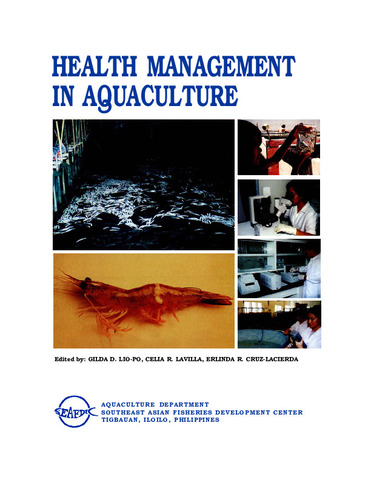
Health management in aquaculture
(Aquaculture Department, Southeast Asian Fisheries Development Center, 2001)A textbook on diseases of cultured warmwater fish and shrimps in the Philippines. Eleven chapters cover essential information on the basic principles of disease causation, major diseases of cultured fish and crustaceans, particularly shrimps, and methods of prevention and control. Emphasis is made on major diseases that occur in the Philippines and other countries in the Asian region. Included also are topics on harmful algae, immunology and molecular biological diagnostic techniques. -
Country status of aquatic emergency preparedness and response systems for effective management of aquatic animal disease outbreaks in Myanmar
(Aquaculture Department, Southeast Asian Fisheries Development Center, 2019)Myanmar is one of the OIE members and the Department of Fisheries (DoF) is highly concerned with transboundary aquatic animal pathogens. Therefore, the Aquatic Animal Health & Disease Control Section has already been formed not only for field diagnostic surveys but also for border control especially at international airport and border trade areas by checking and counter checking export and import of aquatic animals and products. At the moment, the DoF is stressing an issue of some transboundary diseases for finfish such as Gyrodactylus sp., Dactylogyrus sp., Argulus sp., Trichodena sp., Streptococcus sp., Aeromonas sp., and for crustacean are MrNV/XSV and WSSV. In addition, the DoF is facing challenges with parasitic disease and bacterial disease problems due to poor water quality management at culturing fish ponds. For the prevention and control of fish diseases within the country, the DoF is issuing Health Certificates by physical and microbiological examination of fishes and fisheries products. At the same time, Quarterly report on fish disease has being regularly submitted to NACA, OIE since 1998 until now. Although the DoF has no specific law and legislation on the control of quarantine pest and disease of aquatic animal, a good aquaculture practice has been implemented and code of conduct responsible for aquaculture is being followed in the country. The aquatic health management is a challenging issue in aquaculture development. Myanmar is still needing technical assistance to improve quarantine system especially for importation and exportation of live aquatic animals. Moreover, monitoring and surveillance programs with harmonized aquatic emergency preparedness and response system are required to boost up not only for Myanmar but also for effective management of transboundary disease outbreaks in Southeast Asia. -
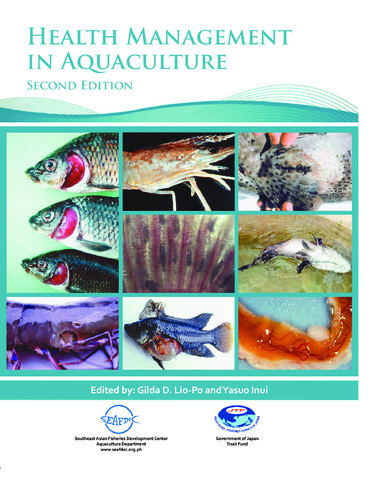
Health management in aquaculture
(Aquaculture Department, Southeast Asian Fisheries Development Center, 2010-07)A textbook on diseases of cultured warmwater fish and shrimps in the Philippines. Eleven chapters cover essential information on the basic principles of disease causation, major diseases of cultured fish and crustaceans, particularly shrimps, and methods of prevention and control. Emphasis is made on major diseases that occur in the Philippines and other countries in the Asian region. Included also are topics on harmful algae, immunology and molecular biological diagnostic techniques.