Characterization of betanodaviruses in the Philippines

Download URL
eafp.orgDate
2008Page views
1,928ASFA keyword

AGROVOC keyword
Taxonomic term

Metadata
Show full item recordShare
Abstract
Viral nervous necrosis caused by betanodaviruses is one of the most devastating diseases in cultured marine finfish. In the Philippines, mass mortalities occurred in sea bass, Lates calcarifer larvae and grouper, Epinephelus coioides broodstock. The virus was isolated using SSN-1 fish cell line and confirmed by PCR. Cytopathic effect started to develop in the cell line 2 days post infection (p.i) with tissue filtrates until the cells completely disintegrated and detached from the flask at 5 days p.i. and the viral protein was detected by immunofluorescence. Sequence analysis revealed that VNN isolated from the brain of grouper broodstock and sea bass larvae were 98.6% similar. Sequence analysis between the Philippine isolates and red-spotted grouper nervous necrosis virus (RGNNV) genotype is 96.9% similar as compared to 72.0% and 64.0% similar with the barfin flounder nervous necrosis virus (BFNNV) and tiger puffer nervous necrosis virus (TPNNV) genotypes, respectively. These results confirm that the Philippine isolates belong to RGNNV genotype.
Suggested Citation
de la Peña, L. D., Mori, K., Quinitio, G. F., Chavez, D. S., Toledo, J. D., Suarnaba, V. S., Maeno, Y., Kiryu, I., & Nakai, T. (2008). Characterization of betanodaviruses in the Philippines. Bulletin of the European Association of Fish Pathologists , 28(6), 230-237. http://hdl.handle.net/10862/2076
Type
ArticleISSN
0108-0288Collections
- Journal Articles [1267]
Related items
Showing items related by title, author, creator and subject.
-
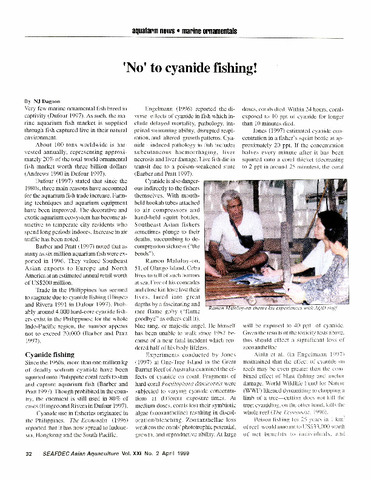
'No' to cyanide fishing!
(Aquaculture Department, Southeast Asian Fisheries Development Center, 1999) -
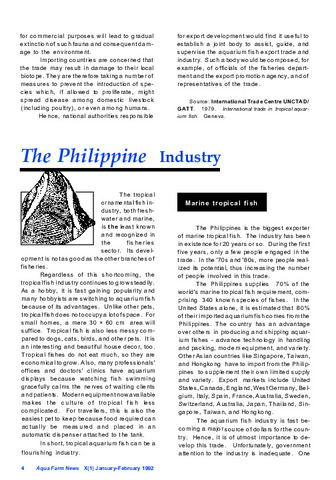
The Philippine industry: Marine tropical fish
(Aquaculture Department, Southeast Asian Fisheries Development Center, 1992) -
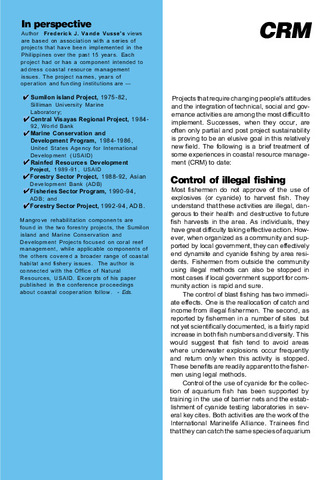
CRM in the Philippines: Lessons learned
(Aquaculture Department, Southeast Asian Fisheries Development Center, 1996)Philippine coastal communities can become capable fishery resource managers and that their management practices can become largely self-sustaining if the project approach focuses on assisting fishermen to learn how to help themselves. Community organization is an essential part of the process and should not be viewed as an end product in itself. There are also no quick fixes, and projects require a complex array of activities if large numbers of coastal residents are to be assisted. In some of these projects, the control of illegal fishing combined with limiting of commercial fishing to offshore areas and good coastal habitat management resulted in a doubling of daily fish catch and income for small-scale fishermen. However, even with the best of management, the total fishery harvest is limited and further increases in individual fishing income can only come from reducing total fishing effort. This will require a system of control on access to the resource to limit the number and kind of fishing gears and to divide the resource equitably. Assisting coastal communities to devise and implement realistic equitable access controls is the major challenge facing coastal resource co-management.