Enhancing nonspecific immune response of grouper, Epinephelus coioides using levamizole as immunostimulant


Share
Abstract
The use of levamisole as an alternative approach to disease prevention and control has been resorted to in aquaculture. Its immunomodulatory effect in several fish species is well documented but its effect on grouper, Epinephelus coioides requires further investigation. To determine its immunomodulatory effect on grouper, juveniles were injected and fed with levamisole. Intraperitoneal injection (IP) at 0 (control), 0.5, 5, 10, 20 and 50 mg levamisole/kg body weight was administered. Grouper were also fed diets containing 0 (control), 125, 250 and 500 mg levamisole/kg supplemental dry diet for 10 days. Hematocrit levels, total and differential leucocyte counts and bactericidal activity were examined 7 days post IP. Three, 5 and 7 weeks after last administration of supplemented feeds, growth and bactericidal activity werie checked. A significant (P<0.05) increase in the total leucocyte count was noted in the injection-treated fish. Granulocyte (19.39%) and monocyte (27.38%) percentages increased while lymphocyte(53.40%) population decreased in the differential leucocyte count. However, hematocrit levels were not affected by levamisole. Bactericidal activity against Vibrio anguillarum increased in treated (injected and supplemented) fish. A significant (P<0.05) increase in weight of juvenileswas observed 10 days after last feeding with supplemented diet. Groupers injected with 0.5 mg levamisole/kg body weight and those supplemented with 125 mg levamisole/kg dry diet exhibited the most significant (P<0.05) changes in parameters tested indicating immunostimulation. Growth (weight gain) and bactericidal activity peaked 5 weeks post administration of levamisole in the feeding experiment. Results of the present study strongly suggest that levamisole can enhance nonspecific defenses in grouper and opens the possibility of using immunostimulants in grouper culture.
Suggested Citation
Pedrajas-Mendoza, S. A., Torres, J. L., & Amar, E. (2008). Enhancing nonspecific immune response of grouper, Epinephelus coioides using levamizole as immunostimulant. UPV Journal of Natural Science , 13(1), 1-10. http://hdl.handle.net/10862/2083
Type
ArticleISSN
0118-461XCollections
- Journal Articles [1266]
Related items
Showing items related by title, author, creator and subject.
-
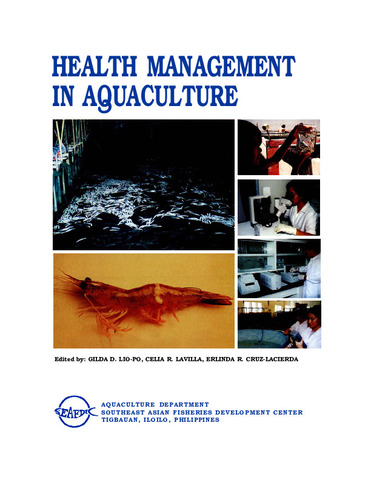
Health management in aquaculture
(Aquaculture Department, Southeast Asian Fisheries Development Center, 2001)A textbook on diseases of cultured warmwater fish and shrimps in the Philippines. Eleven chapters cover essential information on the basic principles of disease causation, major diseases of cultured fish and crustaceans, particularly shrimps, and methods of prevention and control. Emphasis is made on major diseases that occur in the Philippines and other countries in the Asian region. Included also are topics on harmful algae, immunology and molecular biological diagnostic techniques. -
Country status of aquatic emergency preparedness and response systems for effective management of aquatic animal disease outbreaks in Myanmar
(Aquaculture Department, Southeast Asian Fisheries Development Center, 2019)Myanmar is one of the OIE members and the Department of Fisheries (DoF) is highly concerned with transboundary aquatic animal pathogens. Therefore, the Aquatic Animal Health & Disease Control Section has already been formed not only for field diagnostic surveys but also for border control especially at international airport and border trade areas by checking and counter checking export and import of aquatic animals and products. At the moment, the DoF is stressing an issue of some transboundary diseases for finfish such as Gyrodactylus sp., Dactylogyrus sp., Argulus sp., Trichodena sp., Streptococcus sp., Aeromonas sp., and for crustacean are MrNV/XSV and WSSV. In addition, the DoF is facing challenges with parasitic disease and bacterial disease problems due to poor water quality management at culturing fish ponds. For the prevention and control of fish diseases within the country, the DoF is issuing Health Certificates by physical and microbiological examination of fishes and fisheries products. At the same time, Quarterly report on fish disease has being regularly submitted to NACA, OIE since 1998 until now. Although the DoF has no specific law and legislation on the control of quarantine pest and disease of aquatic animal, a good aquaculture practice has been implemented and code of conduct responsible for aquaculture is being followed in the country. The aquatic health management is a challenging issue in aquaculture development. Myanmar is still needing technical assistance to improve quarantine system especially for importation and exportation of live aquatic animals. Moreover, monitoring and surveillance programs with harmonized aquatic emergency preparedness and response system are required to boost up not only for Myanmar but also for effective management of transboundary disease outbreaks in Southeast Asia. -
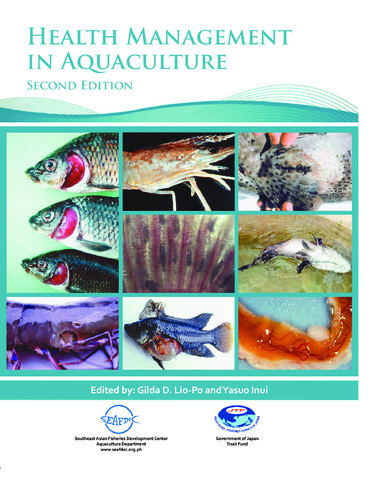
Health management in aquaculture
(Aquaculture Department, Southeast Asian Fisheries Development Center, 2010-07)A textbook on diseases of cultured warmwater fish and shrimps in the Philippines. Eleven chapters cover essential information on the basic principles of disease causation, major diseases of cultured fish and crustaceans, particularly shrimps, and methods of prevention and control. Emphasis is made on major diseases that occur in the Philippines and other countries in the Asian region. Included also are topics on harmful algae, immunology and molecular biological diagnostic techniques.