Managing fisheries conflicts through communication planning: Experience from inland fisheries of Bangladesh

Share
Abstract
Increasing population, ineffective management, competition among fishing gears over access to resources and proliferation of destructive practices are imposing severe stress on the inland water bodies of Bangladesh. These factors also contribute to the increasing incidence of conflicts among fishery stakeholders. When unabated, these conflicts are potential threats to the livelihoods of millions of the poorest fishing communities that depend on these resources. Effective communication between conflicting parties is perceived as a key for establishing successful negotiations for managing conflicts. On this premise, this paper presents and assesses a Fisheries Conflicts Communication Framework, henceforth called FishCom, a tool for developing plans and strategies for managing fisheries conflicts in the inland fisheries of Bangladesh. This tool embodies a structured participatory process intended for use by policy-makers and conflict management practitioners. They have important roles in catalyzing and effecting changes that are instrumental in minimizing, if not totally eliminating conflicts. Experiences from applying FishCom in the inland fisheries study sites in Bangladesh show that it has enabled a systematic stakeholder-inclusive identification and evaluation of fisheries conflicts and planning of communication interventions to manage them.
Suggested Citation
Murshed-e-Jahan, K., Salayo, N. D., & Kanagaratnam, U. (2009). Managing fisheries conflicts through communication planning: Experience from inland fisheries of Bangladesh. Fisheries Research , 99(2), 112-122. https://doi.org/10.1016/j.fishres.2009.04.009
Type
ArticleISSN
0165-7836Collections
- Journal Articles [1266]
Related items
Showing items related by title, author, creator and subject.
-
Inland fisheries resource enhancement and conservation practices in Myanmar
(Aquaculture Department, Southeast Asian Fisheries Development Center, 2015)Myanmar has impressive freshwater capture fisheries. Inland freshwater bodies cover 8.1 million ha of which 1.3 million ha are permanent while the rest are seasonally inundated floodplains. There are repeated references to the crucial importance of fish and fish products in the nutrition of the Myanmar people. Over the past few decades, inland fisheries resources have increased pressure from overfishing, use of destructive fishing gear/methods, pollution and environment changes. In order to make a sustainable inland capture fisheries and conservation of aquatic biodiversity as well as nutritional security and improved rural livelihoods, fisheries resource enhancement and conservation measures have long been adopted in Myanmar since 1967, initiated through a seed replenishment program in natural waters, such rivers, lake, dams, even rice fields, etc. However, the institutional, policy, legislative and financial environments under which enhancement and capture fisheries regimes exist are not conducive to the interests of the fishers. Strong tools for valuation of ecosystem goods and services, enabling governance arrangements and estimation of environmental flows are needed. Fishing communities need to be organized into strong co-management/participatory/community regimes in order to ensure that all stakeholders take part in decision-making process and the benefits accrued are shared equitably by all. -
Fisheries, aquaculture and stock enhancement in Lao PDR
(Aquaculture Department, Southeast Asian Fisheries Development Center, 2006)Fisheries development in Lao PDR is confined to inland fisheries development and sustainable freshwater aquaculture including culture-enhanced capture fisheries and fishery-enhanced aquaculture. Given the potential of water, wetland and aquatic resources and the magnitude of decline in fish catches from the Mekong River and its tributaries, the Government of Lao PDR has given priority to fisheries development with strong concern for sustainable aquaculture. The overall policy framework is therefore geared toward the sustainable use, appropriate management and protection of natural resources: forest, land and water resource including aquatic biodiversity. The national goal for fisheries development during the last decade was focused on how to increase fish production from aquaculture while maintaining capture fisheries, recognizing that about 50% of the dietary protein of Lao people comes from living aquatic resources which are important for food security of the nation. -
State of Philippine coastal fisheries
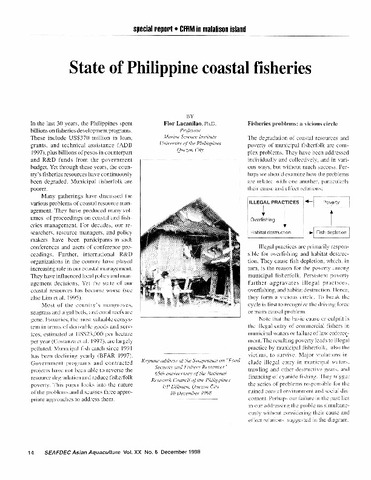
(Aquaculture Department, Southeast Asian Fisheries Development Center, 1998)