Prevalence of viral nervous necrosis (VNN) virus in wild-caught and trash fish in the Philippines

日付
2011Page views
2,048ASFA keyword

AGROVOC keyword
Taxonomic term

Geographic names

Metadata
アイテムの詳細レコードを表示するShare
抄録
Viral nervous necrosis (VNN) caused by piscine nodavirus is a devastating disease affecting mainly marine finfish. In the Philippines, VNN was first reported in hatchery-reared grouper (Epinephelus coioides) broodstock in 2001. These broodstock are usually fed with trash fish. It is therefore suspected that contaminated trash fish may be the source of VNN transmission to the broodstock. To confirm the source of contamination, periodic monitoring of the VNN prevalence using RT-PCR was done on different species of trash fish available in the Iloilo Fishing Port Complex and on the wild-caught fish in Panay Gulf. Results showed that most of the trash fish and wild-caught fish were sub-clinically infected or carriers of VNN, and that the virus might have already been established in the environment where they were living. These findings provide strong evidence that trash fish could be the main source of viral contamination in broodstock since they are identified as the only major input in the culture systems. To prevent the transmission of VNN to broodstock through contaminated trash fish, a shift to a broodstock pelleted feed is highly recommended.
Suggested Citation
de la Peña, L. D., Suarnaba, V. S., Capulos, G. C., & Santos, M. N. M. (2011). Prevalence of viral nervous necrosis (VNN) virus in wild-caught and trash fish in the Philippines. Bulletin of the European Association of Fish Pathologists , 31(4), 129-138. http://hdl.handle.net/10862/2114
ISSN
0108-0288Collections
- Journal Articles [1267]

Except where otherwise noted, this item's license is described as http://creativecommons.org/licenses/by/2.5/scotland/
Related items
Showing items related by title, author, creator and subject.
-
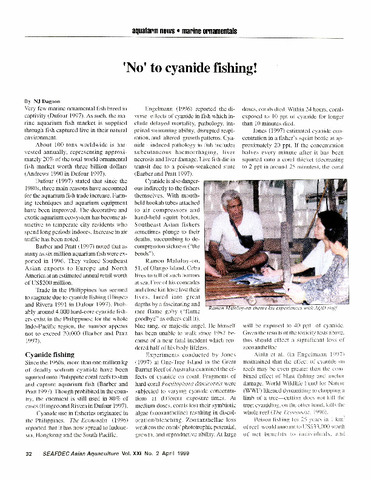
'No' to cyanide fishing!
(Aquaculture Department, Southeast Asian Fisheries Development Center, 1999) -
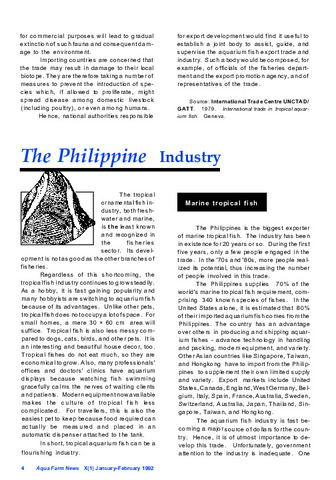
The Philippine industry: Marine tropical fish
(Aquaculture Department, Southeast Asian Fisheries Development Center, 1992) -
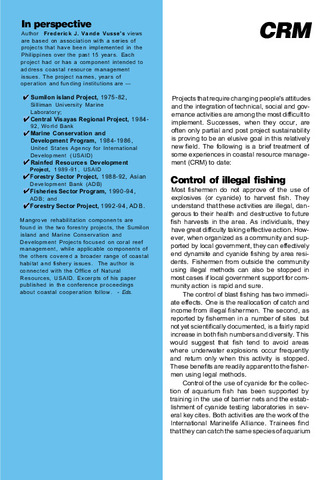
CRM in the Philippines: Lessons learned
(Aquaculture Department, Southeast Asian Fisheries Development Center, 1996)Philippine coastal communities can become capable fishery resource managers and that their management practices can become largely self-sustaining if the project approach focuses on assisting fishermen to learn how to help themselves. Community organization is an essential part of the process and should not be viewed as an end product in itself. There are also no quick fixes, and projects require a complex array of activities if large numbers of coastal residents are to be assisted. In some of these projects, the control of illegal fishing combined with limiting of commercial fishing to offshore areas and good coastal habitat management resulted in a doubling of daily fish catch and income for small-scale fishermen. However, even with the best of management, the total fishery harvest is limited and further increases in individual fishing income can only come from reducing total fishing effort. This will require a system of control on access to the resource to limit the number and kind of fishing gears and to divide the resource equitably. Assisting coastal communities to devise and implement realistic equitable access controls is the major challenge facing coastal resource co-management.