The genus Gracilariopsis (Rhodophyta, Gracilariales) in the Philippines: morphological and taxonomic confirmations

View/
Date
1998Page views
1,729ASFA keyword

AGROVOC keyword
Taxonomic term

Metadata
Show full item recordShare
Abstract
Reports of the economically-important agarophytic seaweed genus Gracilariopsis Dawson from Philippine waters are verified for the first time. Cystocarpic, spermatangial and tetrasporic materials collected from various localities in eastern Panay and northwestern Negros islands conform to the circumscription of this recently reinstated genus. Materials are referred to Gracilariopsis heteroclada Zhang & Xia after morphological comparisons with type materials from southern China. In addition, a discussion of the complicated nomenclatural history of this species is included.
Another putative Gracilariopsis species is reported from Zamboanga City based on cystocarpic materials alone. This species differs from G. heteroclada with its smaller gonimoblast cells and larger height:width ratio of the gonimoblast mass. Vegetatively, the thallus is smooth, devoid of fine, determinate branchlets observed in G. heteroclada.
Suggested Citation
Hurtado-Ponce, A. Q., & Liao, L. M. (1998). The genus Gracilariopsis (Rhodophyta, Gracilariales) in the Philippines: morphological and taxonomic confirmations. The Philippine Scientist , 35, 141-151. http://hdl.handle.net/10862/2135
Type
ArticleISSN
0079-1466Collections
- Journal Articles [1266]
Related items
Showing items related by title, author, creator and subject.
-
Impact of AMPEP on the growth and occurrence of epiphytic Neosiphonia infestation on two varieties of commercially cultivated Kappaphycus alvarezii grown at different depths in the Philippines
(Springer, 2011)Two varieties of the carrageenophyte Kappaphycus alvarezii (Tungawan, TUNG; and Giant tambalang, GTAM) from Zamboanga Sibugay, Philippines were used to test the efficacy of Acadian Marine Plant Extract Powder (AMPEP) as source of nutrients for growth, and to determine if applications had any effect on the percent occurrence of an epiphytic infestation of the red alga Neosiphonia sp. at four different depths in the sea. Results showed that the use of AMPEP significantly (P < 0.05) increased the growth rate of both Kappaphycus varieties tested but decreased the percent occurrence of Neosiphonia sp. The percent occurrence of Neosiphonia sp. infection (6–50% at all depths) of both Kappaphycus varieties with AMPEP treatment was significantly lower than the controls (i.e., 10–75% at all depths). Both the growth rate of the cultivated seaweed and the percent occurrence of the epiphytes decreased as the cultivation depth increased. Plants dipped in AMPEP and suspended at the surface had the highest growth rates (i.e., 4.1%, TUNG; 3.1%, GTAM) after 45 days; those without AMPEP dipping had the highest percent occurrence of Neosiphonia infection (viz. 70–75%). The occurrence of Neosiphonia infestation was found to be correlated with changes in irradiance and salinity at the depths observed. The results suggested that both varieties of K. alvarezii used in this study have the fastest growth rate when grown immediately at the water surface. However, in order to minimize damage caused by the occurrence of epiphytic Neosiphonia, K. alvarezii should be grown within a depth range of 50–100 cm. These observations are important for the improved management of Kappaphycus for commercial farming. Furthermore, the use of AMPEP treatments for enhancement of growth and reduction deleterious Neosiphonia sp. infections is encouraging. -
Optimization of culture conditions for tissue culture production of young plantlets of carrageenophyte Kappaphycus
(Springer Verlag, 2011)To improve the production of Kappaphycus plantlets in tissue culture, optimum media concentrations of an Ascophyllum nodosum extract (Acadian Marine Plant Extract Powder, AMPEP), plant growth regulators (PGR), pH–temperature combinations, and explant density were determined. Kappaphycus alvarezii var. tambalang purple (PUR), kapilaran brown (KAP), vanguard brown (VAN), adik-adik (AA), tungawan green (TGR), and K. striatum var. sacol green (GS) were used as explants. Based on the shortest period for shoot emergence and the economical use of AMPEP, the optimum enriched media was 3.0 mg L−1 AMPEP and 0.1 mg L−1 AMPEP + PGR 1 mg L−1 each phenylacetic acid (PAA) and zeatin for PUR, 1.0 mg L−1 AMPEP + PGR for KAP and GS, 0.1 mg L−1 AMPEP + PGR for VAN, and 3.0 mg L−1 AMPEP and 0.001 mg L−1 AMPEP + PGR for AA and TGR. Results showed that the addition of PGR to low concentrations of AMPEP hastened shoot formation. pH–temperature combinations for the most rapid shoot formation were determined for the brown (KAP) and purple (PUR) color morphotypes of K. alvarezii var. tambalang and the green morphotype of K. striatum var. sacol (GS) cultured in 1.0 mg L−1 AMPEP + PGR. The brown morphotype produced the most number of shoots at pH 7.7 at 20°C after as little as 20 days. Purple K. alvarezii showed an increased shoot formation at pH 6.7 at 25°C and the green K. striatum morphotype at pH 8.7 at 25°C. The optimum number of explants added to the culture media was also determined for tungawan green (TGR), brown (KAP), and tambalang purple (PUR) varieties of K. alvarezii in 1.0 mg L−1 AMPEP + PGR. The number of explants and the volume of the culture media combination were also tested. The highest average number of shoots formed occurred in two explants:1 mL culture media (2:1) for KAP and PUR (35.00% and 16.67%, respectively) and 1 explant: 2 mL culture media for the TGR (100.00%) with a range of 0.5–3.0 mm shoot length after 40 days in culture. The earliest shoot formation was observed after 21 days for the brown and 9 days for both the green and purple color morphotypes of Kappaphycus, in all densities investigated. This indicated that within the range tested, the density of explants did not have a significant effect on the rate of shoot formation but did influence the average number generated from the culture. The rate of production of new and improved Kappaphycus explants for a commercial nursery stock was improved through the use of AMPEP with optimized culture media pH, temperature, and density conditions. -
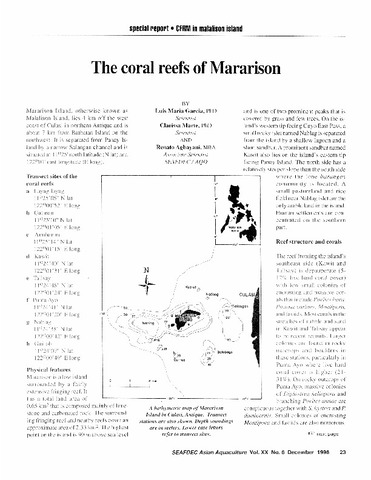
The coral reefs of Mararison
Garcia, Luis Maria ; ; (Aquaculture Department, Southeast Asian Fisheries Development Center, 1998)