Analysis of small-scale coastal aquaculture in the Philippines


Share
Abstract
We studied the influence of the development of aquaculture in the Philippines on the local economy, focusing on coastal fishers in two towns in Capiz and Iloilo, Panay Island, Philippines. Coastal residents in the two towns closely depend on fishing and aquaculture for both their primary and secondary incomes. The small-scale aquaculture business commenced by coastal fishermen has been expanding particularly after the 1990s. The planting of mangrove trees is promoted and small-scale aquafarming is done by coastal fishermen who exert only small environmental loads. Small-scale aquaculture, including the aquaculture of shellfish, net cage culture, pen culture, and seaweed culture, requires low initial investment and imposes minimal workload on operators in terms of breeding management up to shipment, which is why most coastal fishing people want to continue in the business. On the other hand, pond culture, practiced before the 1990s, promises no further rise in production for several reasons that include overproduction of milkfish and the outbreak of diseases in shrimp and prawn. Under these conditions, small-scale aquaculturists in two towns have established a sustainable aquaculture production system that allows them to maintain mangrove forests, utilize natural recirculation functions and help local residents obtain income.
Suggested Citation
Matsuura, T., Siar, S. V., Salayo, N. D., & Baticados, D. B. (2007). Analysis of small-scale coastal aquaculture in the Philippines. In T. Matsuura (Ed.), Comparative Analysis of Aquaculture Management in Brackish Mangrove Areas in Three Southeast Asian Countries (JIRCAS Working Report No. 54) (pp. 65-72). Tsukuba, Ibaraki, Japan: Japan International Research Center for Agricultural Sciences
Type
Book chapterISSN
1341-710XCollections
- Books and Book Chapters [123]
Related items
Showing items related by title, author, creator and subject.
-
The Philippine aquaculture industry
(Aquaculture Department, Southeast Asian Fisheries Development Center, 1988)The aquaculture sector of the Philippine fishing industry registered the highest growth rate of 12.5% in 1977-1986. The contribution of aquaculture to the total fish production was equivalent to 24% in 1986 compared to only 85 in the early 1970's. In terms of quantity, the mariculture subsector registered the highest growth rate of 10.2% in 1982-1986, whereas in terms of value the brackishwater fishpond subsector showed the highest growth rate of 33%. Meanwhile, freshwater aquaculture production exhibited a negative growth rate due to reduction of activities in Laguna de Bay and the slow expansion in hectarage of the commercial freshwater fishponds. Research by several agencies concentrated heavily on the culture of milkfish (Chanos chanos), tilapia (Oreochromis niloticus), Chinese carps (Aristichthys nobilis and Hypophthalmichthys molitrix), tiger prawn (Penaeus monodon), and sea bass (Lates calcarifer). Innovations in seaweed, oyster, and mussel farming are also discussed. Research directions are presented to assure an ecologically sustainable growth in aquaculture with emphasis on countryside development. -
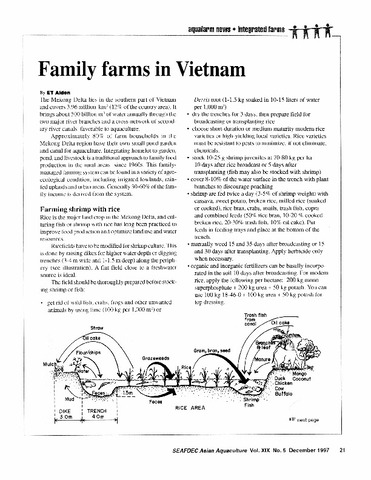
Family farms in Vietnam
(Aquaculture Department, Southeast Asian Fisheries Development Center, 1997) -
Nursery and grow-out operation and management of Penaeus monodon (Fabricius)
(Aquaculture Department, Southeast Asian Fisheries Development Center, 1988)The results of research on nursery and grow-out rearing of prawn conducted by the SEAFDEC Aquaculture Department for over a decade are reviewed. Different rearing facilities designed to accommodate hatchery-produced prawn fry are presented with corresponding data on growth, survival and production. Studies on stocking density, fertilization/natural food production, water management, feeds and feeding schemes and harvest/post-harvest handling are evaluated and viable technology identified. Diseases, pests and predators and other factors considered as production constraints are also mentioned. The success in hatchery operation for prawn coupled by the gradual emergence of nursery and grow-out rearing technology have triggered off a technology-dependent prawn industry. When SEAFDEC AQD was established in 1973, there were very few commercial prawn monoculture ventures in the country. Prawn pond production was mostly an incidental crop in milkfish culture. At present, various prawn grow-out techniques ranging from extensive, semi-intensive and intensive culture systems are in practice. SEAFDEC AQD focused its research on the extensive and semi-intensive culture systems which are within the reach of most farmers in contrast to the intensive system that is highly capital-intensive. There have been much work done in nursery and grow-out operations, but much remains to be done in research, among which are the development of nutritionally-efficient and low-cost feed, control of diseases, etc.