Development of transgenic fish: scientific background
View/
Date
2007Author
Page views
2,057ASFA keyword

AGROVOC keyword
Metadata
Show full item recordShare
Abstract
This chapter highlights some of the important examples of transgenic fish development. An overview of important steps in fish transgenesis is given. The status of development in the case of transgenic carp, tilapias, Atlantic salmon and mud loach is discussed. Other future applications of transgenic fish are presented. The key research and capacity needs for further development of transgenic fish are also discussed.
Suggested Citation
Nam, Y. K., Maclean, N., Fu, C., Pandian, T. J., & Eguia, M. R. R. (2007). Development of transgenic fish: scientific background. In A. R. Kapuscinski, K. R. Hayes, S. Li, G. Dana, E. M. Hallerman, & P. J. Schei (Eds.), Environmental risk assessment of genetically modified organisms, Volume 3. Methodologies for transgenic fish (pp. 61-94). Wallingford: CABI.
Type
Book chapterCollections
- Books and Book Chapters [123]
Related items
Showing items related by title, author, creator and subject.
-
Resistance of two Nile tilapia, Oreochromis niloticus (L.) strains exposed to a mixture of zinc, cadmium and inorganic mercury
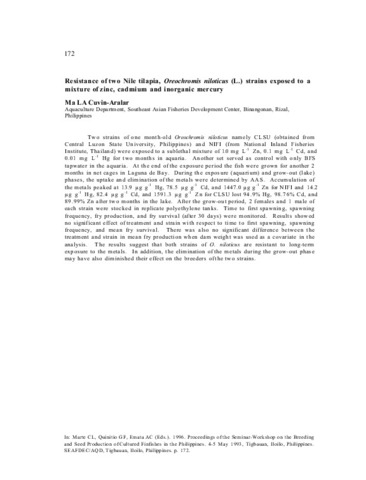
(Aquaculture Department, Southeast Asian Fisheries Development Center, 1996)Two strains of one month-old Oreochromis niloticus namely CLSU (obtained from Central Luzon State University, Philippines) and NIFI (from National Inland Fisheries Institute, Thailand) were exposed to a sublethal mixture of 1.0 mg L-1 Zn, 0.1 mg L-1 Cd, and 0.01 mg L-1 Hg for two months in aquaria. Another set served as control with only BFS tapwater in the aquaria. At the end of the exposure period the fish were grown for another 2 months in net cages in Laguna de Bay. During the exposure (aquarium) and grow-out (lake) phases, the uptake and elimination of the metals were determined by AAS. Accumulation of the metals peaked at 13.9 µg g-1 Hg, 78.5 µg g-1 Cd, and 1447.0 µg g-1 Zn for NIFI and 14.2 µg g-1 Hg, 82.4 µg g-1 Cd, and 1591.3 µg g-1 Zn for CLSU lost 94.9% Hg, 98.76% Cd, and 89.99% Zn after two months in the lake. After the grow-out period, 2 females and 1 male of each strain were stocked in replicate polyethylene tanks. Time to first spawning, spawning frequency, fry production, and fry survival (after 30 days) were monitored. Results showed no significant effect of treatment and strain with respect to time to first spawning, spawning frequency, and mean fry survival. There was also no significant difference between the treatment and strain in mean fry production when dam weight was used as a covariate in the analysis. The results suggest that both strains of O. niloticus are resistant to long-term exposure to the metals. In addition, the elimination of the metals during the grow-out phase may have also diminished their effect on the breeders of the two strains. -
Aquaculture in the Philippines
(Aquaculture Department, Southeast Asian Fisheries Development Center, 1995)Aquaculture is regarded as the most promising source of protein food in the years ahead. Milkfish and Nile tilapia are the major fishes now produced but groupers, sea bass, rabbitfish, red snappers, carps, and catfishes are grown by some farmers. The tiger shrimp is still the most important cultured crustacean, but white shrimps and mudcrabs also have great potential. Oysters and mussels are produced in considerable amounts. Mariculture of the seaweed Eucheuma is now a well established industry, and the pond culture of Gracilaria for agar extraction is beginning to take off. -
Sulfide as an environmental factor and toxicant: Tolerance and adaptations in aquatic organisms
Bagarinao, Teodora (Elsevier, 1992)
This review brings together a large number of independent and seemingly unrelated studies in various disciplines under four major topics: (1) sulfide as an environmental factor in aquatic habitats; (2) sulfide as a toxicant; (3) sulfide tolerance of aquatic organisms; and (4) adaptations limiting sulfide toxicity. Sulfide is widely distributed in the aquatic environment, but has been largely overlooked as an environmental factor for aquatic organisms. Sulfide at nanomoiar to millimolar concentrations adversely affects cytochrome c oxidase, various other enzymes, oxygen transport proteins, cellular structures, and consequently the physiological functions of organisms. These toxic effects are well documented in the biomedical literature, and also occur in the aquatic organisms that have been studied. Sulfide tolerance varies widely among protozoans, sediment meiofauna, polychaetes, bivalves, crustaceans, marine and freshwater fishes, and aquatic plants, often in correlation with the relative sulfide levels in the respective habitats. Aquatic organisms have evolved various adaptations against sulfide toxicity, possibly several acting in concert. Most animals are able to avoid and escape from sulfide, but cannot exclude sulfide from the body. No sulfide-resistant cytochrome c oxidase has been demonstrated, and most animals are capable of some degree of anaerobic meabolism. Various invertebrates have entered into symbiotic associations with sulfide-oxidizing bacteria. Some of these invertebrates immobilize and transport sulfide by means of sulfide-binding proteins or persulfides in the blood. Detoxication of sulfide occurs by methylation, non-specific oxidation, and enzymatic oxidation by mitochondria. Oxidative detoxication of sulfide to thiosulfate by mitochondria is common to several major taxa (protozoan, mollusk, teleosts, mammal), and is effective at low micromolar sulfide concentrations. Among organisms lacking sulfide-oxidizing bacterial symbionts, the mitochondria may thus provide the chief defense against environmental sulfide, and may allow the whole organism to tolerate sulfide concentrations 2–3 orders of magnitude greater than would inhibit cytochrome c oxidase.
(Elsevier, 1992)
This review brings together a large number of independent and seemingly unrelated studies in various disciplines under four major topics: (1) sulfide as an environmental factor in aquatic habitats; (2) sulfide as a toxicant; (3) sulfide tolerance of aquatic organisms; and (4) adaptations limiting sulfide toxicity. Sulfide is widely distributed in the aquatic environment, but has been largely overlooked as an environmental factor for aquatic organisms. Sulfide at nanomoiar to millimolar concentrations adversely affects cytochrome c oxidase, various other enzymes, oxygen transport proteins, cellular structures, and consequently the physiological functions of organisms. These toxic effects are well documented in the biomedical literature, and also occur in the aquatic organisms that have been studied. Sulfide tolerance varies widely among protozoans, sediment meiofauna, polychaetes, bivalves, crustaceans, marine and freshwater fishes, and aquatic plants, often in correlation with the relative sulfide levels in the respective habitats. Aquatic organisms have evolved various adaptations against sulfide toxicity, possibly several acting in concert. Most animals are able to avoid and escape from sulfide, but cannot exclude sulfide from the body. No sulfide-resistant cytochrome c oxidase has been demonstrated, and most animals are capable of some degree of anaerobic meabolism. Various invertebrates have entered into symbiotic associations with sulfide-oxidizing bacteria. Some of these invertebrates immobilize and transport sulfide by means of sulfide-binding proteins or persulfides in the blood. Detoxication of sulfide occurs by methylation, non-specific oxidation, and enzymatic oxidation by mitochondria. Oxidative detoxication of sulfide to thiosulfate by mitochondria is common to several major taxa (protozoan, mollusk, teleosts, mammal), and is effective at low micromolar sulfide concentrations. Among organisms lacking sulfide-oxidizing bacterial symbionts, the mitochondria may thus provide the chief defense against environmental sulfide, and may allow the whole organism to tolerate sulfide concentrations 2–3 orders of magnitude greater than would inhibit cytochrome c oxidase.