Status of Macrobrachium research at Binangonan Research Station (SEAFDEC, Philippines)

Share
Abstract
The freshwater prawn Macrobrachium abounds in the rivers, lakes and estuaries of the Philippines. At SEAFDEC, Binangonan Research Station, a few preliminary studies have been conducted on Macrobrachium sp. and M. rosenbergii . A recent preliminary survey of nearby river systems showed that there is a big demand for Macrobrachium in the market.
Suggested Citation
Padilla, G. G. (1982). Status of Macrobrachium research at Binangonan Research Station (SEAFDEC, Philippines). In M. B. New (Ed.), Giant Prawn Farming. Selected Papers presented at ‘Giant Prawn 1980’, an international conference on freshwater prawn farming held in Bangkok, Thailand, June 15–21, 1980 (Developments in Aquaculture and Fisheries Science, Vol. 10, pp. 389–395). Amsterdam: Elsevier Scientific Publishing Company.
Type
Conference paperSeries
Developments in Aquaculture and Fisheries Science, Vol. 10Collections
- Conference Proceedings [300]
Related items
Showing items related by title, author, creator and subject.
-
The SEAFDEC Aquaculture Department at 21: R&D for sustainable aquaculture
; Bagarinao, Teodora (Aquaculture Department, Southeast Asian Fisheries Development Center, 1995)
This paper reviews the research output of the SEAFDEC Aquaculture Department (AQD) over the past 21 years of its existence. These realized studies are compared with the priority problem areas recommended for research by international or regional seminar-workshops convened by AQD in 1983, 1987, 1991 and 1994. Between 1976 and 1994, AQD researchers produced 554 publications, including 274 in journals indexed by the Institute for Scientific Information, 122 in other journals, and 158 in conference proceedings. Another 82 publications from work done outside AQD were authored or co-authored by AQD researchers, mostly during their graduate programs. In addition, AQD published 21 extension manuals and 14 technical reports and monographs by AQD researchers, and co-published two other monographs by non-AQD researchers. AQD's major contributions have been the technologies for tiger shrimp seed production, grow-out culture, feeds, and disease control; milkfish seed production and feeds; rabbitfish seed production; and tilapia feeds and strain selection. Communication and two-way feedback among AQD researchers and representatives of the aquaculture industry and the SEAFDEC Member Countries must be improved to fine-tune AQD research. In the late 1980s, AQD started redirecting some of its research towards environmental problems in aquaculture. Much of the near future will be spent implementing research imperatives in sustainable and responsible aquaculture.
(Aquaculture Department, Southeast Asian Fisheries Development Center, 1995)
This paper reviews the research output of the SEAFDEC Aquaculture Department (AQD) over the past 21 years of its existence. These realized studies are compared with the priority problem areas recommended for research by international or regional seminar-workshops convened by AQD in 1983, 1987, 1991 and 1994. Between 1976 and 1994, AQD researchers produced 554 publications, including 274 in journals indexed by the Institute for Scientific Information, 122 in other journals, and 158 in conference proceedings. Another 82 publications from work done outside AQD were authored or co-authored by AQD researchers, mostly during their graduate programs. In addition, AQD published 21 extension manuals and 14 technical reports and monographs by AQD researchers, and co-published two other monographs by non-AQD researchers. AQD's major contributions have been the technologies for tiger shrimp seed production, grow-out culture, feeds, and disease control; milkfish seed production and feeds; rabbitfish seed production; and tilapia feeds and strain selection. Communication and two-way feedback among AQD researchers and representatives of the aquaculture industry and the SEAFDEC Member Countries must be improved to fine-tune AQD research. In the late 1980s, AQD started redirecting some of its research towards environmental problems in aquaculture. Much of the near future will be spent implementing research imperatives in sustainable and responsible aquaculture. -
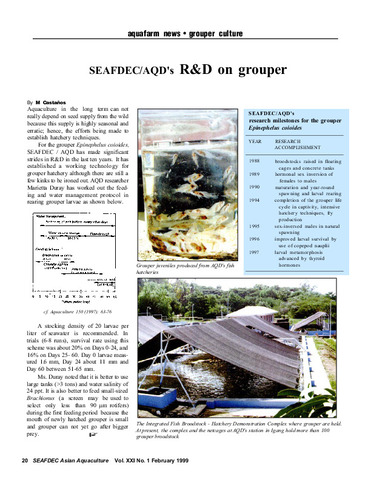
SEAFDEC/AQD's R&D on grouper
(Aquaculture Department, Southeast Asian Fisheries Development Center, 1999) -
Research activities and accomplishments of the SEAFDEC Aquaculture Department, 1988-1991
(Aquaculture Department, Southeast Asian Fisheries Development Center, 1993)Research studies conducted from 1988 to 1991 focused on breeding, seed production, and farming of thirteen aquaculture species of regional importance. Studies aimed at developing economical feeds, as well as disease prevention and control were undertaken. Guided by the recommendations of ADSEA I (Seminar-Workshop on Aquaculture Development in Southeast Asia; 8-12 Sept. 1987; Iloilo City, Philippines), workshops to review the previous years' progress and identify specific studies for implementation were held annually since 1989 with the participation of academic institutions, government and private sectors. Some 212 studies were implemented. Majority were on tiger shrimp, milkfish, and sea bass. Studies on other species of fishes, crustaceans, molluscs, and seaweeds, as well as larval food organisms, seafarming and economics of hatchery and grow-out culture systems were also undertaken. As of December 1991, 168 studies were completed. Research results were published in 204 scientific journals, proceedings, and other publications. In addition, 27 papers were in press and 63 manuscripts had been submitted. That research output is gaining recognition in the international scientific community can be gleaned from the number of papers published in refereed journals covered by Current Contents (CC). Of the 142 papers published in scientific journals in 1988-1991, 115 (81%) appeared in CCcovered journals. This has increased from 58.8% (124 of 211) in 1976-1987. The active participation of the research staff in scientific meetings is equally evident from the number of publications in proceedings of scientific meetings from 1988-1991 (63).