Potential use of the sea lettuce Ulva lactuca replacing soybean meal in the diet of the black tiger shrimp Penaeus monodon juvenile
URL ที่เชื่อมโยง
www.bioflux.com.roวันที่
2015Page views
4,802
AGROVOC keyword
Taxonomic term

เมตาดาต้า
แสดงระเบียนรายการเต็มShare
นามธรรม
To evaluate the biological value of incorporating the sea lettuce Ulva lactuca meal in the diet of the black tiger shrimp (Penaeus monodon), 3 diets were fed to groups of shrimps containing two levels (15% and 30% replacement of soybean meal) of the sea lettuce for 90 days. Biological parameters were determined either periodically or at the termination of the experiment. Specific growth rate (SGR) of shrimp fed the control diet and those fed with the diet containing 15% replacement were not significantly different from each other while that of shrimp fed 30% soybean replacement was slightly but significantly inferior. All other parameters such as survival rate, feed intake, food conversion efficiency, protein efficiency ratio protein and lipid deposited and body composition were all statistically similar between the experimental groups of shrimp. Thus, the 30% replacement level or 10.5% inclusion level could be used in the diet of the shrimp P. monodon. When performances were compared with the best result in incorporating U. lactuca protein concentrate from a previous study and that in the present study (both were 30% replacement or 10.5 inclusion level), they were statistically similar. Thus, the raw U. lactuca meal is recommended because it did not require additional processing to produce the concentrated seaweed.
การอ้างอิง
Serrano, A. E., Jr., Santizo, R. B., & Tumbokon, B. L. M. (2015). Potential use of the sea lettuce Ulva lactuca replacing soybean meal in the diet of the black tiger shrimp Penaeus monodon juvenile. Aquaculture, Aquarium, Conservation and Legislation , 8(3), 245-252. http://hdl.handle.net/10862/2421
Type
ArticleISSN
1844-8143คอลเลกชัน
- Journal Articles [1266]
Related items
Showing items related by title, author, creator and subject.
-
An overview of the nutrition, feed and feeding techniques of prawn penaeid/shrimps
(Philippine Council for Aquatic and Marine Research and Development, 1989)This paper echoes what transpired during the first International Conference of Penaeid Prawns/Shrimps held in Iloilo City in December 4-7, 1984, particularly on the Nutrition nd Feed Development. Around 25 papers were presented during the conference. The nutrient requirements of P. japonicus and to some extent, P. monodon have been studied quite extensively compared to other penaeid species. Requirements for protein, carbohydrates fats, amino acids and essential fatty acids for juveniles and larvae have been defined compared to those of the broodstock. Optimum protein levels for prawn juveniles vary from 28-38% for P. kerathurus, 40-46% for P. monodon, 43% for P. indicus and 50-54% for P. japonicus. Dissacharides like sucrose and trehalose have been found to be good source of carbohydrates at 20-25% in the diet. Crustacean diets require around 0.5% cholesterol. There are few studies on vitamine and mineral requirements. There are artificial diets for juveniles and microencapsulated diets that can completely replace live organisms as larval feed. Microencapsulated diets have been field-tested for P. vannamei, P. stylirostris, P. monodon, P. indicus and P. merguiensis in Ecuador, Taiwan, Malaysia, Thailand and the Philippines. When a commercial diet for the broodstock becomes available ther will be an artificial diet for athe life cycle of tha prawn. -
Series: Aquaculture extension manual; No. 19
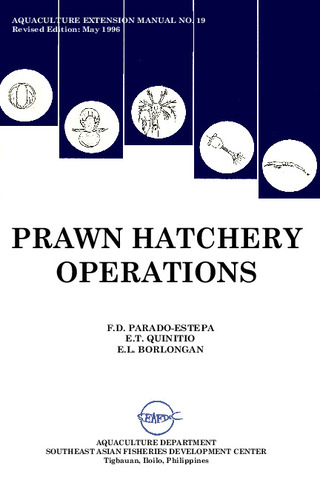
Prawn hatchery operations
; Quinitio, Emilia T. ; (Aquaculture Department, Southeast Asian Fisheries Development Center, 1996-05)
The manual, an updated version of the 1984 SEAFDEC/AQD manual, presents the underlying principles and step-by-step instructions of prawn larval and post-larval rearing. The techniques described are not only applicable to Penaeus monodon, but may also be modified and applied to other penaeid and metapenaeid species. The following aspects are covered: Site selection; Life cycle; Hatchery design and planning; Hatchery operations; Diseases; and Economics.
; (Aquaculture Department, Southeast Asian Fisheries Development Center, 1996-05)
The manual, an updated version of the 1984 SEAFDEC/AQD manual, presents the underlying principles and step-by-step instructions of prawn larval and post-larval rearing. The techniques described are not only applicable to Penaeus monodon, but may also be modified and applied to other penaeid and metapenaeid species. The following aspects are covered: Site selection; Life cycle; Hatchery design and planning; Hatchery operations; Diseases; and Economics. -
The lowdown on world shrimp culture - II
(INFOFISH, 2001)This paper introduces some new members of the international shrimp culture club and goes on to discuss some recent technological innovations in the industry, particularly the polyculture of tilapia (mainly Oreochromis mossambicus) and shrimp.