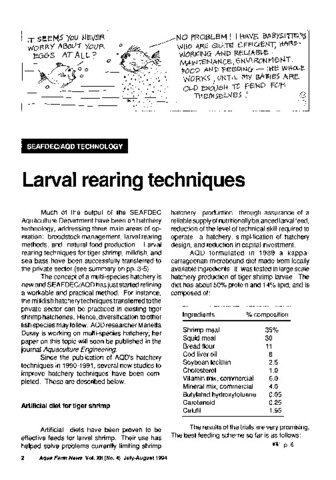
Larval rearing techniques


Share
Suggested Citation
SEAFDEC/AQD (1994). Larval rearing techniques. Aqua Farm News , 12(4), 2-3, 6-7. http://hdl.handle.net/10862/2518
Type
magazineArticleISSN
0116-6573Collections
- Aqua Farm News [286]
Related items
Showing items related by title, author, creator and subject.
-
Aquaculture development in Japan
(Aquaculture Department, Southeast Asian Fisheries Development Center, 1988)Along with the growth of the national economy, aquaculture in Japan has steadily developed in recent years. From 1976 to 1985, production of cultured fish and shellfish increased by 28% from 927 thousand mt to 1184 thousand mt. The contribution of aquaculture to total domestic production constituted 22% in value and 9.7% in weight for 1985. Increase in aquaculture production may be attributed to stronger domestic consumer demand for high grade fish products. The principal species for culture include sea bream (Pagrus major), black sea bream (Acanthopagrus schelegi), yellowtail (Seriola guinqueradiata), Japanese flounder (Paralichthys olivaceus), pufferfish (Takifugu rubrives), Kuruma ebi (Penaeus japonicus), abalone (Nordicus discus), blood ark shell (Scapharca broughtonii) and edible seaweeds (Porphyra, Undaria, Laminaria). Rapid strides in improved culture techniques have been attained in seed production, grow-out, harvest and disease control in these various species. Present trend show increasing reliance on cultured rather than fishery products to meet market demand. In some species, e.g., coho salmon, rainbow trout, oyster and laver, production depends entirely on culture. In other species, production by aquaculture contribute a significant portion to total production. However, to maintain the balance between supply and demand for certain principal aquaculture products, controlled production is now being practised for certain species. In addition to these trends, technical improvements in aquaculture has led to a decrease in the number of management units and area of facilities devoted to production. In the future, greater efforts will be directed to diversify the species cultured to suit consumer preference. Emphasis will also be placed on improving taste and texture of cultured products. New types of feed that will not pollute areas around the culture facilities will be developed. Remarkable achievements in biotechnology will also be applied in aquaculture to improve seed quality. Parallel with developments in aquaculture, Japan is exerting greater efforts to propagate fishery resources in coastal waters through stock enhancement activities. This is aimed at establishing a multiple fish and shellfish propagation system in the seas surrounding Japan to maintain or increase production from fishery resources. -
Semi-mass culture of the dinoflagellate Gymnodinium splendens as a live food source for the initial feeding of marine finfish larvae
(Springer Verlag, 1997)A technique was developed for the semi-mass culture of the unarmored dinoflagellate, Gymnodinium splendens under laboratory conditions. A maximum cell density of 4600 to 6800 cells ml−1 was observed within 8 to 11 days of culture. An initial feeding test for 8 days with three important marine finfish larvae showed that red spotted grouper, Epinephelus akaara preferred G. splendens fed 200 cells ml−1 with 44% survival. The Japanese stripe knife jaw, Oplegnathus fasciatus, attained 22% survival fed a combination of G. splendens and rotifers (200 cells ml−1 and 5 ind. ml−1, respectively). Red sea bream, Pagrus major larvae did not respond well to the initial feeding of G. splendens alone. Red sea bream were observed to be solely dependent on rotifers (5 ind. ml−1) as initial food. Gymnodinium splendens may be used as a live food in the initial feeding of red spotted grouper larvae (E. akaara) to reduce mortality and to further enhance growth during the critical first few days of rearing. -
Nursery and grow-out operation for tilapia and carp
(Aquaculture Department, Southeast Asian Fisheries Development Center, 1988)Most researches conducted at the Binangonan Freshwater Station of the SEAFDEC Aquaculture Department were directed toward enhancing growth and survival of the young tilapia and carp in the nursery as well as increasing yields in grow-out cages, pens, and ponds. Studies included the culture and evaluation of phytoplankton and zooplankton as feeds of the tilapia and carp fry to fingerlings; determination of protein and amino acid requirements of young Nile tilapia; development of practical dry diets; evaluation of feeding regimes, feeding rates, and feeding frequencies ; and the use of fertilizers in nursery ponds. For the grow-out aspect, one of the earliest studies demonstrated the profitability of the monoculture of tilapia in cages which triggered the initial proliferation of tilapia cage culture by the private sector in areas near the Station. Subsequently, supplemental feeds were developed and evaluated; non-conventional feedstuffs were tested as feeds or feed components; and the growth rates of Nile tilapia fingerlings in cages at varying stocking densities were evaluated at three distinct rearing periods covering one year. Prior to the successful mass production of bighead carp fingerlings at the Station, studies on polyculture of tilapia, milk fish, and different species of carp were conducted in cages and pens with remarkable results. This led to the technology-verification projects on polyculture at various areas in Laguna Lake. With the availability of freshwater fishponds for research purposes, studies on polyculture in ponds were also conducted.