Journal Articles: Recent submissions
101-120 / 1267
-
Evaluation of seafloor environmental characteristics of harvesting ground of a kelp Saccharina longissima using GIS in the Pacific coastal area of eastern Hokkaido, Japan
Ito, Sayaka ; ; ; Hasegawa, Natsuki ; ; ; ; ; ; ; ; (Elsevier, 2022-09)
The characteristics of the seafloor environment of the harvesting grounds of the kelp, Saccharina longissima, were evaluated by spatial analysis using a geographic information system (GIS) in the Pacific coastal area of eastern Hokkaido. The kelp harvesting grounds were formed in water depths ranging from 1.2 m to 9.6 m, slopes ranging from 0° to 16.3°, bottom substrate (coarseness score) ranging from 1.82 to 3.00, bottom current velocities ranging from 0.7 cm/s to 116.4 cm/s, and a maximum slope of 37.6°. These values include the viable environmental conditions for the kelp. The kelp growth parameters estimated from kelp measurement data before the harvesting season were positively related to the bottom current velocity. This suggests that the bottom current velocity has a significant effect on kelp growth. The 58 harvesting grounds were classified into two categories based on their growth: those with high kelp growth and those with low kelp growth. Based on a decision tree model, the differences between the two harvesting ground categories were explained by the bottom current velocity, maximum slope, and bottom substrate. In addition, their specific environmental conditions were also quantified. The quantified environmental conditions were also used to create a potential map for the kelp growth in the harvesting grounds. This study provides an understanding of the environmental characteristics of the kelp harvesting grounds, as well as a procedure for mapping the kelp growth potential, thus contributing to the sustainable use of the kelp resources through kelp harvesting ground management and maintenance.
; ; ; Hasegawa, Natsuki ; ; ; ; ; ; ; ; (Elsevier, 2022-09)
The characteristics of the seafloor environment of the harvesting grounds of the kelp, Saccharina longissima, were evaluated by spatial analysis using a geographic information system (GIS) in the Pacific coastal area of eastern Hokkaido. The kelp harvesting grounds were formed in water depths ranging from 1.2 m to 9.6 m, slopes ranging from 0° to 16.3°, bottom substrate (coarseness score) ranging from 1.82 to 3.00, bottom current velocities ranging from 0.7 cm/s to 116.4 cm/s, and a maximum slope of 37.6°. These values include the viable environmental conditions for the kelp. The kelp growth parameters estimated from kelp measurement data before the harvesting season were positively related to the bottom current velocity. This suggests that the bottom current velocity has a significant effect on kelp growth. The 58 harvesting grounds were classified into two categories based on their growth: those with high kelp growth and those with low kelp growth. Based on a decision tree model, the differences between the two harvesting ground categories were explained by the bottom current velocity, maximum slope, and bottom substrate. In addition, their specific environmental conditions were also quantified. The quantified environmental conditions were also used to create a potential map for the kelp growth in the harvesting grounds. This study provides an understanding of the environmental characteristics of the kelp harvesting grounds, as well as a procedure for mapping the kelp growth potential, thus contributing to the sustainable use of the kelp resources through kelp harvesting ground management and maintenance. -
Daytime habitat use and abundance of a freshwater shrimp Macrobrachium yui Holthuis, 1950 (Decapoda: Palaemonidae) in tropical forest stream, northern Laos
; ; ; ; ; ; Ito, Sayaka (Carcinological Society of Japan, 2021-11-30)
From 2008 to 2014, we monitored the abundance and daytime habitat use of the freshwater shrimp Macrobrachium yui at a fixed site on a tributary of the Xuang River in northern Laos. Throughout the monitoring period, the shrimp M. yui showed strong preference for cobble and small boulder substrates, as well as moderate preferences for 21–30 cm depth and the midstream (251–350 cm distance from the bank) as daytime habitat factors. The shrimp M. yui, on the other hand, exhibited intense avoidance for shallower water depths (less than 10 cm), stagnant (0 cm s−1) and faster water velocity (greater than 60 cm s−1), finer substrates (from silt to gravel), and stream margin (less than 50 cm from the bank). During the day, the habitat with the cobble and small boulder in the midstream is probably the best place for the shrimp M. yui to hide from predators. The abundance of the shrimp M. yui had positive and negative correlations with water depth and sand percentage in the bottom sediment, respectively. It suggests that a decrease in water depth caused by increased deposition of fine sediment from the catchment has a negative impact on the shrimp abundance. -
Use of rotifers-fed microalgal paste in the seed production of mangrove crab Scylla serrata in the Philippines
Huervana, Joana Joy; ; Villa-Franco, Annie (Springer, 2022-09-09)
Despite the progress in the production of artificial diets for marine larvae, feeding during the early life stages of most aquaculture species still relies on live feeds such as rotifers. Advanced rotifer culture techniques are also available, however, in the Philippines, majority use batch cultures with fresh microalgae. These microalgae are prone to collapse resulting to inadequate supply of food for the rotifers that are fed to the larvae. Mangrove crab is one of the economically important aquaculture species in the country where mass seed production requires sufficient and steady supply of rotifers. Thus, here we examined the possibility of substituting fresh culture of green microalgae Tetraselmis tetrathele (FA) with flocculated T. tetrathele paste (FP) and commercially available Tetraselmis sp. (CP) as feed for rotifers (Brachionus rotundiformis) in the seed production of mangrove crab. Rearing of larvae was done until crab instar 1 (DOC 24) where growth and survival were taken to evaluate the viability of rotifers-fed microalgal paste. It was observed that the growth index (FA–6.93 ± 0.07; FP–6.91 ± 0.07; CP–6.96 ± 0.05) was similar for all treatments (P > 0.05) at termination. Comparable survival rates were noted for FA and FP at 1.08 ± 0.59% and 3.21 ± 2.09%, respectively (P > 0.05) while a significantly higher survival (P < 0.05) was recorded for CP at 7.73 ± 1.90%. These findings suggest that the algal paste tested are potential alternatives to fresh microalgae and this technique could benefit hatchery operators who lack the capital for setting up the facility and technical skills to maintain microalgae production. -
Cage culture of tropical eels, Anguilla bicolor pacifica and A. marmorata juveniles: Comparison of growth, feed utilization, biochemical composition and blood chemistry
Aya, Frolan; Garcia, Luis Maria (Wiley, 2022-11-02)
This study examined the performance and suitability of two tropical anguillid eels, Anguilla bicolor pacifica and A. marmorata, under cage culture conditions. Juvenile eels (1.73 ± 0.14 g body weight) of each species were stocked in triplicate hapa net cages (1 × 1 × 1.5 m; 30 eels/cage) suspended in outdoor tanks. Growth, feed utilization, biochemical composition and blood chemistry of the two species were compared after 210 days. Except for survival, mean final body weight (FBW), weight gain percentage (WG), specific growth rate (SGR) and yield of A. bicolor pacifica (64.51 ± 13.07 g, 3514 ± 690%, 2.14 ± 0.12%/day, 1534 ± 380 g/m3) were significantly higher than that of A. marmorata (7.77 ± 2.90 g, 356 ± 125%, 0.89 ± 0.16%/day, 178 ± 89 g/m3). In comparison with A. bicolor pacifica, significantly lower feed intake (FI), feed efficiency (FE) and protein efficiency ratio (PER) observed in A. marmorata suggest the need to develop eel diets with feeding stimulants to improve feed acceptance. Biometric indices, body proximate and amino acid composition were not significantly different between the two species. However, serum glutamic oxaloacetic transaminase (GOT), glutamic pyruvic transaminase (GPT) and total protein (TP) in A. bicolor pacifica were significantly higher than that in A. marmorata. These findings suggest that the differences in growth performance and feed utilization between the two anguillid eel species are related to feed palatability, and that A. bicolor pacifica appears to be a suitable species for cage culture because of its faster growth. -
Accumulation and depletion of oxytetracycline (OTC) and oxolinic acid (OXA) in Pompano, Trachinotus blochii
Tendencia, Eleonor (European Association of Fish Pathologists, 2022-09-03)
Accumulation and depletion including withdrawal period for oxytetracycline (OTC) and oxolinic acid (OXA) in pompano (Trachinotus blochii) were determined following oral administration. Pompano were cultured in 250-L fiberglass tanks in a flow-through system provided with aeration. Observed average temperature was 30°C; salinity was 30 ppt. Fish were starved for 2 days then fed with OTC medicated diet (75mg/kg fish/day) or OXA medicated diet (30 mg/kg fish/day) 3 times a day for 10 successive days at 2% body weight and thereafter switched to regular diet for 45 days. Muscle and blood samples were taken at regular intervals during and after cessation of medication. OTC residues in the muscle and blood were analysed using the high performance liquid chromatography (HPLC). Peak OTC accumulation was observed at day 10 of treatment. Higher OTC accumulation was observed in the muscle (0.88+0.27 µg/g) than in the blood (0.3+0.09 µg/ml). OXA accumulation peaked on day 5 of treatment; higher OXA accumulation was observed in the muscle (0.11+0.06 µg/g) compared to blood (0.005+0.0001 ug/ml). Withdrawal period at 30°C for OTC in pompano muscle was 19 days (570 degree-days) and 17 days (510 degree-days) in the blood. For OXA, the withdrawal period in pompano muscle and blood at 30°C temperature was 3 days (90 degree-days). -
Effect of water mass mixing on phytoplankton dynamics in the scallop culture areas off Okhotsk Sea: A microcosm experiment
Aya, Frolan; Kudo, Isao (Elsevier, 2022-09)
The nearshore (Soya Warm Water (SWW)) and offshore (Intermediate Cold Water (ICW) and Okhostk Sea Low Salinity Water (OSLSW)) waters in the Okhotsk Sea differ substantially in their physico-chemical characteristics. Thus, the extent to which water mass mixing impacts phytoplankton dynamics in the Japanese scallop Patinopecten yessoensis culture areas needs to be assessed to properly manage scallop stocks. This study examined the phytoplankton dynamics in nearshore (SWW) and offshore (ICW and OSLSW) waters and phytoplankton response to water mass mixing (SWW + ICW, OSLSW + ICW) for 5 days in spring (2007) and summer (2007–2009) microcosm experiments. Increased chlorophyll a concentration in ICW was observed due to higher nutrients available for phytoplankton uptake than in OSLSW and SWW at the start of each microcosm experiment. In comparison to spring microcosm, mixing of SWW + ICW promoted higher chlorophyll a concentration and faster Si(OH)4 utilization than in OSLSW + ICW in summer. In addition, the size structure of chlorophyll a differed from micro-size (>) in SWW + ICW to nano-size (<) chlorophyll a in OSLSW + ICW. Suspended particulate organic matter (SPOM) \(\mathsf{\delta^{13}C}\) ratios were positively correlated with chlorophyll a in both mixed microcosms whereas SPOM \(\mathsf{\delta^{15}N}\) isotopic ratios were inversely related to nitrate concentration in SWW + ICW, except in spring. This suggests that stable isotopes can be used in predicting phytoplankton biomass and nutrient utilization. In comparison to microcosm experiments, nearshore water column structure suggests vertical water mixing in summer to autumn when phytoplankton biomass and micro-size fraction were at maximum. Taken together, the advance of nutrient-rich ICW to nutrient-poor nearshore areas in the Okhotsk Sea resulted in increased chlorophyll a biomass and dominance of micro-size phytoplankton in summer, potentially enhancing nutrient and food supply to bottom-cultured scallops as suggested by both microcosm experiments and field observations. -
Proteus mirabilis (MJA 2.6S) from saline-tolerant tilapia exhibits potent antagonistic activity against Vibrio spp., enhances immunity, controls \(\mathsf{NH_3}\) levels and improves growth and survival in juvenile giant tiger shrimp, Penaeus monodon
Apines-Amar, Mary Jane; Caipang, Christopher Marlowe ; ; ; Amar, Edgar ; ; Pedroso, Fiona (Wiley, 2022-08-10)
Of several isolates from saline-tolerant tilapia exhibiting anti-vibrio activity, an isolate that demonstrated inhibitory activity with the biggest zone of inhibition against the shrimp pathogens, Vibrio harveyi and V. parahaemolyticus were chosen and investigated in this study. The isolate showed significant inhibition against the shrimp pathogens, V. harveyi and V. parahaemolyticus in a competitive assay. Upon 16S rRNA sequencing, the isolate was identified as putative Proteus mirabilis (MJA 2.6S). P. mirabilis (MJA 2.6S) exhibited extracellular protease, cellulase and amylase activities. Pathogenicity tests showed that it was not pathogenic to the shrimp even at the highest concentration of 108 CFU ml−1. Further, P. mirabilis (MJA 2.6S) improved growth and survival, stimulated higher phenoloxidase and bactericidal activities in the shrimp host and protected it from V. harveyi experimental infection. In addition, the isolate P. mirabilis (MJA 2.6S) significantly reduced the ammonia level of the pond water samples in vitro. Taken together, the results clearly showed the strong probiotic potential of P. mirabilis (MJA 2.6S) in shrimp and hence further studies are needed to determine its wider application as a probiotic in P. monodon culture. -
Evaluation of maturation promoting factor in polychaete (Marphysa sp.) on Indian white prawn, Penaeus indicus female broodstock
Santander-Avancena, Sheryll; Traifalgar, Rex Ferdinand ; Monteclaro, Harold ; ; ; ; Quinitio, Gerald (Wiley, 2022-07-15)
Polychaete is considered the best maturation diet for penaeids; however, fluctuating supply and quality warrant detailed studies to understand the specific maturation-promoting factors present in polychaete. Indian white prawn, Penaeus indicus, was fed diets supplemented with different fractions of Marphysa sp. extracts. Fractions, such as the total soluble fraction (TSF), neutral lipid fraction (NLF), and polar lipid fraction (PLF), were incorporated in the maturation diet at 0.25, 0.50, and 1.00% following a 3 × 3 factorial design. One group was fed with basal diet (BD), and another was fed with fresh squid, mussel, and polychaete, serving as the control. After a 30-day feeding trial, results showed that the inclusion of polychaete extracts in the diet significantly improved P. indicus maturation compared to groups fed BD and control with 40% maturation rates (MR) (p = 3.4 × 10⁻⁴). MR was optimum in groups receiving diets supplemented with ≥0.5% TSF (70.00% ± 0.00) and NLF (60.00% ± 5.77). Similar improved MR was achieved in treatments receiving ≥0.25% PLF supplementation (60% ± 0.00). Accordingly, relative expression of ovarian vitellogenin mRNA of broodstock fed under 0.25 and 0.50% PLF group was 4.44 and 3.96 folds higher than BD, respectively (p = 0.003). No significant differences were detected in the broodstock survival, latency period, hepatosomatic, and gonadosomatic indices. Biochemical content analyses showed no significant differences among the nine treatments except for broodstock's higher ovary protein content in the TSF group (p = 0.037). This study highlights PLF as the most potent component of the polychaete extract in promoting gonad maturation in P. indicus maturation supplemented at a 0.25% optimum inclusion level. -
Motile aeromonads recovered from tilapia (Oreochromis niloticus) cultured in earthen ponds in the Philippines: Assessment of antibiotic susceptibility and multidrug resistance to selected antibiotics
Pakingking, Rolando V., Jr.; Espanola, Jasca Gayle ; Palma, Peter ; Usero, Roselyn (AquacultureHub Inc., 2022-07)
A total of 177 motile Aeromonas spp., comprised of A. hydrophila (n=162) and A. sobria (n=15), isolated from the water, sediment, gills and intestines of tilapia collected from the grow-out culture earthen ponds in the Philippines were investigated for their antimicrobial susceptibility to 10 antibiotics commonly used in fish aquaculture. All motile Aeromonas spp. tested generally exhibited a very high percentage of resistance to amoxicillin (A. hydrophila: 95%; A. sobria: 100%), erythromycin (99%;100%), neomycin (83%;100%), and oxytetracycline (92%;100%), respectively. On the contrary, they showed substantial susceptibility to chloramphenicol, nitrofurantoin, doxycycline, enrofloxacin and norfloxacin. Results of the antimicrobial susceptibility testing demonstrated that 94.4% and 100% of A. hydrophila and A. sobria isolates tested were resistant to antibiotics belonging to at least 3 or more categories and therefore considered as multiple drug resistant strains. The multiple antibiotic resistance (MAR) indexing of A. hydrophila and A. sobria strains showed that they originated from high-risk sources. -
Growth and carrageenan quality of sporophyte and gametophyte of the commercially important red seaweed Kappaphycus alvarezii
Luhan, Maria Rovilla; Mateo, Jonalyn ; (Science and Technology Information Institute, Department of Science and Technology, 2022)
One dilemma facing the farming of the carrageenophyte Kappaphycus is the deteriorating quality of seedstock. Rejuvenating the commercial stocks using spores from reproductive wild parents that are sexually and asexually produced could perhaps restore the traits that are useful for culture. The use of gametophyte and sporophyte (=tetrasporophyte) phases of Kappaphycus alvarezii from spores is explored as a source of seedstock. The growth and physical properties of semi-refined carrageenan extracted from the resulting sporophyte and gametophyte thalli of the same ages were determined. The growth rate of the diploid tetrasporophyte thalli was significantly higher than that of the haploid gametophyte. Gel strength and yield of semi-refined carrageenan from the two life cycle phases were not significantly different, whereas the viscosity was significantly higher in the diploid tissues. Kappaphycus sporophytes were potentially superior to gametophytes as a source of seedstock for mariculture, but problems need to be addressed – including improving the growth rate and reducing the cost of production – before its application could be realized. -
Identification of a chromosomally-encoded sucrose operon-like gene cluster in Vibrio parahaemolyticus strain PH05 isolated from Negros Island, Philippines
De Mesa, Czarina Anne; Mendoza, Remilyn ; Amar, Edgar ; ; Saloma, Cynthia (Cold Spring Harbor Laboratory, 2021-02-27)
The ability of bacteria to metabolize a wide variety of carbon sources has been known to aid in their ability for efficient colonization. Vibrio parahaemolyticus, a known aquatic pathogen has been reported to have the ability to metabolize a number of carbohydrates including D-glucose, D-galactose, L-arabinose, D-mannose, and D-ribose to name a few. Classical isolation of V. parahaemolyticus from other members of the family Vibrionaceae relies on its carbon utilization pattern. Conventionally, V. parahaemolyticus lacks the ability to utilize sucrose and this has been the basis for its isolation using the Thiosulfate-citrate-bile salts-sucrose (TCBS) agar. Reports of V. parahaemolyticus having the ability to utilize sucrose have been presented yet there is paucity of information and detailed study on this phenotype. In this study, we report the V. parahaemolyticus strain PH05 that has the ability to metabolize sucrose. Phenotypic and genotypic characterization of this V. parahaemolyticus strain isolated from Negros Island, Philippines, revealed that V. parahaemolyticus strain PH05 is atypical appearing yellow on TCBS agar plates. It is capable of utilizing sucrose, unlike the majority of V. parahaemolyticus isolates. Genome analyses of this strain revealed the presence of a chromosomally encoded sucrose operon-like gene cluster encoded in chromosome 2 with the following sucrose-utilization associated genes: scrY, ccpA, treP, scrK, and scrB genes coding for sucrose porin, catabolite control protein A, PTS System sucrose-specific EIIBC component, fructokinase, and sucrose-6-phosphate hydrolase. The mode of transmission of these genes to V. parahaemolyticus strain PH05 is still unknown. However, the presence of insertion sequences (IS) and phage elements in the same chromosome suggests horizontal gene transfer events. Taken together, our results point to the possibility that acquired sucrose utilization genes may contribute to the fitness of V. parahaemolyticus strain PH05 in the environment. -
Grazing periodicity, grazing rate, feeding preference, and gut examination of early juveniles of abalone Haliotis asinina–fed five benthic diatom species
Villa-Franco, Annie; de la Peña, Milagros R. ; Nievales, Marie (Springer, 2022-06-03)
This study evaluated the suitability of five diatom species (Amphora sp., Cocconeis sp., Navicula ramosissima, Nitzschia sp., and Tryblionella sp.) as food to abalone Haliotis asinina early juveniles (5-mm shell length). Grazing periodicity, grazing rate, and feeding preference were measured; at the same time, abalone gut content was examined. Grazing incidence appeared to be continuous with significantly higher grazing intensity observed at nighttime from 6 p.m. to 10 p.m. (79%) than at daytime from 10 a.m. to 2 p.m. (40%) (p < 0.05). Grazing rates from 6 p.m. to 10 p.m. were significantly higher on N. ramosissima (1.6 × 10⁵) among diatom species but was not statistically different from Cocconeis sp. (1.1 × 10⁵) (p > 0.05). Broken cells of Amphora sp. (22%) were significantly higher in the gut of H. asinina compared to Cocconeis sp. (2.8%), N. ramosissima, (1.8%), and Tryblionella sp. (0.2%) although the abundance of Nitzschia sp. (6%) was not significantly different from Amphora sp. (p > 0.05). Early juveniles showed significant preference for Cocconeis sp. (18.6%), followed by Nitzschia sp. (16.2%), N. ramosissima (13.9%), and Amphora sp. (13.4%), with the least preference for Tryblionella sp. (7.8%). Survival of H. asinina was similar in 4 diatom species (46–71%) except in Tryblionella sp. (8–12%). These findings suggest that diatom species Cocconeis sp., Nitzschia sp., Amphora sp., and N. ramosissima are the suitable live food for H. asinina early juveniles. Knowledge from this study would contribute to the development of a feeding protocol that would maximize production of H. asinina early juveniles in the hatchery. -
Seasonal growth, organ indices and food consumption of the Japanese scallop Patinopecten yessoensis (Jay, 1857) in relation to food availability in Tokoro seabed, Okhotsk Sea, North Japan
Aya, Frolan; Kudo, Isao (The Plankton Society of Japan (The Japanese Association of Benthology), 2022-05-30)
The coastal waters off Tokoro, Okhotsk Sea have been characterized by a substantial decrease in primary production from spring to summer season which will have repercussions on the maintenance of the Japanese scallop Patinopecten yessoensis (Jay, 1857) culture. This study examined the seasonal changes in scallop growth, condition and organ indices in relation to environmental conditions, and compared the sinking particulate organic carbon (POC) flux as an estimate of food availability to scallop food requirements. Monthly specimens were obtained in July 2005, and from May 2006 to December 2008 off Tokoro, Okhotsk Sea. Growth parameters derived from the modified von Bertalanffy growth function of 885 scallop individuals were the mean asymptotic shell height H∞=126.51 mm, Brody growth coefficient K=0.081 year−1, and t0=6.19 year. Condition (CI) and gonadosomatic indices (GSI) increased in April and May, decreased from June to September, but increased again from October until May. The adductor muscle index (AMI) increased from June to October, but declined from November until May when CI and GSI began to increase. Primary production (PP) and chlorophyll a biomass decreased from spring (25.75–29.74 µg C L−1 h−1 and 1.74–5.37 µg L−1) to autumn (0.90–10.83 µg C L−1 h−1 and 0.29–0.75 µg L−1) concurrent with decreasing CI and GSI, but no deleterious effect on AMI was evident during these periods. The sinking POC flux (25–68 mg C m−2 day−1) was low during summer when gonad activity was also low, but started to increase in autumn when gonad activity started to peak. Although a deficit in food availability (lower sinking POC fluxes than scallop food consumption) was observed during summer, the potential advection of organic matter from offshore to nearshore region may have provided additional source of food to bottom-cultured scallops, contributing in part to the increase in shell growth and somatic tissues. -
Comparison of commercial Spirulina, live Navicula sp. and Chaetoceros calcitrans concentrate as settlement cues for sandfish, Holothuria scabra
Sibonga, Rema; ; Lebata-Ramos, Ma. Junemie Hazel ; Nievales, Marie ; Pedroso, Fiona (Springer, 2022-05-23)
The settlement of sea cucumbers is a crucial phase of larval development because the highest mortality occurs at this stage. Substrates and cues are commonly used to induce larval settlement. Commercial algae and live benthic diatoms are the most common settlement cues being used. The present study evaluated Chaetoceros calcitrans concentrate as a potential settlement cue for H. scabra. Three settlement cues, replicated three times, were compared: commercial ‘Spirulina’, live benthic diatom Navicula sp., and C. calcitrans concentrate. Settlement substrates without cue served as control. ‘Spirulina’ paste and C. calcitrans concentrate were painted onto the settlement substrates, while settlement substrates were introduced into a Navicula sp. culture tank to enable attachment of the benthic diatom. Faster and higher settlement was observed in the treatment with ‘Spirulina’ paste as cue at 89% five days post introduction of substrates, compared with live Navicula sp. and C. calcitrans concentrate at 74% and 63% seven days post introduction, respectively. For the control, only 25% of the larvae have settled eight days after introduction to the substrates. ‘Spirulina’ paste and live Navicula sp. showed better settlement rates, but these were not significantly different compared with C. calcitrans concentrate. Therefore, C. calcitrans concentrate can be a potential settlement cue for H. scabra larvae. -
Settlement of oyster Magallana bilineata (Röding, 1798) spat in the natural environment: Seasonality and substrate texture preference
Lebata-Ramos, Ma. Junemie Hazel; ; Solis, Ellen Flor ; ; Sibonga, Rema ; (Malacological Society of Australasia; Society for the Study of Molluscan Diversity; Taylor and Francis, 2022-05-12)
This study determined the seasonality of Magallana bilineata spat settlement in a natural oyster bed and established surface texture preference of competent larvae by comparing the numbers of spat settling on the smooth and rough surfaces of ceramic tiles over a period of 31 months. This will guide farmers when to deploy cultches to maximise spat harvest. Regardless of tile orientation, spat numbers were significantly higher on the rough side (129.07 ± 9.3 m−2) than on the smooth side (66.95 ± 7.0 m−2). Spat collection was highest in March, June and July in each of 2015, 2016 and 2017. There was no significant correlation between the number of spat settling in each month with temperature, salinity, pH, dissolved oxygen (DO), sulphide, phosphate, nitrate, nitrite and ammonia concentrations, plankton density measured at deployment and retrieval of tiles, except for DO during deployment. The only significant correlations with mean shell length (SL) were with DO and ammonia during tile retrieval. Mean SL did not significantly differ between tile orientations and surfaces but differed between months, being highest in August 2015 and August 2016. From these results, it is best to deploy roughened cultches in this particular area in March, June and July. -
Biofloc-based nursery production system: Heeding the call towards a sustainable shrimp culture industry in the Philippines
Caipang, Christopher Marlowe; ; Fagutao, Fernand ; Pakingking, Rolando V., Jr. ; (International Network for Natural Sciences, 2022)
The increasing global population resulted in intense pressure on the food production sectors to meet the rise in food demand. The aquaculture industry, which is one of the major food production sectors, provides opportunities in addressing issues on malnutrition and poverty alleviation. Shrimp farming is an important sub-sector in aquaculture because shrimp are not only good sources of food, but they contribute to the national economy through export revenues. This resulted in the rapid intensification of shrimp aquaculture, which created negative issues on sustainability and environmental impacts. Hence, this necessitates an urgent need to develop aquaculture production systems that yield high productivity and profitability yet possess a low carbon footprint. Biofloc technology (BFT) fit into these criteria as this technology permits intensive culture of aquatic species, less use of resources, and improved water quality as a consequence of the production and activity of beneficial microbial biomass, which, at the same time, can be utilized as a source of feed for the growing shrimp. BFT has been shown to be successful on a commercial scale during shrimp grow-out, and recent studies have shown that this technology can be further refined and optimized for the production of shrimp during the nursery phase. This review, therefore, highlights the basics of BFT and how this technology is being optimized in the production of shrimp during the nursery phase. More specifically, this discusses the benefits of this approach in ensuring a productive yet sustainable way of producing shrimp in the context of Philippine aquaculture. -
Effect of background tank color in combination with sand substrate and shelters on survival and growth of Scylla tranquebarica instar
; Hamasaki, Katsuyuki; Shapawi, Rossita ; Kawamura, Gunzo ; Huervana, Joana Joy ; Yong, Annita Seok Kian (Elsevier, 2022-05)
Effect of tank color in combination with substrate-shelters on the survival and growth of the instar of purple mud crab, Scylla tranquebarica (initial body weight of 28.7 ± 2 mg) was investigated. Ten treatments were tested in triplicate with black (B) and white (W) tanks were set as the control, while other tanks were provided with a combination of sand substrate (S), and/or polyvinyl chloride pipes (P) as horizontal and nets (N) as vertical shelter, referred as B, BS, BSP, BSN, BSPN, W, WS, WSP, WSN and WSPN, respectively. Survival of the instar in black tanks (26.7 to 60.0%) was higher than in white tanks (20.0 to 46.7%) (P = 0.052). Survival in the horizontal shelter treatments (46.7 and 63.3%) exceeded that in the vertical shelter groups (30.0 and 50.0%) (P = 0.068). The final body weight of the instar in black tank (2.4 to 3.8 g) was significantly lower than white tank (2.6 to 4.8 g) (P = 0.02). Specific growth rate was significantly greater in sand substrate treatments (8.4 to 9.1%/day) than in controls (7.9 and 8.0%/day) (P = 0.015). In conclusion, horizontal shelter was better than vertical type, and black tank with substrate and horizontal shelter was more suitable for culture of purple mud crab instar. -
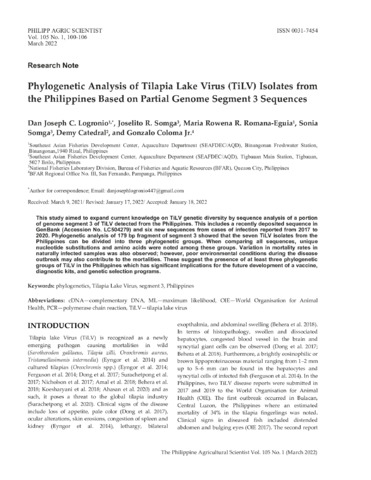
Phylogenetic analysis of tilapia lake virus (TiLV) isolates from the Philippines based on partial genome segment 3 sequences
Logronio, Dan Joseph; ; Romana-Eguia, Maria Rowena R. ; ; ; (College of Agriculture and Food Science, University of the Philippines Los Baños, 2022-03)
This study aimed to expand current knowledge on TiLV genetic diversity by sequence analysis of a portion of genome segment 3 of TiLV detected from the Philippines. This includes a recently deposited sequence in GenBank (Accession No. LC504279) and six new sequences from cases of infection reported from 2017 to 2020. Phylogenetic analysis of 179 bp fragment of segment 3 showed that the seven TiLV isolates from the Philippines can be divided into three phylogenetic groups. When comparing all sequences, unique nucleotide substitutions and amino acids were noted among these groups. Variation in mortality rates in naturally infected samples was also observed; however, poor environmental conditions during the disease outbreak may also contribute to the mortalities. These suggest the presence of at least three phylogenetic groups of TiLV in the Philippines which has significant implications for the future development of a vaccine, diagnostic kits, and genetic selection programs. -
Economic analysis of stake and rack-hanging methods of farming oysters (Crassostrea iredalei) in the Philippines
; Davis, George (Elsevier, 1998)
The cost efficiency of stake and rack-hanging methods of farming oysters are compared. Annual costs and returns data for both methods were obtained from a socioeconomic survey conducted in 1991 at the Aquaculture Department of the Southeast Asian Fisheries Development Center (SEAFDEC/AQD). On average, 14 kg m−2 (shell-on) and 22 kg m−2 (shell-on) were produced using the stake and rack-hanging methods, respectively. The translog cost function for 58 oyster farms was estimated using iterative seemingly unrelated regression (SUR). Statistical analysis indicates that the higher production from the rack-hanging method is significantly different (α=0.10) from the production using the stake method. The cost-efficient method varied based on production levels. At output levels less that 9044 kg (shell-on), the rack-hanging method had lower average cost per unit, and for higher production levels the stake method had the lower average costs. Similar conclusions were drawn from the marginal cost analysis. Results imply when production is less than 9044 kg, then the most efficient technology is the rack-hanging method and if production is greater than 9044 kg, the most efficient method is the stake method. -
Efficacy of poultry by-product meal as an effective alternative to fish meal in aquaculture feed for milkfish Chanos chanos
Sugita, Tsuyoshi; ; Sumbing, Joemel (Japan International Research Center for Agricultural Sciences, 2020)
We verified the efficiency of poultry by-product meal (PBM) as a substitute for fish meal (FM) in feed for juvenile milkfish (Chanos chanos). Juveniles (mean 48.0 g) were fed for 12 weeks with two experimental feeds containing different levels of PBM (8.0% and 12%), FM (10% and 5.0%), and cod liver oil (fish oil or FO, 4.0% and 3.8%). A feed without PBM having higher levels of FM and FO (20% and 4.5%, respectively) was used as control. Weight gain, specific growth rate, and feed conversion ratio were not significantly affected by the levels of dietary PBM. In addition, no significant differences were detected among the dietary groups in plasma triglyceride, total cholesterol, phospholipid, glucose, or total protein concentrations. Furthermore, crude protein, crude fat, moisture, and ash contents in the whole body, liver, and dorsal muscle were not significantly influenced by the dietary treatments. The results of organoleptic examinations that included tests of smell, flavor, and texture were almost the same among the dietary groups. These results indicated that PBM is the applicable substitute for FM, with performance of the high PBM feed (PBM-FM-FO = 12%-5.0%-3.8%) being comparable to that of the control feed.