An integrated semi-intensive shrimp and livestock system in the Philippines


Share
抄録
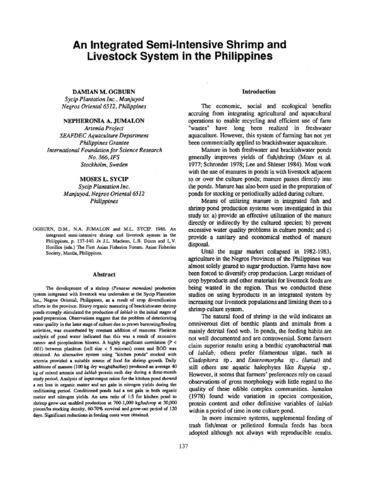
The development of a shrimp (Penaeus monodon) production system integrated with livestock was undertaken at the Sycip Plantation Inc., Negros Oriental, Philippines, as a result of crop diversification efforts in the province. Heavy organic manuring of brackishwater shrimp ponds strongly stimulated the production of lablab in the initial stages of pond preparation. Observations suggest that the problem of deteriorating water quality in the later stage of culture due to prawn burrowing/feeding activities, was exacerbated by constant addition of manures. Plankton analysis of pond water indicated that this was a result of excessive nanno- and picoplankton blooms. A highly significant correlation (P < .001) between plankton (cell size < 5 microns) count and BOD was obtained. An alternative system using "kitchen ponds" stocked with artemia provided a suitable source of food for shrimp growth. Daily additions of manure (100 kg dry weight/ha/day) produced an average 40 kg of mixed artemia and lablab protein each day during a three-month study period. Analysis of input:output ratios for the kitchen pond showed a net loss in organic matter and net gain in nitrogen yields during the conditioning period. Conditioned ponds had a net gain in both organic matter and nitrogen yields. An area ratio of 1:5 for kitchen pond to shrimp grow-out enabled production at 700-1,000 kg/ha/crop at 30,000 pieces/ha stocking density, 60-70% survival and grow-out period of 120 days. Significant reductions in feeding costs were obtained.
Type
Conference paperCollections
- Conference Proceedings [300]
Related items
Showing items related by title, author, creator and subject.
-
Asian shrimp situation
(Aquaculture Department, Southeast Asian Fisheries Development Center, 1990) -
Nutrient flow and physicochemical profile studies of an integrated poultry-salt-Artemia-milkfish-sea bass-shrimp pond production system
(Wetteren, Belgium: Universal Press, 1987)The physicochemical and biological parameters of an integrated flow-through poultry-salt-Artemia-milkfish-sea bass-shrimp pond production system were monitored for 6 months to determine the pattern of nutrient changes and associated plankton communities as water passed through the system. A 20 ha salt farm in Negros Oriental, Philippines, was used as a model of the integrated system. The construction of a poultry farm at the inlet reservoir provides continuous fertilization and allows considerable control of nutrient inputs to the pond system. Nutrients increase markedly in the chicken pond and in subsequent ponds undergo cycles of biological assimilation and bacterial mineralization. Principal component analysis ordinates temporal and spatial changes in 33 variables that were monitored. Using scatter diagrams of the principal components enabled separation of ponds adjacent to the crystallization bed and ponds high in fish biomass from the rest of the system. Variables that served to numerically delineate the ponds in this manner were salinity, phosphate, ammonia, alkalinity, turbidity, acidity, microplants, pico- and nannoplankton. The implications of this ordination in relation to pond management techniques is discussed. -
A further note to “fishing gear for prawn and shrimp used in the Philippines today”
(Carcinological Society of Japan, 1983)Motoh (1980) reported 9 and 13 kinds of shrimping gear for the fry and the adult respectively, of which most of them are indigenously used today in the Philippines. Howerver, druing the continued ecological survey of penaeids in the country conducted by him and his staff, six kinds of shrimping gear or devices were additionally found by them, which have been used traditionally in the country. The reasons that the present author intends to introduce the gear or devices are as follwos: 1) To record theses unque devices from the nature conservation point of view, which were invented by local people through their long experiences, though devices been forgotten due to their poor catching effectiveness, and 2) To recommend the continuous use of these devices by local people, which impose much less construction technique and energy on the users compared to modern mechanized catching tools.