SEAFDEC/AQDINSTITUTIONAL REPOSITORY
    • English
    • 日本語
    • ไทย
    • Bahasa Indonesia
  • 日本語 
    • English
    • 日本語
    • ไทย
    • Bahasa Indonesia
  • ログイン
アイテム表示 
  •   ホーム
  • 01 SEAFDEC/AQD Publications
  • Conference Proceedings
  • Proceedings of the International Workshop on Resource Enhancement and Sustainable Aquaculture Practices in Southeast Asia 2014 (RESA)
  • アイテム表示
  •   ホーム
  • 01 SEAFDEC/AQD Publications
  • Conference Proceedings
  • Proceedings of the International Workshop on Resource Enhancement and Sustainable Aquaculture Practices in Southeast Asia 2014 (RESA)
  • アイテム表示
JavaScript is disabled for your browser. Some features of this site may not work without it.

Post-larval rearing strategies in sandish (Holothuria scabra) culture
  • Global styles
  • MLA
  • Vancouver
  • Elsevier - Harvard
  • APA
  • Help
Thumbnail
閲覧/開く
NievalesMF2015.pdf (109.9Kb) Open Access
Downloads: 420
日付
2015
著者
Nievales, Marie Frances
Sibonga, Rema ORCID
Figurado, Harold
Page views
1,666
AGROVOC keyword
Post-larval rearing methods
sea cucumbers AGROVOC
Holothuria scabra AGROVOC
Metadata
アイテムの詳細レコードを表示する

Share 
 
抄録
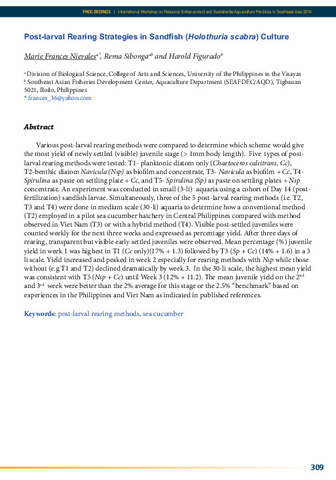
Various post-larval rearing methods were compared to determine which scheme would give the most yield of newly settled (visible) juvenile stage (> 1mm body length). Five types of postlarval rearing methods were tested: T1- planktonic diatom only (Chaetoceros calcitrans, Cc), T2-benthic diatom Navicula (Nsp) as biofilm and concentrate, T3- Navicula as biofilm + Cc, T4Spirulina as paste on settling plate + Cc, and T5- Spirulina (Sp) as paste on settling plates + Nsp concentrate. An experiment was conducted in small (3-li) aquaria using a cohort of Day 14 (postfertilization) sandfish larvae. Simultaneously, three of the 5 post-larval rearing methods (i.e. T2, T3 and T4) were done in medium scale (30-li) aquaria to determine how a conventional method (T2) employed in a pilot sea cucumber hatchery in Central Philippines compared with method observed in Viet Nam (T3) or with a hybrid method (T4). Visible post-settled juveniles were counted weekly for the next three weeks and expressed as percentage yield. After three days of rearing, transparent but visible early settled juveniles were observed. Mean percentage (%) juvenile yield in week 1 was highest in T1 (Cc only)(17% + 1.3) followed by T3 (Sp + Cc) (14% + 1.6) in a 3 li scale. Yield increased and peaked in week 2 especially for rearing methods with Nsp while those without (e.g T1 and T2) declined dramatically by week 3. In the 30-li scale, the highest mean yield was consistent with T5 (Nsp + Cc) until Week 3 (12% + 11.2). The mean juvenile yield on the 2nd and 3rd week were better than the 2% average for this stage or the 2.5% benchmark based on experiences in the Philippines and Viet Nam as indicated in published references.
記述
Abstract only.
URI
http://hdl.handle.net/10862/2791
Suggested Citation
Nievales, M. F., Sibonga, R., & Figurado, H. (2015). Post-larval rearing strategies in sandish (Holothuria scabra) culture. In M. R. R. Romana-Eguia, F. D. Parado-Estepa, N. D. Salayo, & M. J. H. Lebata-Ramos (Eds.), Resource Enhancement and Sustainable Aquaculture Practices in Southeast Asia: Challenges in Responsible Production of Aquatic Species: Proceedings of the International Workshop on Resource Enhancement and Sustainable Aquaculture Practices in Southeast Asia 2014 (RESA) (p. 309). Tigbauan, Iloilo, Philippines: Aquaculture Department, Southeast Asian Fisheries Development Center.
Type
Conference paper
ISBN
9789719931041
Collections
  • Proceedings of the International Workshop on Resource Enhancement and Sustainable Aquaculture Practices in Southeast Asia 2014 (RESA) [56]


© SEAFDEC/AQD  2025
ご意見をお寄せ下さい | Subscribe


ブラウズ

リポジトリ全体コミュニティ/コレクション公開日著者タイトル主題このコレクション公開日著者タイトル主題

登録利用者

ログイン登録

統計

View Usage Statistics

© SEAFDEC/AQD  2025
ご意見をお寄せ下さい | Subscribe


Export citations

Export the current results of the search query as a citation list. Select one of the available citation styles, or add a new one using the "Citations format" option present in the "My account" section.

The list of citations that can be exported is limited to items.

Export citations

Export the current item as a citation. Select one of the available citation styles, or add a new one using the "Citations format" option present in the "My account" section.

Export Citations

DOCUMENT REQUEST NOT AVAILABLE

This publication is still available (in PRINT) and for sale at AQD bookstore. The library is currently restricted to send PDF of publications that are still for sale.

You may contact bookstore@seafdec.org.ph or visit AQD bookstore for orders.

FILE UNDER EMBARGO

This file associated with this publication is currently under embargo. This will be available for download after the embargo date.