Fishery resource enhancement: An overview of the current situation and issues in the southeast Asian region


Share
นามธรรม
The total global production from capture fisheries has plateaued since the mid 90s. This stagnation in production or reduced productivity of the world’s coastal and marine wild fisheries is caused by overfishing and degradation of habitats through coastal development and destructive fishing methods. Reports have shown that if the current fishing trends continue, all of the commercial fisheries will have collapsed by 2050. To boost production, scientists, fisheries managers, government agencies, and NGOs have been looking at ways of enhancing fish stocks. Replenishing depleted stocks may be done by regulating fishing effort, restoring degraded nursery and spawning habitats or through resource enhancement. Resource enhancement using individuals reared in aquaculture facilities or seed stocks abundant in the wild is becoming a popular method of supplementing depleted stocks. It is one of the many strategies that could help address the decreasing fisheries production in the wild. A brief history of resource enhancement, the aquatic species released in the different countries in the region, the reasons for releasing stocks, and the issues involved, are discussed briefly in this paper. Among the main reasons for resource enhancement are to increase production or enhance stocks and increase food supply and/or family income. Other reasons include protection of endemic and maintenance of endangered species, rehabilitation of degraded natural habitats and for recreation fisheries, among others. Age or size of seeds, seed quality, genetics, governance, economics, biodiversity conservation, politics, and the introduction of exotics are among the resource enhancement issues identified in the region.
การอ้างอิง
Lebata-Ramos, M. J. H., & Doyola-Solis, E. F. (2016). Fishery resource enhancement: An overview of the current situation and issues in the southeast Asian region. In K. Hajime, T. Iwata, Y. Theparoonrat, N. Manajit, & V. T. Sulit (Eds.), Consolidating the Strategies for Fishery Resources Enhancement in Southeast Asia. Proceedings of the Symposium on Strategy for Fisheries Resources Enhancement in the Southeast Asian Region, Pattaya, Thailand, 27-30 July 2015 (pp. 124-128). Samutprakan, Thailand: Training Department, Southeast Asian Fisheries Development Center.
Type
Conference paperคอลเลกชัน
- Conference Proceedings [300]
Related items
Showing items related by title, author, creator and subject.
-
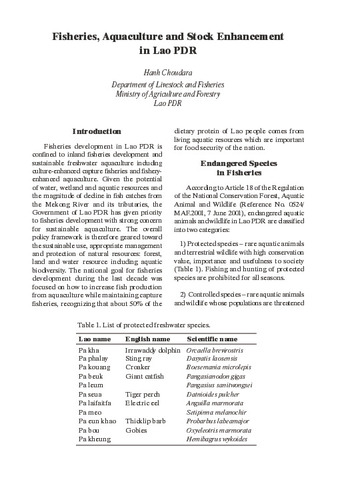
Fisheries, aquaculture and stock enhancement in Lao PDR
(Aquaculture Department, Southeast Asian Fisheries Development Center, 2006)Fisheries development in Lao PDR is confined to inland fisheries development and sustainable freshwater aquaculture including culture-enhanced capture fisheries and fishery-enhanced aquaculture. Given the potential of water, wetland and aquatic resources and the magnitude of decline in fish catches from the Mekong River and its tributaries, the Government of Lao PDR has given priority to fisheries development with strong concern for sustainable aquaculture. The overall policy framework is therefore geared toward the sustainable use, appropriate management and protection of natural resources: forest, land and water resource including aquatic biodiversity. The national goal for fisheries development during the last decade was focused on how to increase fish production from aquaculture while maintaining capture fisheries, recognizing that about 50% of the dietary protein of Lao people comes from living aquatic resources which are important for food security of the nation. -
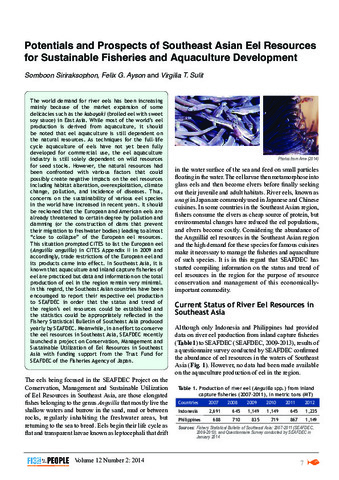
Potentials and prospects of Southeast Asian eel resources for sustainable fisheries and aquaculture development
(Secretariat, Southeast Asian Fisheries Development Center, 2014)The world demand for river eels has been increasing mainly because of the market expansion of some delicacies such as the kabayaki (broiled eel with sweet soy sauce) in East Asia. While most of the world’s eel production is derived from aquaculture, it should be noted that eel aquaculture is still dependent on the natural resources. As techniques for the full-life cycle aquaculture of eels have not yet been fully developed for commercial use, the eel aquaculture industry is still solely dependent on wild resources for seed stocks. However, the natural resources had been confronted with various factors that could possibly create negative impacts on the eel resources including habitat alteration, overexploitation, climate change, pollution, and incidence of diseases. Thus, concerns on the sustainability of various eel species in the world have increased in recent years. It should be reckoned that the European and American eels are already threatened to certain degree by pollution and damming (or the construction of dams that prevent their migration to freshwater bodies) leading to almost “close to collapse” of the European eel resources. This situation prompted CITES to list the European eel (Anguilla anguilla) in CITES Appendix II in 2009 and accordingly, trade restrictions of the European eel and its products came into effect. In Southeast Asia, it is known that aquaculture and inland capture fisheries of eel are practiced but data and information on the total production of eel in the region remain very minimal. In this regard, the Southeast Asian countries have been encouraged to report their respective eel production to SEAFDEC in order that the status and trend of the region’s eel resources could be established and the statistics could be appropriately reflected in the Fishery Statistical Bulletin of Southeast Asia produced yearly by SEAFDEC. Meanwhile, in an effort to conserve the eel resources in Southeast Asia, SEAFDEC recently launched a project on Conservation, Management and Sustainable Utilization of Eel Resources in Southeast Asia with funding support from the Trust Fund for SEAFDEC of the Fisheries Agency of Japan. -
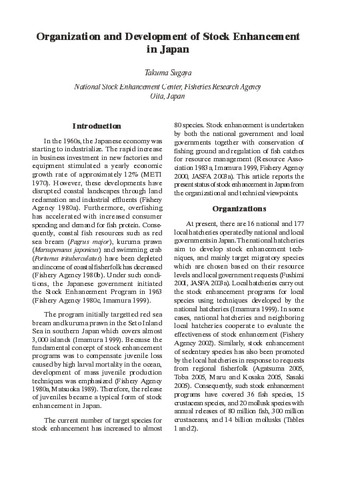
Organization and development of stock enhancement in Japan
(Aquaculture Department, Southeast Asian Fisheries Development Center, 2006)In the 1960s, the Japanese economy was starting to industrialize. The rapid increase in business investment in new factories and equipment stimulated a yearly economic growth rate of approximately 12% (METI 1970). However, these developments have disrupted coastal landscapes through land reclamation and industrial effluents (Fishery Agency 1980a). Furthermore, overfishing has accelerated with increased consumer spending and demand for fish protein. Consequently, coastal fish resources such as red sea bream (Pagrus major), kuruma prawn (Marsupenaeus japonicus) and swimming crab (Portunus trituberculatus) have been depleted and income of coastal fisherfolk has decreased (Fishery Agency, 1980). Under such conditions, the Japanese government initiated the Stock Enhancement Program in 1963 (Fishery Agency, 1980; Imamura, 1999). The program initially targeted red sea bream and kuruma prawn in the Seto Inland Sea in southern Japan which covers almost 3,000 islands (Imamura, 1999). Because the fundamental concept of stock enhancement programs was to compensate juvenile loss caused by high larval mortality in the ocean, development of mass juvenile production techniques was emphasized (Fishery Agency 1980a; Matsuoka, 1989). Therefore, the release of juveniles became a typical form of stock enhancement in Japan. The current number of target species for stock enhancement has increased to almost 80 species. Stock enhancement is undertaken by both the national government and local governments together with conservation of fishing ground and regulation of fish catches for resource management (Resource Association 1983a; Imamura 1999; Fishery Agency 2000; JASFA 2003a). This article reports the present status of stock enhancement in Japan from the organizational and technical viewpoints.