Typical prawn diseases - causes, prevention, and treatment
View/
Date
1988Page views
13,276ASFA keyword

AGROVOC keyword
Taxonomic term

Metadata
Show full item recordShare
Abstract
Diseases of prawn in ponds are caused by microorganisn like viruses, bacteria fungi and protozoans as well as factors such as nutritional deficiency, poor pond conditions and environmental pollutants. Most of these may be controlled by environmental and dietary manipulation. Control of transfers or introduction of new prawn species may also reduce the risk of disease occurrence. Chemotherapy is considered only as alast resort in the control of diseases in prawn ponds. The basic features of prawn diseases with emphasis on causative agents and methods of preventio and treatment are discussed.
Suggested Citation
Baticados, M. C. L. (1988). Typical prawn diseases - causes, prevention, and treatment. In Y. N. Chiu, L. M. Santos, & R. O. Juliano (Eds.), Technical Considerations for the Management and Operation of Intensive Prawn Farms (pp. 134-143). Iloilo City, Philippines: U.P. Aquaculture Society.
Type
Book chapterCollections
- Books and Book Chapters [123]
Related items
Showing items related by title, author, creator and subject.
-
Transboundary aquatic animal diseases: History and impacts in ASEAN aquaculture
(Aquaculture Department, Southeast Asian Fisheries Development Center, 2019)Aquaculture is one of the important sectors in the economy of most Asia-Pacific countries. However, majority of aquaculture farms are small-scale and most often lack the necessary facilities to comply with or are not well informed of the product standards imposed by concerned authorities, especially for international trade. Most countries in the region have a high reliance on aquatic animals as the major source of protein for their populations. In the past 20 years, farming of shrimp and fish for export has become a major employer and revenue earner for many countries in the region. Aquaculture is a major employer, contributes significantly to national economies, assists in poverty reduction, and is an important element in food security and other national development priorities. Aquaculture has developed rapidly in the region and is now a significant component in the national economies of many countries. However, recent disease events in fish and shrimp farming have indicated that preparedness and response measures are lacking, contributing to spread of disease across large areas of the countries involved. The growth of aquaculture in recent decades has been dependent on the international movement of aquatic animals and, in particular, the introduction of non-native species. The movement of live aquatic animals and their products has the potential to spread pathogens from one country or region to another, which may result to disease outbreaks. In shrimps as example, most major disease outbreaks were associated with the movement of live animals (broodstock, nauplii and postlarvae) when the patterns of disease spread were analyzed. Many aquatic animal diseases, once established, are often difficult to treat or to eliminate. Over the past 30 years, the Asia-Pacific region has been swept by a number of devastating diseases of aquatic animals which have caused massive economic and social losses. These include spread and outbreaks of infection with Aphanomyces invadans (EUS) in freshwater fish, viral nervous necrosis (VNN) in marine fish, viral hemorrhagic septicaemia (VHS) in marine and freshwater fish, and several viral diseases in shrimps such as white spot disease (WSD), white tail disease (WTD), yellow head disease (YHD) and infectious myonecrosis (IMN) among others. This demonstrates the vulnerability of the aquaculture industry as well as the wild populations to disease emergence in the region. The impacts of these diseases have been aggravated by the lack of effective preparedness and response whenever diseases emerge. Although some national, regional and international actions towards disease emergencies have paved way to disease spread prevention in recent years (e.g. Acute hepatopancreatic necrosis diseases; AHPND), there are still several emerging diseases that need to be considered by aquaculture-producing countries, especially in the ASEAN, through a harmonized and effective emergency preparedness and disease response. -
Series: Aquaculture extension manual; No. 16
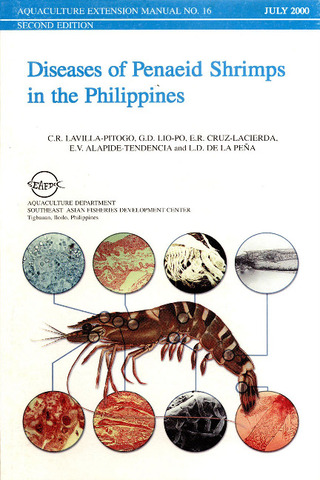
Diseases of penaeid shrimps in the Philippines
; ; ; Tendencia, Eleonor ; (Aquaculture Department, Southeast Asian Fisheries Development Center, 2000)
The manual provides information on the diseases that affect the 3 major species of shrimps cultured in the Philippines: Penaeus monodon, P. merguiensis and P. indicus. It includes the common name of the disease, causative agent, species affected, stages affected, gross signs, effects on the host and methods of prevention and treatment. This revised edition includes newly discovered diseases. It is hoped that the manual will be of considerable help to shrimp farmers in identifying the disease and lead to prevention or early disease diagnosis and control.
; (Aquaculture Department, Southeast Asian Fisheries Development Center, 2000)
The manual provides information on the diseases that affect the 3 major species of shrimps cultured in the Philippines: Penaeus monodon, P. merguiensis and P. indicus. It includes the common name of the disease, causative agent, species affected, stages affected, gross signs, effects on the host and methods of prevention and treatment. This revised edition includes newly discovered diseases. It is hoped that the manual will be of considerable help to shrimp farmers in identifying the disease and lead to prevention or early disease diagnosis and control. -
Advances in diagnosis and management of shrimp virus diseases in the Americas
(Aquaculture Department, Southeast Asian Fisheries Development Center, 2002)The most important diseases of cultured penaeid shrimp, in terms of economic impact, in Asia, the Indo-Pacific, and the Americas, have infectious etiologies. Although diseases with bacterial, fungal, and parasitic etiologies are also important, certain virus-caused diseases stand out as the most significant. The pandemics due to the penaeid viruses WSSV, TSV, YHV, and IHHNV have collectively cost the penaeid shrimp industry billions of dollars in lost crops, jobs, and export revenue. Although not as sudden nor as catastrophic in their onset and course, certain bacterial, fungal, and parasitic diseases of shrimp have also been responsible for very significant production losses, and the relative importance of many of these diseases should not be discounted. The social and economic impacts of the pandemics caused by WSSV and TSV have been especially profound in the Americas, and in the wake of these viral pandemics the shrimp culture industry has sought ways to restore the industry’s levels of production to the “pre-virus” years. Central to improving disease) prevention and management strategies is the incorporation of the concepts of biosecurity into shrimp farm design and operational strategies. Disease management in shrimp aquaculture is an important component to biosecurity of farms and to the sustainability of individual farms, shrimp farming countries, or entire geographic regions. The first step in disease management requires the availability of accurate and reliable diagnostic methods and knowledge of the biology of the diseases of concern. The recognition of the need for biosecurity and disease management in the Americas is reflected in the recent proliferation of shrimp disease diagnostic laboratories in the Americas. Where there were only a handful of shrimp disease diagnostic laboratories a decade ago, there are 40 or more such laboratories serving the industry today. Diagnostic methods may be applied to determining the cause of disease(s) that are adversely affecting the culture performance or survival of farmed shrimp stocks or they may be used for surveillance purposes to screen for the presence of specific pathogens in otherwise healthy shrimp for the purpose of disease control. As diagnostic methods have improved and become more widely available, the interest in culturing specific pathogen-free (SPF) shrimp stocks in biosecure facilities has increased markedly in many regions in the Americas. The methods being used in shrimp disease diagnostic laboratories in the Americas were recently surveyed. Of the 40 laboratories contacted, 27 responded to the survey. Approximately 75% of the labs responding to the survey provide diagnostic services using both molecular (PCR, RT-PCR and gene probes) and classical (routine histology and microbiology) methods, while nearly all (93%) of the diagnostic labs offer diagnostic testing and screening services based on molecular methods (i.e. assays with gene probes and PCR/RT-PCR).