Parasites of window-pane oyster (Placuna placenta Linnaeus, 1758) from Trapiche, Oton in west central Philippines

View/
Date
2015Page views
1,291ASFA keyword

AGROVOC keyword
Taxonomic term

Metadata
Show full item recordShare
Abstract
Parasitology of edible and commercially valuable window-pane oysters (Placuna placenta L.) using gross macroscopic examination and histology was conducted. To screen for the presence of parasites, wild oysters were collected monthly from January 2008 to December 2008 from Trapiche, Oton in west central Philippines. Thirty live adult oysters with shell length (SL) of 52-89 mm were hand-picked monthly. Gross observation showed the presence of pea crabs (Pinnotheres sp.) in the mantle cavity of the oysters. The overall prevalence and intensity of P. placenta with pea crabs were 4.44% and 1, respectively. Histological examination revealed the occurrence of Tylocephalum sp. (prevalence and intensity of the parasites were 1.66 % and 0.5, respectively) in connective tissues around the digestive gland. Tylocephalum sp. was found surrounded by hemocytic infiltration. Ciliates (Ancistroma sp.) were also observed in the gills with overall prevalence of 38.83% and intensity of 7.51. Larval stages of trematodes of Bucephalus sp. (prevalence, 18.83%; intensity of 1.5) were found in the connective tissues of the female gonad. The study presents a documentation of parasites of P. placenta in the Philippines.
Suggested Citation
Erazo-Pagador, G. (2015). Parasites of window-pane oyster (Placuna placenta Linnaeus, 1758) from Trapiche, Oton in west central Philippines. The Philippine Agricultural Scientist , 98(3), 323-327. http://hdl.handle.net/10862/3044
Type
ArticleISSN
0031-7454Collections
- Journal Articles [1267]
Related items
Showing items related by title, author, creator and subject.
-
Research on seaweeds and mollusks
(Aquaculture Department, Southeast Asian Fisheries Development Center, 1995)Research on seaweeds focused on the carrageenan-producing Kappaphycus alvarezii and the agar-producing Gracilaria spp. Growth of K. alvarezii was better on horizontal lines than on vertical or cluster lines from bamboo rafts. All morphotypes (brown green, and red) grew faster at 50 cm than at 100 cm below the water surface, but the green morphotype showed better carrageenan properties. A socioeconomic survey of K. alvarezii farming in Panagatan Cays, Antique revealed that a farmer has an average annual production of 3 tons/ha (dry) with the fixed bottom and hanging longline methods. Three species of Gracilaria in natural beds in lloilo showed monthly variations in biomass and agar quality; G. heteroclada had the highest biomass and gel strength. When this species was grown in tanks, growth and agar sulfate content were influenced by the interaction of light, salinity, and nutrients. Enriched and unenriched stocks of G. heteroclada differed in agar quality. When G. heteroclada was grown with the tiger shrimp Penaeus monodon in extensive ponds, the highest growth rate and production were obtained at the seaweed stocking density of 250 g/m2; this was in November when average water temperature, transparency, and salinity were low. Salinity tolerance varies among Gracilaria species.Oyster (Crassostrea iredalei) and mussel (Perna viridis) farming in Western Visayas were assessed in 1992 in terms of the culture methods, socioeconomics, marketing, and profitability. A more localized survey of oyster and mussel fanning was conducted through rapid rural appraisal in two coastal towns in 1993. A farmer-participatory study followed in 1994 for the culture of oysters, mussels, seaweeds, and rabbitfishes in a river mouth in Dumangas, lloilo. Green mussel, brown mussel (Modiolus metcalfei), and seaweeds transplanted to Dumangas from Capiz have reproduced. In another study, the green mussel was tested as a biological filter in tiger shrimp ponds; shrimps stocked with mussels grew better than those without. A nationwide survey on the Placuna placenta fishery in 1993 showed 27 remaining 'kapis' beds; many others have been depleted due to excessive gathering, pollution, siltation, and trawling. Broodstocks are being developed to produce 'kapis' seed for grow-out and restocking. For the first time at AQD, adult donkey-ear abalone Haliotis asinina from the wild spawned naturally in laboratory tanks. Juvenile abalones can be successfully grown on Gracilaria or abalone diet. -
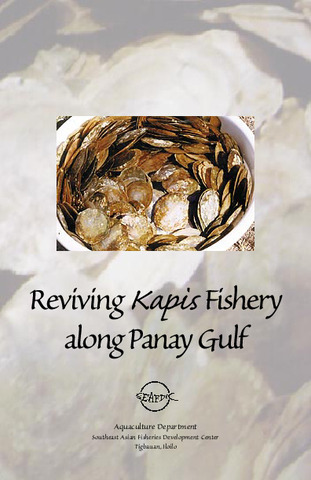
Reviving kapis fishery along Panay Gulf
(Aquaculture Department, Southeast Asian Fisheries Development Center, 2000)Discusses SEAFDEC AQD's work on reviving window-pane shell (kapis) fishery through restocking of breeders along Panay Gulf. -
Management of feeding aquaculture species
(Aquaculture Department, Southeast Asian Fisheries Development Center, 2002)This chapter teaches the reader to: differentiate the different feeding strategies in pond culture; learn feeding management methods such as stock sampling and record keeping, calculating daily feed ration, choosing appropriate feed size, and methods of applying feeds; understand the impact of feeding management on water quality and environment and on the cultured animal’s growth, survival, and feed conversion ratio; and describe the different feeding schemes used to culture fishes (milkfish, tilapia, rabbitfish, bighead carp, native catfish, sea bass, orange-spotted grouper, and mangrove red snapper; and crustaceans (tiger shrimp and mud crab). Other species for aquaculture stock enhancement (donkey’s ear abalone, seahorses, window-pane oyster) are also discussed.