Identification of mud crab species in coastal areas of Pangasinan


Share
Abstract
The study was conducted to identify the mud crab species (Scylla spp.) that thrive in 12 coastal municipalities and 2 cities in Pangasinan. Ten mud crab samples were taken from each of the sampling site and classified based on Keenan et al. (1998). Likewise, the abundance and differences in size and weight of the mud crab samples were determined. The study showed that there are only three mud crab species, Scylla serrata, S. tranquebarica and S. olivacea, found in the coastal areas of Pangasinan. S. serrata was the most abundant species (54.28%), followed by S. tranquebarica (24.28%) and S. olivacea (22.14%). Crabs weighing more than 300 g (~.12 cm carapace width or CW) were obtained from the municipalities of Anda, Bolinao, Dasol, Burgos, Bani, Agno, Alaminos and Infanta. These municipalities are geographically situated in coastal areas where S. serrata are found. Crabs weighing below 300 g (~.12 cm CW) were collected from the municipalities of Sual, Labrador, San Fabian, Lingayen, Dagupan and Binmaley. These towns have mangrove areas and low saline waters where S. tranquebarica and S. olivacea thrive.
Description
Abstract only.
Suggested Citation
Cerezo, R. B., & Tapia, M. C. (2017). Identification of mud crab species in coastal areas of Pangasinan. In E. T. Quinitio, F. D. Parado-Estepa, & R. M. Coloso (Eds.), Philippines : In the forefront of the mud crab industry development : proceedings of the 1st National Mud Crab Congress, 16-18 November 2015, Iloilo City, Philippines (p. 137). Tigbauan, Iloilo, Philippines: Aquaculture Department, Southeast Asian Fisheries Development Center.
Type
Conference paperISBN
9789719931072Collections
Related items
Showing items related by title, author, creator and subject.
-
Overview of the mud crab industry in the Philippines
Quinitio, Emilia T. (Aquaculture Department, Southeast Asian Fisheries Development Center, 2017)
Mud crab farming has long been established in the Philippines and the country is the second top producer in the world. Except for Scylla paramamosain, the three other species, S. serrata, S. tranquebarica and S. olivacea are commonly found in the country, but S. serrata is the preferred species for farming. Crab seeds for farming are mainly from the wild and in recent years, a small percentage from the hatchery. Due to the apparent decline of the wild crab stocks, provincial and municipal ordinances have been issued by a number of Local Government Units (LGUs) along with the Bureau of Fisheries and Aquatic Resources (BFAR) to conserve and manage the remaining resources. From the hatchery, megalopa or crab instars are grown in net cages installed in the nursery pond. Mud crab farming engages mostly in long-term grow-out culture of juvenile crabs to market size for 3-5 months, short-term fattening of lean crabs for 15-45 days, and recently, soft-shell crab production. Polyculture of juvenile crabs to market size with one to three other commodities in earthen brackishwater ponds is usually practiced. Mud crabs for soft-shell crab production are mainly from the wild, while SEAFDEC/AQD demonstrates the use of hatchery-produced juvenile mud crabs as seedstock. Refinement is continuously being done to improve the economic viability of producing crabs, although basic technologies have been developed for all phases of culture (hatchery, nursery, grow-out, fattening and soft shell crab production). The major issues facing the industry are the lack of seedstock, difficulty of zoea 5 to molt to megalopa stage, cannibalism particularly at the nursery phase, species identification at the juvenile stage, use of fish as aquafeed, diseases, effects of climate change and quality of crabs at postharvest. In 2012, the Philippine Council for Agriculture, Aquatic and Natural Resources Research and Development (PCAARRD) of the Department of Science and Technology (DOST) started funding projects under the National Mud Crab Science and Technology Program (NMCSTP) to address these issues. The major aim of the Program was to improve the production, profitability and sustainability of crab farming. SEAFDEC/AQD leads in capacity building with focus on the sustainability of the mud crab industry. Various collaborations and research studies on mud crab culture enabled SEAFDEC/AQD to package mud crab technologies, conduct local and international training courses and on-site technology demonstrations, and publish extension manuals and scientific publications since the mid1990s. Research and Development activities have been translated into improved production. With the recent developments and refinements of technologies, it is expected that the Philippines will increase its production by 25-50% in the next 5 years.
(Aquaculture Department, Southeast Asian Fisheries Development Center, 2017)
Mud crab farming has long been established in the Philippines and the country is the second top producer in the world. Except for Scylla paramamosain, the three other species, S. serrata, S. tranquebarica and S. olivacea are commonly found in the country, but S. serrata is the preferred species for farming. Crab seeds for farming are mainly from the wild and in recent years, a small percentage from the hatchery. Due to the apparent decline of the wild crab stocks, provincial and municipal ordinances have been issued by a number of Local Government Units (LGUs) along with the Bureau of Fisheries and Aquatic Resources (BFAR) to conserve and manage the remaining resources. From the hatchery, megalopa or crab instars are grown in net cages installed in the nursery pond. Mud crab farming engages mostly in long-term grow-out culture of juvenile crabs to market size for 3-5 months, short-term fattening of lean crabs for 15-45 days, and recently, soft-shell crab production. Polyculture of juvenile crabs to market size with one to three other commodities in earthen brackishwater ponds is usually practiced. Mud crabs for soft-shell crab production are mainly from the wild, while SEAFDEC/AQD demonstrates the use of hatchery-produced juvenile mud crabs as seedstock. Refinement is continuously being done to improve the economic viability of producing crabs, although basic technologies have been developed for all phases of culture (hatchery, nursery, grow-out, fattening and soft shell crab production). The major issues facing the industry are the lack of seedstock, difficulty of zoea 5 to molt to megalopa stage, cannibalism particularly at the nursery phase, species identification at the juvenile stage, use of fish as aquafeed, diseases, effects of climate change and quality of crabs at postharvest. In 2012, the Philippine Council for Agriculture, Aquatic and Natural Resources Research and Development (PCAARRD) of the Department of Science and Technology (DOST) started funding projects under the National Mud Crab Science and Technology Program (NMCSTP) to address these issues. The major aim of the Program was to improve the production, profitability and sustainability of crab farming. SEAFDEC/AQD leads in capacity building with focus on the sustainability of the mud crab industry. Various collaborations and research studies on mud crab culture enabled SEAFDEC/AQD to package mud crab technologies, conduct local and international training courses and on-site technology demonstrations, and publish extension manuals and scientific publications since the mid1990s. Research and Development activities have been translated into improved production. With the recent developments and refinements of technologies, it is expected that the Philippines will increase its production by 25-50% in the next 5 years. -
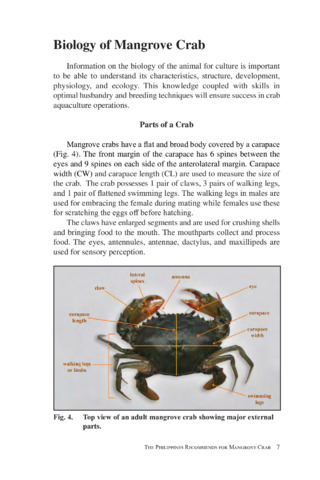
[The Philippines recommends for mangrove crab:] Biology of mangrove crab
(DOST-PCAARRD, 2021) -
The reestablishment of mangrove crabs (Scylla spp.) in an abandoned pond following natural mangrove recolonization
Lebata-Ramos, Ma. Junemie Hazel; ; Sibonga, Rema (Wiley, 2024-01)
Scylla spp. are among the most economically important fisheries resources derived from the mangroves. However, the widespread mangrove destruction resulted in the loss of habitat, thus the dwindling capture production of many mangrove-associated faunas. Although studies have shown that Scylla populations have reestablished in mangrove-reforested areas, this study was the first in a mangrove-recolonized abandoned pond in the Philippines. Six fishers conducted standardized fishing every spring tide of the month using cylindrical bamboo traps. All crabs caught from July 2010 to December 2011 were recorded for species, sex, sexual maturation of females, carapace width (CW), and body weight (BW). Total landings comprised 14,262 crabs weighing 1,743 kg; 79.67% Scylla olivacea, 20.18% S. tranquebarica, and 0.15% S. serrata. CW ranged 3.1–17.1 cm and BW 10–1,250 g, with the male crabs comprising 39.23–64.65% of the monthly landings and the females distributed as 19.88–45.01% immature, 0.50–16.57% mature, 0.45–16.02% gravid, and less than 0.10% spent crabs. Monthly landings ranged 254–1,231 pcs of crabs or 32.38–160.59 kg. The monthly mean catch per unit effort (CPUE), in terms of number, was 0.101 ± 0.01–0.456 ± 0.02 crab gear−1 day−1 (max = 1.13), while in terms of biomass, 12.86 ± 0.84–54.36 ± 3.16 g gear−1 day−1 (max = 112.50). Length–weight relationships of S. olivacea and S. tranquebarica are expressed as W = 0.224967L2.9864 (r2 = 94.08%, p < 0.001; n = 11,363) and W = 0.173409L3.1074 (r2 = 92.71%, p < 0.001; n = 2,878), respectively. This study revealed that Scylla spp. could reestablish in mangrove-recolonized abandoned ponds.