SEAFDEC/AQDINSTITUTIONAL REPOSITORY
    • English
    • 日本語
    • ไทย
    • Bahasa Indonesia
  • English 
    • English
    • 日本語
    • ไทย
    • Bahasa Indonesia
  • Login
View Item 
  •   SEAFDEC/AQD Institutional Repository Home
  • 02 SEAFDEC/AQD Collaborative Publications
  • SEAFDEC/AQD-Department of Agriculture (DA) - Philippines
  • Bureau of Agricultural Research (BAR)
  • Fisheries Sector Program (FSP)
  • Research Output of the Fisheries Sector Program: Volume 2. Reports on Fisheries and Aquaculture
  • View Item
  •   SEAFDEC/AQD Institutional Repository Home
  • 02 SEAFDEC/AQD Collaborative Publications
  • SEAFDEC/AQD-Department of Agriculture (DA) - Philippines
  • Bureau of Agricultural Research (BAR)
  • Fisheries Sector Program (FSP)
  • Research Output of the Fisheries Sector Program: Volume 2. Reports on Fisheries and Aquaculture
  • View Item
JavaScript is disabled for your browser. Some features of this site may not work without it.

Grow-out of milkfish in net-walled marine pens in La Union
  • Global styles
  • MLA
  • Vancouver
  • Elsevier - Harvard
  • APA
  • Help
Thumbnail
View/Open
Date
2007
Author
Domenden, Nestor D.
Page views
7,619
ASFA keyword
cage culture ASFA
fish culture ASFA
aquaculture ASFA
stocking density ASFA
feeds ASFA
costs ASFA
returns ASFA
AGROVOC keyword
Chanos chanos AGROVOC
milkfish AGROVOC
Philippines AGROVOC
Taxonomic term
Chanos chanos GBIF
Metadata
Show full item record

Share 
 
Abstract
Grow-out of milkfish in 125 m2 net-walled marine pens was tested in Santo Tomas Cove, La Union at three stocking densities of 6, 9, and 12 fish/m2 and using commercial feed (crumbles and pellets) with 25–30% crude protein. After 115 days, survival of milkfish in marine pens was 92–97%. Fish stocked at 12/m2 or 1,500/pen grew to average weights of 286 g, larger than the fish stocked at lower densities. Feed conversion ratio was 2.3 at the highest density and worse at the lower densities. Costs and returns of milkfish grow-out in marine pens at three densities showed that feeds were the most costly component (55–69%) of production. The milkfish harvest was equivalent to about 33 mt/ha at the stocking of 120,000 fish/ha. Only at this high density was adequate profit made for a 48% return on investment per crop. Two crops are possible in the Ilocos region during the dry season from November to June. Grow-out of milkfish in marine pens can be improved if seed and feeds could be procured at lower cost.
URI
http://hdl.handle.net/10862/3280
Suggested Citation
Domenden, N. D. (2007). Grow-out of milkfish in net-walled marine pens in La Union. In T. U. Bagarinao (Ed.), Research Output of the Fisheries Sector Program (Vol. 2. Reports on Fisheries and Aquaculture, pp. 123-124). Quezon City, Philippines: Bureau of Agricultural Research, Department of Agriculture.
Type
Book chapter
ISBN
9718511776
Collections
  • Research Output of the Fisheries Sector Program: Volume 2. Reports on Fisheries and Aquaculture [32]

Related items

Showing items related by title, author, creator and subject.

  • Thumbnail
    Series: Aquaculture extension manual; No. 25

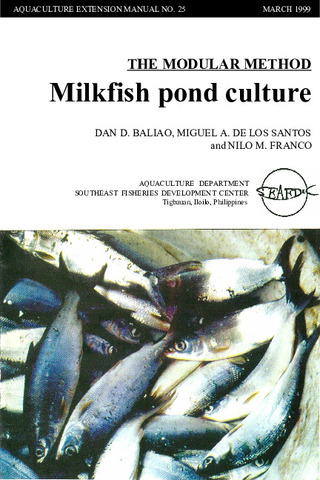
    The modular method: Milkfish pond culture 

    Baliao, Dan D.; de los Santos, Miguel A.; Franco, Nilo M. (Aquaculture Department, Southeast Asian Fisheries Development Center, 1999)
    The modular method of milkfish culture (Chanos chanos) described in the manual is an improvement over the traditional extensive method. The manual is intended for the use of fish farmers and aquaculturists, extensionists, ...
  • Thumbnail

    Evaluation of organic and inorganic fertilizers in brackishwater milkfish ponds 

    Bombeo-Tuburan, Isidra; Agbayani, Renato F.; Subosa, Precilla F. (Elsevier, 1989)
    The study was conducted in twelve 144-m2 ponds to evaluate the effect of different organic and inorganic fertilizers on the growth, survival, gross production, and profitability of marketable milkfish. The ...
  • Thumbnail

    Milkfish breeding and hatchery technology at SEAFDEC/AQD 

    Unknown author (Aquaculture Department, Southeast Asian Fisheries Development Center, 1999)
    Describes the techniques already adopted by the private sector: broodstock management, broodstock diet, commercial fry production, live transport, and larval diet. A list of AQD research publications on milkfish is included.
© SEAFDEC/AQD  2025
Send Feedback | Subscribe


Browse

All of SAIRCommunities & CollectionsBy Issue DateAuthorsTitlesSubjectsThis CollectionBy Issue DateAuthorsTitlesSubjects

My Account

LoginRegister

Statistics

View Usage Statistics

© SEAFDEC/AQD  2025
Send Feedback | Subscribe


Export citations

Export the current results of the search query as a citation list. Select one of the available citation styles, or add a new one using the "Citations format" option present in the "My account" section.

The list of citations that can be exported is limited to items.

Export citations

Export the current item as a citation. Select one of the available citation styles, or add a new one using the "Citations format" option present in the "My account" section.

Export Citations

DOCUMENT REQUEST NOT AVAILABLE

This publication is still available (in PRINT) and for sale at AQD bookstore. The library is currently restricted to send PDF of publications that are still for sale.

You may contact bookstore@seafdec.org.ph or visit AQD bookstore for orders.

FILE UNDER EMBARGO

This file associated with this publication is currently under embargo. This will be available for download after the embargo date.