Evaluation of fertilizer use and milkfish yields in Palawan
ดู/
วันที่
2007Page views
6,405ASFA keyword

AGROVOC keyword
Taxonomic term

เมตาดาต้า
แสดงระเบียนรายการเต็มShare
นามธรรม
Milkfish yields in Palawan in 1993–94 were low, only 595 kg/ha-yr on average and ranged 100–700 kg/ha-yr in 35 of 50 farms surveyed. Only seven farms had yields between 1,000 and 1,800 kg/ha-yr. Yields were higher in deeper ponds, and shallowness of ponds was a major constraint to high yields. Farm -gate prices of milkfish ranged from P25 to P55 and averaged P42. The prices of milkfish were on average 43x greater than the price of organic fertilizers (chicken manure) and 6x more than the price of inorganic fertilizers. The income from milkfish made up 10-95% and averaged 53% of the total income of the farmers. One crop cycle a year was the practice in 28 of the 50 farms; 20 farms had two crops, and two farms went for 3–4 crops a year. A crop cycle was 3–4 months long in 14 farms, 5–6 months in 29 farms, and 7–9 months in 7 farms. Crop cycles started with draining and drying the ponds and applying fertilizers to grow natural food. Most of the farms were supplied by tidal water and water exchange in the ponds was done every spring tide in 33 farms. The other farms changed water once a month, once or twice in a crop cycle, or once a year. Application rates of organic fertilizers were mostly less than 1 ton/ha-yr and averaged 515 kg/hayr, but three farms used as much as 1,250 kg/ha-yr, and one farm used 3,000 kg/ha-yr. Half as much inorganic fertilizers were used; the average for the 50 farms was only 211 kg/ha-yr, but one farm used as much as 1,350 kg/ha-yr. The fertilizers encouraged natural food to grow in the ponds. Two of the farms grew mostly plankton, 15 grew the benthic mat lablab, and 33 grew the green filamentous algae lumut. None of the farms used commercial feeds. Stocking rates varied widely among the farms, ranged from 1,000 to 60,000 fry or fingerlings per hectare per year and averaged 8,000/ ha-yr. Two-thirds of the farms stocked less than 7,000/ha-yr, but eight farms stocked fry or fingerlings at much higher rates of 13,000–60,000/ ha-yr. An input use variation model showed that milkfish yield was a function of the ratios of prices of milkfish to prices of organic and inorganic fertilizers; pond water depth and salinity; milkfish income as percent of total income; family size; membership in aquaculture association; and contacts with government‘s extension services and information dissemination system. The surveyed farms ranged from 3 to 40 years old, with 92% under 20 years; they had been in operation 1–23 years, 76% of them for less than eight years. Of the 50 farms in the survey, only nine were private (titled) lands, 34 were covered by fishpond lease agreements (FLA issued by the Bureau of Fisheries and Aquatic Resources), and the others had only survey documents or no papers at all. Farm sizes ranged 0.8–50 ha (average 12.5 ha), and 52% of them were smaller than 6 ha. The private farms were small, only 1–7 ha except one that was 25 ha. The FLA farms were much larger, and 23 of them were 5–50 ha. Large parts of the large farms were not operational, and 90% of the farms used effective areas of less than 7 ha. The low lease fees for FLAs evidently did not encourage farm development to increase yields. The farms had mostly shallow ponds 25–100 cm deep (average 68 cm).
การอ้างอิง
Dumada-ug, E. B., & Sevilleja, R. (2007). Evaluation of fertilizer use and milkfish yields in Palawan. In T. U. Bagarinao (Ed.), Research Output of the Fisheries Sector Program (Vol. 2. Reports on Fisheries and Aquaculture, pp. 138-149). Quezon City, Philippines: Bureau of Agricultural Research, Department of Agriculture.
Type
Book chapterISBN
9718511776Related items
Showing items related by title, author, creator and subject.
-
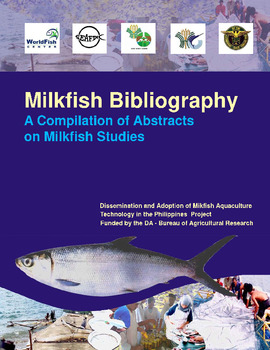
Milkfish bibliography: a compilation of abstracts on milkfish studies
(WorldFish Center, 2007)Milkfish Bibliography covers 700 references on milkfish biology; broodstock management and fry, fingerling and egg collection and production; milkfish culture systems; health and nutrition; post harvest technology; socioeconomic and related studies; and environment and ecology. Included references range from published/unpublished documents, theses, journal articles, to project reports and conference papers. -
Ongoing research studies on maturation and spawning of milkfish, Chanos chanos at the brackishwater shrimp and milkfish culture applied research and training project, Jepara, Indonesia
(Aquaculture Department, Southeast Asian Fisheries Development Center, 1976)The paper gives an account of the research work carried out at Jepara, Indonesia, on induction of maturity of milkfish in ponds and enclosures, and procurement of the spawners from the wild for seed production by hypophysation. Seven to eight years old pond grown milkfish were found sexually immature. Experiments are being conducted for growing and inducing maturity in 1-2 years old milkfish in fertilized ponds with regular tidal flow of water and also under regular hypophysation program. Milkfish spawners collected from sea had a few males in oozing condition and females mostly spent. -
Ration reduction, integrated multitrophic aquaculture (milkfish-seaweed-sea cucumber) and value-added products to improve incomes and reduce the ecological footprint of milkfish culture in the Philippines
(AquaFish Collaborative Research Support Program, Oregon State University, 2012)In the Philippines, cage culture of milkfish in marine environments is increasing. The practice uses high stocking densities, with significantly greater inputs of artificial feeds which more often than not, have led to excessive feeding and consequently excessive nutrient loading in receiving waters, exacerbating problems with pollution. These could have contributed to occurrence of periodic fish kills in areas of marine milkfish culture clusters. In marine cage culture, about 80% of variable expenses are attributable to feed costs. Experiments were conducted to compare production characteristics of milkfish fed on alternate days versus those raised on daily feeding in marine cage culture. Fish were fed either daily or every other day using a reduced feed ration at 7.5% of fish biomass at the start of culture down to 3% of fish biomass towards harvest. We showed this ration level was as effective as the industry standard that begins at a rate of 10% average body weight. Morevover, we had previously found that milkfish reared in brackishwater ponds on an alternate day feeding scheme using the reduced ration level produced a 56% cost savings in feed with little impact on total yield relative to fish raised on a daily feeding protocol. In the present study, survival rates (~ 90%) were comparable between the control fish fed daily and groups fed on alternate days in marine cages. Similarly, total harvested biomass of fish in the alternate day and daily feeding groups was similar as was the harvest value, although fish on the alternate day feeding scheme grew slightly less. The amount of feed and the corresponding cost of feeds consumed were significantly lower in stocks that were fed on alternate days compared with those fed daily (P < 0.05). Feed conversion ratio (FCR) was lower in the alternate-day fed group (FCR = 2.46) relative to stocks fed daily (FCR = 3.59). Overall, the results demonstrate that feed costs can be reduced by around 32% in stocks fed on alternate days, which yields an estimated 20-25% improvement in production efficiency relative to raising animals on a daily feeding protocol. Hence, a significant costs savings with reduced impact of nutrient loading in the environment is likely to be realized for farmers who adopt an alternate day feeding scheme in raising milkfish in marine cages.