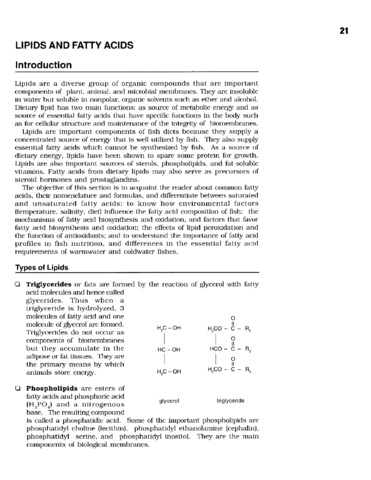
The essential nutrients: Lipids and fatty acids


Share
Abstract
The objective of this section is to acquaint the reader about common fatty acids, their nomenclature and formulas, and differentiate between saturated and unsaturated fatty acids; to know how environmental factors (temperature, salinity, diet) influence the fatty acid composition of fish; the mechanisms of fatty acid biosynthesis and oxidation, and factors that favor fatty acid biosynthesis and oxidation; the effects of lipid peroxidation and the function of antioxidants; and to understand the importance of fatty acid profiles in fish nutrition, and differences in the essential fatty acid requirements of warmwater and coldwater fishes.
Suggested Citation
Millamena, O. M. (2002). The essential nutrients: Lipids and fatty acids. In O. M. Millamena, R. M. Coloso, & F. P. Pascual (Eds.), Nutrition in Tropical Aquaculture: Essentials of fish nutrition, feeds, and feeding of tropical aquatic species (pp. 21–32). Tigbauan, Iloilo, Philippines: Aquaculture Department, Southeast Asian Fisheries Development Center.
Contents
- Introduction
- Types of lipids
- General function of lipids
- Fatty acids
- Structure and classification
- Nomenclature
- Fatty acid composition of fish
- Biosynthesis of fatty acids
- Oxidation of fatty acids
- Lipid peroxidation
- Importance of fatty acid profiles in fish nutrition
- Essential Fatty Acid Requirements of Fish
- Guide questions
Type
Book chapterISBN
971851158XRelated items
Showing items related by title, author, creator and subject.
-
Evaluation of dietary freeze-dried Chaetoceros calcitrans supplementation to control Vibrio harveyi infection on Penaeus monodon juvenile
; ; ; ; Amar, Edgar (Elsevier, 2014)
Effects of supplementation of diets with freeze-dried Chaetoceros calcitrans to control Vibrio harveyi infection are evaluated through immune responses, and disease resistance of juvenile Penaeus monodon. Total lipid and fatty acid profile of Chaetoceros calcitrans is also analyzed. A challenge infection with 107 cfu/mL concentration of Vibrio harveyi is intramuscularly injected to juvenile Penaeus monodon after 45 days of feeding of diets supplemented with 15 g/kg and 30 g/kg dried Chaetoceros calcitrans. The use of dried Chaetoceros calcitrans is compared with that of ß-1,3 glucan Curdlan, a commercial immune enhancer. Incorporation of 30 g/kg Chaetoceros calcitrans in the diet enhances the immune system of shrimp as effected by high prophenoloxidase activity and plasma protein concentration and is better compared to the commercially available Curdlan. Chaetoceros calcitrans also contains polyunsaturated fatty acids (PUFAs) such as linolenic acid and eicosapentanoic acid (EPA) which are responsible for its antibacterial action against Vibrio harveyi. All these biological activities of Chaetoceros calcitrans add up to increase resistance of the juvenile Penaeus monodon to vibriosis as shown by its high survival rate from the challenge infection with Vibrio harveyi. Therefore, it is worthwhile to use Chaetoceros calcitrans as supplementary feed. Its effect in increasing the immune competence coupled with its antibacterial action, make the shrimp resistant to luminous vibriosis that continues to affect the industry, thereby augmenting aquaculture production.
(Elsevier, 2014)
Effects of supplementation of diets with freeze-dried Chaetoceros calcitrans to control Vibrio harveyi infection are evaluated through immune responses, and disease resistance of juvenile Penaeus monodon. Total lipid and fatty acid profile of Chaetoceros calcitrans is also analyzed. A challenge infection with 107 cfu/mL concentration of Vibrio harveyi is intramuscularly injected to juvenile Penaeus monodon after 45 days of feeding of diets supplemented with 15 g/kg and 30 g/kg dried Chaetoceros calcitrans. The use of dried Chaetoceros calcitrans is compared with that of ß-1,3 glucan Curdlan, a commercial immune enhancer. Incorporation of 30 g/kg Chaetoceros calcitrans in the diet enhances the immune system of shrimp as effected by high prophenoloxidase activity and plasma protein concentration and is better compared to the commercially available Curdlan. Chaetoceros calcitrans also contains polyunsaturated fatty acids (PUFAs) such as linolenic acid and eicosapentanoic acid (EPA) which are responsible for its antibacterial action against Vibrio harveyi. All these biological activities of Chaetoceros calcitrans add up to increase resistance of the juvenile Penaeus monodon to vibriosis as shown by its high survival rate from the challenge infection with Vibrio harveyi. Therefore, it is worthwhile to use Chaetoceros calcitrans as supplementary feed. Its effect in increasing the immune competence coupled with its antibacterial action, make the shrimp resistant to luminous vibriosis that continues to affect the industry, thereby augmenting aquaculture production. -
The essential fatty acid requirement of milkfish (Chanos chanos Forsskal)
(Springer Verlag, 1992)The essential fatty acid (EFA) requirement of milkfish was examined by a 12-week feeding trial using defined, purified diets at water temperature of 28–29°C and salinity of 32‰. The test diets contained varying levels of 18:0 (triglyceride form, TG), 18:3(n−3), 18:2(n−6) and (n−3) highly unsaturated fatty acids (n−3 HUFA). Milkfish juveniles were starved for 7 days and were than fed lipid-free diet for 30 days before the initiation of feeding trials. Low growth and feed efficiency together with high mortalities were observed in fish fed the lipid-free diet as well as in the EFA-deficient diet. Supplementation of 2% 18:2(n−6) to the tristearin based diet did not improve growth rate of milkfish as effectively as feeding with (n−3) fatty acids. The highest weight gain was obtained in milkfish fed a combination of 5% 18:0 + 1.0% 18:3(n−3) + 0.5% 20:5(n−3) + 0.5% 22:6(n−3) although the supplementation of 2% 18:3(n−3) alone or combination of 0.5% 20:5(n−3) + 0.5% 22:6(n−3) to the tristearin based diets were also effective for improvement of growth. Thus, (n−3) fatty acids, such as 18:3(n−3) and (n−3)HUFA were nutritionally more important than 18:2(n−6) for milkfish. The fatty acid composition of the polar lipids from whole body of milkfish juveniles fed the various test diets were influenced by the composition of the dietary fatty acids. -
Developmental historicity and saccharide heterotrophy of Schizochytrium sp. OT01: Implication of docosahexaenoic acid production for biotechnological applications
Batbatan, Christopher; Hepowit, Nathaniel ; (Rushing Water Publishers, 2011)
Thraustochytrids have been targeted worldwide in search of highly oleaginous strains for industrial applications and newly collected holotypes are described based on life cycle developmental history and saccharide heterotrophy. Schizochytrium sp. OT01, a novel thraustochytrid protist from Panay, Philippines, distinguished from other reported strains by its asexual reproductive history - including the successive binary division of vegetative cells forming tetrads or octads, granular maturation of thalli into zoosporangia liberating heterokont motile zoospores and transformation of spheroidal thalli into amoeboid cells. Live-cell differential imaging and electron micrographs support its distinctive morphological features, such as hair-like pseudopodial astrals along hyaline margins of mature limaciform amoeboids and in motile zoospores prior to heterokont flagellum elongation. Moreover, its heterotrophic culture on certain saccharides (glucose, fructose, cellobiose, sucrose and starch) in continuously agitated fermentation condition was further investigated to determine hydrocarbon assimilative profiles as deduced from biomass yield and polyunsaturated fatty acid production. Increasing biomass yield was observed in increasing concentrations of saccharides; however, aside from glucose and fructose, a graphical drop of biomass was apparent beyond 15 gL, implying osmotic stress at these levels. Maximum biomass yield was observed at 30 gL- glucose and fructose concentration, reaching to about 6 g/l as expressed in freeze-dried weight of harvested cells, which indicates that OT01 could efficiently absorb and metabolize glucose and fructose compared to other hydrocarbons with relatively greater molecular weights. Even though biomass yield amounts were relatively low in cellobiose, sucrose and starch; however, docosahexaenoic acid (DHA) content in total fatty acids was relatively higher, amounting to 45.23, 46.25 and 48.86%, respectively. Moreover, oleagineity levels in glucose and fructose were highest, with lipid yield amounting to 655.55 and 609.38 mg, respectively, in every gram of freeze-dried weight cells. Consequently, DHA yield was significantly higher in both glucose and fructose, reaching respectively to 492.04 and 478.18 mg per liter of nutrient broth, which indicates higher absorption and metabolism efficiency of monosaccharides into fatty acids.