Journal Articles, Conference Papers and Book Chapters by SEAFDEC Staff: Recent submissions
Now showing items 1321-1340 of 1693
-
Variation in the vertebral number of the milkfish Chanos chanos, collected from various localities
(The Faculty of Fisheries, Nagasaki University, 1977)A total of 2497 milkfish fry were collected in 1976 from nine localities in six countries, viz. India, Thailand, Indonesia, Philippines, Taiwan and Tahiti. Vertebra counts ranged from 40 to 45. The general trend of geographical gradient in vertebral counts in the milkfish was observed to be lower in the west (or otherwise, along continents) and higher in the east (or around oceanic islands). Extremes in the means of vertebral counts by localities were seen in the samples from India with 43.08 and from Tahiti with 43.82. It was suggested that there may be at least four subpopulations among the milkfish throughout the tropical Indo-Pacific waters. -
Induction of maturity and spawning in Penaeus monodon Fabricius, 1798, by unilateral eyestalk ablation (Decapoda, Natantia)
(Brill Academic Publishers, 1976)Preliminary experiments carried out at the Aquaculture Department of the Southeast Asian Fisheries Development Centre in the Philippines have achieved success in the rearing of viable F1 postlarvae of Penaeus monodon from pond reared stocks. Unilateral eyestalk ablation was carried out on 100 female. 7 of these had successfully spawned at 23-months. Egg numbers up to 355,000 per female and successful hatch rates of up to 81% wee obtained. Bilaterally ablated female suffered total mortality by 196 days from eyestalk removal without 1 recorded spawning. Similarly, no spawnings were obtained from unablated controls. It is difficult to determine whether success can be solely attributed to unilateral ablation, or whether a fortuitous choice of experimental site played some major role. In any case, the data obtained are a valuable guide for future work aimed at propagating P.monodon commercially under fully controlled conditions. -
A simple method of tagging prawns
(University of the Philippines, 1976)The recognition of individual animals is crucial to many aspects of research. Prawns present unique difficulties in this respect since they molt regularly. Thus almost all tagging and marking methods developed for prawns so far have proven inadequate. Some are lost during molting; others cause injury to the prawns. A new and efficient method has been developed at the Igang Sea Farming Station of the Aquaculture Department. Brass tags measuring 5 mm by 20 mm and numbered consecutively are encircled around the eyestalk like a small bracelet. The prawn is gently held at the base of the carapace by the left hand while the right hand slips the brass tag over the eye. The tag is gently pressed around the eyestalk to prevent its slipping out. All tagging is done under water to avoid stress. -
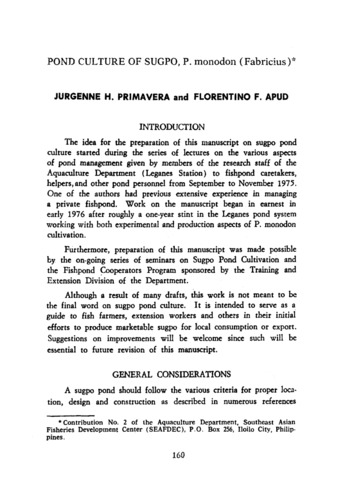
Pond culture of sugpo, P. monodon (Fabricius)
Primavera, Jurgenne ; (BFAR, 1976)
A resume is presented of the practical considerations involved in establishing a sugpo pond culture operation, as a guide to fish farmers, extension workers and others interested in producing marketable sugpo in the Philippines. In addition to outlining the general biology of P.monodon , information is given for pond preparation, stocking, transfer from nursery pond to rearing pond, rearing, harvesting, processing and transport. A large appendix deals with the control of pests, predators and diseases, fertilisation and supplementary feeding, and incorporates an illustrated manual of operations.
; (BFAR, 1976)
A resume is presented of the practical considerations involved in establishing a sugpo pond culture operation, as a guide to fish farmers, extension workers and others interested in producing marketable sugpo in the Philippines. In addition to outlining the general biology of P.monodon , information is given for pond preparation, stocking, transfer from nursery pond to rearing pond, rearing, harvesting, processing and transport. A large appendix deals with the control of pests, predators and diseases, fertilisation and supplementary feeding, and incorporates an illustrated manual of operations. -
Notes on the external sex characters of Chanos chanos (Forskal) spawners
(Fisheries Research Society of the Philippines, 1976)In the present study, no visible differences between the sexes of C. chanos with reference to external features such as colouration, shape of head, snout and operculum, presence of tubercles or nasal pores, length, size and shape as well as any roughness in the various fins, could be found. However, the anal region of the mature milkfish (sabalo) exhibits discernible anatomical differences in the male and female. The male has two main openings visible externally: the anterior anus and the posterior urogenital opening at the tip of the urogenital papilla. The female has three main openings instead of two: the anteriormost anus, followed by the genital pore and the urinary pore located posterior to the genital pore at the tip of the urogenital papilla. Internal examinations were also made on both sexes. In ripe sabalo, it is easier to distinguish the sexes since milk oozes out of the urogenital pore by pressing the abdomen of the ripe male fish. Gravid females are identified by their distended abdomens. -
Effect of different stocking densities on survival and growth of sugpo (Penaeus monodon Fabricius) in a milkfish-rearing pond
Primavera, Jurgenne; ; (STII-DOST, 1976)
Employing a direct stocking monoculture method, postlarval P. monodon were stocked in 8 compartments of a shallow milkfish rearing pond at densities of 1, 2, 3 and 4/sq m with replicates. Feeding was exclusively natural (microbenthic lablab and plankton); Chanos fingerlings were later introduced to control excessive growth of lablab. Measurements of temperature, DO, pH, salinity and alkalinity were taken daily; stock sampling of length and weight was done every 30 days. Halfway through the culture period, the nylon net separating the compartments was accidentally lifted thereby invalidating data for 5 of the compartments. The prawns were harvested after 5.5 months. Survival was approximately the same for all stocking rates (51.76% at 4/sq m; 50.20% at 2/sq m; 42.54% at 1/sq m and 49.75% for the five remaining compartments treated as one). Growth rates are less conclusive due to the paucity of data. Effects of such physiochemical conditions as high and shallow depth are discussed. -
Survival rates of different Penaeus monodon Fabricius postlarval stages
Primavera, Jurgenne (National Science Development Board, 1976)
Four different postlarval stages (P11, P15 , P21, and P25) of P. monodon were stocked in suspension nets at the rate of 200 fry/sq m with 3 nets for each postlarval stage. Pond bottom was simulated by filling each net with a 15 cm layer of mud; dried twigs were provided for protection of the fry. Feeding with lablab and determination of temperature, dissolved oxygen, pH, salinity and alkalinity were regularly undertaken. Results show higher survival rates for P15 and P18 compared to the other stages. -
Vertical distribution of euthecosomatous pteropods in the upper 100m of the Hilutangan Channel, Cebu, The Philippines
(Springer-Verlag, 1978)The vertical distribution of euthecosomatous pteropods in the upper 100 m of the Hilutangan Channel, Cebu, The Philippines was studied, based on 126 samples, comprising 47, 282 individuals. Thirty-min horizontal plankton tows were performed at depths of 1, 20, 50, 70 and 100 m in January and February 1972. Thirteen species -including 3 subspecies - of juvenile and adult euthecosomes were identified. In decreasing order of abundance the species are: Creseis acicula (20.4%), Limacina trochiformis (19.9%), Creseis virgula constricta (14.6%), L. inflata (10.5%), Clio pyramidata (9.9%), Creseis virgula conica (8.9%), L. bulimoides (7.3%), Diacria quadridentata (5.3%), Cavolinia longirostris (1.9%), Creseis virgula virgula (1.0%), Hyalocylix striata (0.1%), Cuvierina columella (0.08%), Cavolinia uncinata (0.002%). In 3 species, a large percentage were juveniles; for 1 species, Clio pyramidata , only juveniles were caught. The Vertical species distribution was similar to the distribution of the respective species in Caribbean and Bermuda waters. Temperature, salinity and dissolved oxygen influence vertical distribution little, if at all. -
Population biology of the Japanese little-neck clam, Tapes philippinarum, in Kaneohe Bay, Oahu, Hawaiian Islands
(University of Hawaii Press, 1977)The Japanese little-neck clam, Tapes philippinarum, an introduced species in Kaneohe Bay, Oahu, Hawaiian Islands, has a thriving population only in a U5-hectare mud flat after heavy fishing triggered depletion in six other beds within the bay. Monthly gonad examination of the clams suggested that spawning occurs at a low level throughout the year with a peak from January to February. This observation is corroborated by the appearance of new recruits in the monthly sample from April to June and by their presence at low levels at other times of the year. Size-specific fecundity, determined indirectly from differences in the length: dry weight relationships of ripe and spent clams, ranges from 432,000 eggs in a 20-mm clam, increasing exponentially to 1.35 x 10⁶ eggs in a 40-mm clam. Estimates of the population of clams 11 mm and larger, which were 3.09 x 10⁶ in 1970 and 3.4 x 10⁶ in 1972, show a growth of 5 percent per year during the 2-year period; monthly quantitative sampling showed no evidence of population growth after 1972. A survivorship curve obtained from the monthly samples gave a total instantaneous mortality of z = 0.2005. The age-specific mortality agrees with the age-frequency of the empty shells collected from the bed, with a correlation coefficient of 0.9345 with 4 d.f. The condition of the empty shells indicated that 57 percent of the mortality is attributable to crab predation, mainly by Thalamita crenata, which constitutes 70 percent of the experimental crab catch in the clam bed. Sixty percent of the broken shells were 19.5 to 30.4 mm in length; in experiments with predation by T. crenata, 96 percent of those eaten fell within the 14.5 to 30.4 mm size range. The difference between the lower limits of the size ranges can be attributed to the size structure of the clams during the survey period. The experimental population had an artificially maintained size structure. Experimental exclusion of predators over a limited area suggested that crab predation regulates clam size structure but not clam density. -
The larval stages of benizuwai-gani, Chinoecetes japonicus Rathbun reared in the laboratory
(The Japanese Society of Fisheries Science, 1976)This study deals with the larval stages of C. japonicus, and with the comparison with those of Zuwaigani, C. opilio. There are 2 zoneae and 1 megalopa. The larval stages of C. japonicus are morphologically similar to those of C. opilio excepting some characters as follows: (1) Chromatophores of Zoeae and megalopa are vermillion or crimson in C. japonicus and brown or reddish in C. opilio. (2) C. japonicus is generally bigger than C. opilio in zoeae and megalopa. (3) Length of postero-lateral spine on 3rd abdominal segment is>1.3times the length of the 4th abdominal segment in C. japonicus, but is shorter than (rarely equal to) that in C. opilio. (4) Ischiopodite of cheliped has no spine in C. japonicus, but it has a spine in C. opilio, in megalopa. -
Early larval development of the seabass Lates calcarifer with emphasis on the transition of energy sources
(Japanese Society of Fisheries Science, 1986)The early growth, yolk and oil globule resorption, early morphological and behavioral de-velopment, and initial feeding of hatchery-raised Lates calcarifer were studied. Based on the developmental events and the energy the reby utilized, the early life history of this species can be broken down into the following five phases: 1) rapid early growth due to rapid yolk resorption (from hatching to about 15 hr after hatching (TAH); 2) morphological differentiation and slowgrowth based on energy from yolk (to about 50 h TAH when the yolk is exhausted); 3) slow growth with initiation of feeding and swimming activities, based on energy from oil globule and from exogenous food (to about 110 h TAH); 4) accelerated growth and effective feeding and swimming based on the same two sources of energy as in the preceding stage (up to about 120-140 h TAH when the oil globule is exhausted); and 5) accelerated growth, effective feeding and swimming and further development based solely on exogenous energy (beyond 140 h TAIT). -
The response of Penaeus monodon juveniles to varying protein/energy ratios in test diets
(Elsevier, 1986)Two sets of factorial experiments were conducted for 8 weeks to determine the response of Penaeus monodon juveniles (average weights = 0.60 ± 0.16 g and 0.80 ± 0.05 g) to diets containing various protein/energy ratios. The first experiment used casein as the sole source of protein, while the other used a combination of 70%:30% casein:gelatin for its protein source. A two-fold increase in the body weight was achieved for prawns fed diet combinations of 40-50% protein, 5-10% lipid and 20% carbohydrate with energy values of 285-370 kcal/100 g, regardless of the protein source used. Reduction in protein content of the diet from 50% to 40% while maintaining the total energy level at 330 kcal/100 g resulted in a non-significant decrease in growth. The inclusion of 15% lipid in the diet produced adverse effects on the animal while sucrose levels beyond 20% resulted in a decreased growth rate. An increase in energy level, at constant dietary protein level, resulted in improved utilization of protein and feed conversion efficiency. Survival of the prawn was higher with diets containing casein and gelatin as the protein source than with those containing casein as the sole source of protein. -
Spontaneous maturation and spawning of milkfish in floating net cages
(Elsevier, 1986)Milkfish (Chanos chanos Forsskal) reared from wild-caught fry and from hatchery-bred fry matured at 3.5-5.5 years (2.3-4.9 kg). Maturation and spawning of the hatcherybred fish marks the first time the milkfish life-cycle has been completed in captivity. Milkfish at various stages of gonadal development were obtained in July-October 1980 and March-June 1981 derived from wild-caught fry, and in February-June 1983 from the hatchery-bred fish. The fish were held in floating net cages 9 m and 10 m diameter by 3 m deep, located in 7 m deep water off Igang, Guimaras Island, Philippines. Annual ranges of temperature and salinity were 25-33°C and 25-38 ppt, respectively. The fish were fed commercial feed pellet (42% protein) at 1.5-2% of body weight twice daily. Sexual maturation occurred during the natural breeding season of wild milkfish in the nearby waters. Gonadosomatic index (GSI) of mature males was 0.32-3.95 (wild-caught, 0.32-3.95; hatchery-bred, 1.71-3.85). For mature females it was 1.24-8.12 (wildcaught, 1.56-7.62; hatchery-bred, 1.24-8.12). Two spawnings were recorded in August 1980 and eight in May-July 1981 from the broodstock derived from wild-caught fry, with 342-6293 eggs collected from each spawning, while 14 spawnings were observed in May-June 1983 from the hatchery-bred fish, with 770-114 000 eggs collected. The time of spawning was between 23.00 and 02.00 h. Fertilization rate was 55-99% for the broodstock from wild-caught fry and 47-100% for the hatchery-bred fish. Hatch rate varied from 9 to 80%. Factors affecting spontaneous maturation, spawning and rematuration are discussed. Although slight improvements in egg collection were obtained, further innovations in egg collecting techniques will have to be developed. The results indicate the potential for hatchery production of milkfish fry from captive broodstock and for restocking of waters deprived of naturally occurring fry. -
The milkfish seed resources survey in Sri Lanka: Status, problems and recommendations
Bagarinao, Teodora (Ministry of Fisheries and Aquatic Resources, Sri Lanka, 1986)
A summary is provided of information concerning the milkfish (Chanos chanos) seed resources of Sri Lanka, highlighting problems related to seed collection. Various recommendations are made to overcome these problems and the following areas are covered: logistic aspects; technical aspects; seed supply; demand for seed; uneven sizes of seed; storage techniques; mortality; collection season; shore waters and other new collection grounds; development of collection methods and gear; and, identification of milkfish fry. -
Studies on the chronic soft-shell syndrome in the tiger prawn, Penaeus monodon Fabricius, from brackishwater ponds
(Elsevier, 1986)Prawn culture is becoming more widespread in the Philippines. In recent years, prawn production in brackishwater ponds has been adversely affected by a chronic soft-shell syndrome. A field survey of prawn ponds in the island of Panay showed that occurrence of soft-shelled prawns could be predicted with 98% accuracy under poor soil and water conditions in the ponds. Some management practices were also highly correlated with the soft-shell syndrome. Soft- and hard-shelled prawns collected during the survey were analyzed for calcium and phosphorus levels. In soft-shelled prawns, calcium and phosphorus levels were significantly higher in the hepatopancreas, and phosphorus was significantly lower in the exoskeleton than in hardshelled prawns. Chitinoclastic bacteria, Vibrio and Aeromonas, were isolated from soft-shelled prawns but experimental infection with these species to induce soft-shelling gave largely negative results. Laboratory experiments using an organostannous pesticide revealed that a 96-h exposure to at least 0.0154 ppm of the pesticide could result in soft-shelling of 47-60% of the prawns. Soft-shelled prawns were fed various quantities of frozen mussel meat for 4 weeks to find out if soft-shelling could be reversed by dietary manipulation. Successful reversal of soft-shelling, general improvement of shell quality, and best growth and survival rates were observed in prawns fed a 14% mussel meat diet. -
The length-weight relationship, food habits and condition factor of wild juvenile milkfish in Sri Lanka
Bagarinao, Teodora; (Elsevier, 1986)
Wild juvenile milkfish (Chanos chanos) were obtained from Negombo lagoon in September 1984. Thirty-one specimens (92–186 mm FL) had a fork length-body weight relationship of log W = −5.6083 + 3.2598 log L. These fish were caught in the early morning and had empty guts. The mean condition factor (K) was 8.7. The intestine length to fork length ratio (I) was 3.7. Two large specimens (245 mm and 340 mm FL) caught around mid-day from the ocean off Negombo had full guts. Food was mostly blue-green algae, diatoms and detritus, with a number of copepods and nematodes. These fish had K values of 11.7 and 13.6 and I values of 8.1 and 8.5. The age and the month of spawning of these fish were back-calculated using known milkfish growth rates. It seems that in Sri Lanka, milkfish spawn from January to at least November. -
Growth, survival and macronutrient composition of Penaeus monodon Fabricius larvae fed with Chaetoceros calcitrans and Tetraselmis chuii
(Elsevier, 1982)Penaeus monodon larvae were reared from zoea1 (Z1) to mysis3 (M3) using two different algal feeds, Chaetocero calcitrans and Tetraselmis chuii. Artemia nauplii were added to both treatments at mysis2. Mean survival and growth rates in both treatments were different at 5% level of significance on the second and third day of culture, but did not differ during the mysis stage and the end of the 8-day culture period. Z3 and M3 larvae fed with C. calcitrans had a lower crude protein but a higher lipid content than T. chuii-fed larvae. Differences in carbohydrate content were noticed in M3 larvae. The implication of the findings are discussed. -
The effects of artificial diets on fry production and growth of Oreochromis niloticus breeders
(Elsevier, 1985)Tilapia breeders were fed with pelleted supplemental diets containing 20 or 40% crude protein at a daily feeding rate of 1% of fish biomass for 24 weeks in cages and tanks. Breeders were weighed and fry were collected at 3-week intervals. The 40% protein diet consistently gave the highest fry production and growth of breeders. The 20% protein diet gave variable results; fry production and growth were comparable to those of breeders fed with the 40% protein diet in some trials but significantly low in others. Breeders without supplemental feeding invariably had the least number of fry and the lowest body weights. -
Weaning of hatchery-bred milkfish larvae from live food to artificial diets
; Bagarinao, Teodora (Elsevier, 1984)
Two-week old milkfish (Chanos chanos ) larvae (7.5 mm standard length, 2.3 mg wet body weight) previously fed only rotifers were weaned abruptly to six artificial diets (commercial feed TP, artificial plankton AS and BP, experimental SEAFDEC diets CT and CB, and moist egg diet) with control larvae fed Artemia nauplii. Survival rates ranged from 38% on moist egg diet to 63% on BP, with 42% in the control. On day 43, larvae attained mean lengths of 7.7 mm on moist egg diet to 13.4 mm on Artemia , with no significant differences between diets. The mean wet weights were highest in larvae fed Artemia (77.8 mg). Results show the feasibility of weaning (gradually) even younger milk-fish larvae in hatcheries, using artificial diets. -
Small scale tilapia cage technology adopted in fishing villages in Laguna Lake, Philippines
(Elsevier, 1984)A small-scale tilapia cage project was tested in two fishing villages in the Philippines. The results showed that household incomes of participating families increased from P6183 to P41 768 per year, and household savings from about zero to P71.02 per day. Participating families consequently purchased gear for sustenance fishing, and luxury goods for their households.