Journal Articles, Conference Papers and Book Chapters by SEAFDEC Staff: Recent submissions
Now showing items 1461-1480 of 1693
-
Philippine mangroves: status, threats and sustainable development
Primavera, Jurgenne (United Nations University Press, 2004)
The status of the Philippine mangroves is examined, the functions of mangrove areas are highlighted, the threats to mangrove resources are identified, and the prospects for sustainable use are discussed. The Philippines harbour 39 species of true mangroves belonging to the following genera: Acanthus, Camptostemon, Lumnitzera, Excoecaria, Pemphis, Xylocarpus, Aegiceras, Osbornia, Nypa, Aegialitis, Bruguiera, Ceriops, Kandelia, Rhizophora, Scyphiphora, and Sonneratia. The fauna is equally diverse. Apart from fish and shrimp, other animals collected from mangroves are crabs and lobsters, bivalve and gastropod molluscs, and other invertebrates. Mangrove services include coastal protection, erosion control, sediment stabilization, flood regulation, nutrient supply and regeneration, waste treatment, and wildlife habitats. Mangroves could be valuated at around 10,000 US$/ha/year. As elsewhere, it can be expected that the net present value is highest if the mangrove cover is maintained. The decline of mangroves from about 500,000 ha in 1918 to only 120,500 ha in 1994 was caused by overexploitation by coastal dwellers and to conversion to settlements, agriculture, aquaculture, salt pans, and industry. The remaining mangroves should be conserved. It is recommended to establish the following zones: (1) protected forest; (2) productive forest; (3) reforestation areas; and (4) conversion areas.
(United Nations University Press, 2004)
The status of the Philippine mangroves is examined, the functions of mangrove areas are highlighted, the threats to mangrove resources are identified, and the prospects for sustainable use are discussed. The Philippines harbour 39 species of true mangroves belonging to the following genera: Acanthus, Camptostemon, Lumnitzera, Excoecaria, Pemphis, Xylocarpus, Aegiceras, Osbornia, Nypa, Aegialitis, Bruguiera, Ceriops, Kandelia, Rhizophora, Scyphiphora, and Sonneratia. The fauna is equally diverse. Apart from fish and shrimp, other animals collected from mangroves are crabs and lobsters, bivalve and gastropod molluscs, and other invertebrates. Mangrove services include coastal protection, erosion control, sediment stabilization, flood regulation, nutrient supply and regeneration, waste treatment, and wildlife habitats. Mangroves could be valuated at around 10,000 US$/ha/year. As elsewhere, it can be expected that the net present value is highest if the mangrove cover is maintained. The decline of mangroves from about 500,000 ha in 1918 to only 120,500 ha in 1994 was caused by overexploitation by coastal dwellers and to conversion to settlements, agriculture, aquaculture, salt pans, and industry. The remaining mangroves should be conserved. It is recommended to establish the following zones: (1) protected forest; (2) productive forest; (3) reforestation areas; and (4) conversion areas. -
Culture of grouper, sea bass and red snapper
(University of the Philippines Aquaculture Society, Inc., 2001)Marine fish production has increased dramatically in the past ten years and majority of the cultured species were produced in Asia in 1992. Increase in production was accompanied with concerns on increasing outbreak of disease, degradation of environment as a consequence of culture practices, and the alleged shortage of seed supply and feeds. This paper reviews the state of the art of the culture of grouper, sea bass and red snapper. -
Aquaculture industry profile and trends
(University of the Philippines Aquaculture Society, Inc., 2001) -
Induction of sex inversion in juvenile grouper, Epinephelus malabaricus, (Bloch and Schneider) by bi-weekly injections of 17 alpha-methyltestosterone
; Garcia, Luis Maria; (Society for the Study of Endocrinology, Metabolism and Reproduction, University of Hong Kong, 1989)
Groupers (Family Serranidae) are protogynous hermaphrodites. Natural sex inversion of different species occurs at 2-11 years of age . The scarcity of wild mature males and the length of time to change sex underline the need to do induced sex inversion studies. In Epinephelus tauvina and E. fario, sex inversion was successfully induced by oral administration of 17 alpha-methyltestosterone (MT). This paper reports on the induction of sex inversion of juvenile grouper E. malabaricus using bi-weekly intramuscular injections of MT. -
Mud crab pond and pen culture
(University of the Philippines Aquaculture Society, Inc, 2001) -
Acute toxicity of mercury to Oreochromis niloticus fingerlings
(SEAMEO BIOTROP, 1991)Fingerlings of Oreochromis niloticus were exposed to the following mercury (as HgCl2) concentrations: 0.005, 0.01, 0.02, 0.03, 0.04, 0.05 and 0.06 mg l-1 Hg of water. Hyperactivity and erratic swimming were the first indications of mercury intoxication. Scoliosis, a curvature in the mid-trunk region, was observed in some fish in the 0.03 - 0.06 mg l-1 Hg tanks. The occurrence of scoliosis is significantly correlated with mercury concentration. The 24 hour LC50 (0.0375 mg l-1 Hg) did not differ significantly with the 96 hour LC50 (0.0350 mg l-1 Hg). -
Disease management in shrimp farming
(INFOFISH, 2002)Shrimp monoculture systems have been beset with devastating losses due to infectious diseases and environmental deterioration. On a global scale, efforts to make shrimp culture a sustainable industry are warranted because of the high value and demand of shrimp. A Code of Practice for Sustainable Shrimp Farming prepared by the Global Aquaculture Alliance has been adopted by various shrimp producing countries addressing issues like mangroves, site evaluation, design and construction, feeds and feed use, shrimp health management, therapeutic agents and other chemicals, general pond operations, effluents and solid wastes, and community and employee relations. Shrimp hatcheries have benefited from technological advances in practically every aspect of rearing including implements to control water quality, eliminate pathogens, and improved nutrition through innovative artificial feeds and supplements. These technologies have made postlarval production very successful, although in many cases, high survival cannot exactly be equated with good quality. Thus a closer look at hatcheries is essential to ensure that rearing protocols match the conditions to which postlarvae will be exposed to upon stocking in ponds. Compiled information on the estimated number of hatcheries and forms in major shrimp growing areas in Asia show a relatively smaller number of small independent hatcheries compared to farms, which demonstrates that effective disease control programmes need to emanate from hatcheries. Presently, three programmes for the hatchery need serious attention. These are (a) the continued implementation of fry analysis procedures, not only as a marketing tool, but so as to exclude pathogenic organisms from ponds, (b) adherence to agreed-upon codes of practice and conformity with accepted guidelines on live transfers to minimise disease spread, and (c) development of a reliable source of domesticated broodstock and incorporating specific pathogen free (SPF) and specific pathogen resistant (SPR) stocks in these programmes to minimise or eliminate dependence on wild broodstock. One of the main constraints is the lack of cost-effective and efficient methods to prevent and correct environmental deterioration, and to maintain biosecurity. In addition to providing primary health care, disease control strategies should be a combination of pathogen exclusion and environmental management: the former for primary pathogens such as viruses and the latter for secondary pathogens like bacteria, whose pathogenicity is heightened by environmental degradation and lowered resistance of shrimps. Shrimp forming should start employing systems to manage and lessen waste and the outflow of organic pollutants that could contribute to self-pollution or deterioration of the quality of receiving waters. These include improved feeds and conversion ratios to make feed utilisation more economical and efficient, implementation of recirculating or zero discharge technology, improving the efficiency of aeration systems, improvement of pond siting, understanding of the pond ecosystem and the role of microbes in the environment. In addition to implementing disease control measures and ensuring product quality in various industry sectors, approaches need to be welded together for a holistic approach to health management. -
Milkfish, Chanos chanos
(CAB International Publishing, 2002)This chapter reviews information on nutrient requirements, feeds and feeding practices of milkfish. -
New developments in marine prawn disease research in south east Asia.
(Malaysian Fisheries Society. Occasional Publication No. 6, 1992)Researches on marine shrimp diseases for the past three years centered primarily on the diagnosis and control of viral and bacterial infections as well as nutritional, toxic and environmental diseases. Diagnostic techniques developed or adopted recently for prawn viruses include the ELISA technique for detecting baculoviruses, acridine orange fluorescence, eosin flourescence and in vitro culture of the Penaeus monodon-type baculovirus (MBV) on lymphoid organ-derived monolayer culture. Studies have been conducted on the identification, pathogenicity and chemical control of bacteria causing luminous vibriosis and shell disease. Investigations on non-infections diseases such as the chronic soft-shell syndrome, blue shrimp disease and aflatoxicosis elucidated the factors responsible for the development of these diseases. Current research on marine shrimp diseases, other related problems and recommendations are discussed. -
Series: Special Publication No. 30
Evaluation of different live food organisms on growth and survival of river catfish, Mystus nemurus (C&V) larvae
(European Aquaculture Society, 2001)Mystus nemurus is one of the most commercially important freshwater fish in Malaysia. Even though artificial breeding or reproduction of M. nemurus is done in private hatcheries around Peninsular Malaysia, inadequate seed supply coupled with relatively high fingerling prices limits its production. Presently, the supply of fingerlings cannot satisfy the demand for fish farming due to some constraints on the larval rearing, so larval rearing of M. nemurus has yet to be improved in terms of nutrition requirement and suitable size of food for the larvae. At present, the conventional method of fish larviculture using live food such as Artemia nauplii is being practiced by most Malaysian catfish hatchery operators. Using expensive live food like Artemia has made the mass production of catfish fry/fingerlings less profitable. Alternative measures are necessary in order to help minimize importation and use of Artemia. Indigenous species of live food organisms, which are great potential as feed and can easily be cultured and mass-produced at low cost, may be used as substitutes. Studies on those live foods are lacking, hence this study was conducted to determine the effect of different live foods on growth and survival of Mystus nemurus larvae. -
Series: PCAMRD Book Series; No. 10/1991
Aquaculture and the coastal environment
Primavera, Jurgenne (Philippine Council for Aquatic and Marine Research and Development, 1991)
Philippine aquaculture production mostly comes from pond culture (brackishwater) constituting 47% of the total 1987 production of 560,970 t followed by mariculture of seaweeds, mollusks and finfishes. Fishponds have increased from around 61,000 ha in 1941 to 210,400 ha at present while the 130,000 ha of remaining mangroves constitute only 13-26% of the original area. The effects of aquaculture on the coastal environment are apparent in the decline in nearshore fisheries production and loss of services (typhoon buffer, flood control, soil stabilization). Mangrove conversion into ponds, species introductions and transplantations, spread of parasites, pests and diseases, increased organic nutrient loading, use and release of chemicals, sedimentation, extraction of groundwater, and salinification of soil and water supplies, are the identified aquaculture-related practices that lead to the degradation of nearshore resources. Some ecological effects also have social repercussions. Recommended measures to solve these problems include: rationalized use of mangroves and mangrove reforestation; regulation of groundwater extraction, import/ use of chemicals, disposal of organic wastes, and introductions/transplantations; research (bacteriology of aquaculture facilities, effects of organic wastes, effects of sedimentation, effects of chemicals on marine organisms including antibiotic resistance, etc.); training and extension; and improvement of interagency coordination. -
Aquasilviculture trials in mangroves in Aklan province, Panay Island, central Philippines
Primavera, Jurgenne (Japan International Research Center for Agricultural Sciences, 2000)
To integrate production of crabs and shrimp with mangrove conservation, the SEAFDEC Aquaculture Department initiated studies on Mangrove-Friendly Aquaculture (MFA). Culture pens and ponds in old growth and newly regenerating mangrove sites in Aklan, central Philippines were stocked with mudcrab Scylla olivacea/S. tranquebarica. Investments costs, survival and production, and cost-return analysis for mudcrab culture in pens and ponds are reported in the paper. Aside from the aquasilviculture trials in collaboration with local government units, other activities in the Aklan mangrove sites are the survey and mapping of the 75-ha area in Ibajay, construction of a treehouse, and the educational use as field site by Coastal Resources Management trainees (of SEAFDEC-AQD) and field biology students (of the University of the Philippines in the Visayas). -
Photoperiod effects on feeding, food conversion, growth, and survival of abalone (Haliotis asinina Linne) during nursery rearing
(Phuket Marine Biological Center, 2001)Juveniles of Haliotis asinina, 10 mm shell length were subjected to four photoperiodic regimes namely, 6L:18D, OL:24D, diffused 12:12D, and ambient light (12L:12D) serving as control. Juveniles were fed fresh seaweed, Gracilariopsis bailinae, in excess amounts throughout the experiment. At the end of a 105-day experiment, juveniles held under ambient photoperiod were significantly bigger and had higher average daily growth rate than the rest of the treatments. Feed conversion efficiency was higher at ambient light than at other photoperiodic regimes. Daily feeding rates at 65-day culture period were similar for all treatments; however towards the end of culture period, feeding rate of abalone at ambient light was lowest compared to the rest of the treatments. Percent survival was significantly higher in animals at ambient light and at 6L: 18D with 99% and 97% respectively, than at other photoperiodic regimes. -
Series: FAO Fisheries Report No. 572
Viewpoint on formulating policies for sustainable shrimp culture
(Rome, Italy: Food and Agriculture Organization of the United Nations, 1999)An examination is made of all the negative impacts attributed to shrimp culture, particularly to intensive culture, considering also remedial measures recommended to ameliorate their ill-effects and discussing the implications and practicability of the suggested measures. The following impacts are covered: loss of mangrove ecosystems; organic loading and pollution; nutrient enrichment and eutrophication; the use of bio-active materials; longevity and toxicity of chemicals to non-target species; development of antibiotic resistance; species introduction and spread of disease; decline in natural stock of shrimps and other species; water and soil salinization and land subsidence; privatization of resources; competition for land, credit and commercial products; decline in domestic food crops; and, the 'fish meal trap'. -
The effect of stocking density, temperature and light on the early larval survival of the abalone Haliotis asinina Linné
(Phuket Marine Biological Center, 2001)Newly hatched trocophore larvae of the abalone haliotis asinina linne were stocked at densities of 1000, 3000 and 5000 larvae/1 at low (20-25oC) and high (ambien, 28-30oC) water temperature levels in light (transparent) and dark (black cloth-coered) lass container. Larvae were reared in UV light-irradiated sea water until pre-settement stage. Aeration was not provided during the 20-h incubation periond. A 3x2x2 factorial design with three replicates per treatment was folloed. A three-way analysis of variance (ANOVA) showed a significant interaction among the factors tested. Analysis at each density level showed that at stocking density of 1000 larvae/1, no significant difference between temperatures and between light or dark condition was observed. However, at densities of 3000 and5000, significantly higher survival was obtained at low, than high temperature (P<0.05), but no difference between the light and darck conditions. Analysis at each temperature showed that, at high temperature,better survival was obtained at stocking density of 1000, than higher densities (P<0.001), and at light than at darck condition (P<0.05). However, at low temperature, no significant difference between light abd darck conditions was detected. ANOVA at light or darck condition showed that at any of these conditons, larvae survival was always higher at 1000 stocking density that t other density (P 0.05). Survival was not significntly different between stockng density of 3000 and 5000 larvae/1 at any of those light conditions. Theredore, during incubation of newly hatched trocophore larvae of H. Asinina to pre-settlement stage, the optimum stocking density at high temperature (28-30oC) was 1000/1, in a light-penetrable rearing container. When reared at higherstocking densities of 3000 or 5000, a higher survival was obtained when temperature was lower to 20-25oC in either rearing conditions tested. -
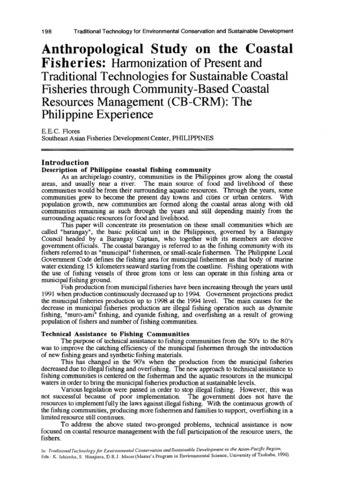
Anthropological study on the coastal fisheries: harmonization of present and traditional technologies for sustainable coastal fisheries through community-based coastal resources management (CB-CRM): the Philippine experience.
(Master’s Program in Environmental Sciences, University of Tsukuba, 1996)As an archipelago country, communities in the Philippines grow along the coastal areas, and usually near a river. The main source of food and livelihood of these communities would be from their surrounding aquatic resources. Through the years, some communities grew to become the present day towns and cities or urban centers. With population growth, new communities are formed along the coastal areas along with old communities remaining as such through the years and still depending mainly from the surrounding aquatic resources for food and livelihood. This paper will concentrate its presentation on these small communities which are called "barangay", the basic political unit in the Philippines, governed by a Barangay Council headed by a Barangay Captain, who together with its members are elective government officials. The coastal barangay is referred to as the fishing community with its fishers referred to as "municipal" fishermen, or small-scale fishermen. The Philippine Local Government Code defines the fishing area for municipal fishermen as that body of marine water extending 15 kilometers seaward starting from the coastline. Fishing operations with the use of fishing vessels of three gross tons or less can operate in this fishing area or municipal fishing ground. Fish production from municipal fisheries have been increasing through the years until 1991 when production continuously decreased up to 1994. Government projections predict the municipal fisheries production up to 1998 at the 1994 level. The main causes for the decrease in municipal fisheries production are illegal fishing operation such as dynamite fishing, "muro-ami" fishing, and cyanide fishing, and overfishing as a result of growing population of fishers and number of fishing communities. -
Incidence and causes of mass fish kill in a shallow tropical eutrophic lake (Laguna de Bay, Philippines)
; ; ; ; Romana-Eguia, Maria Rowena; ; (Shiga Prefectural Government, 2001)
Mass fish kills in Laguna de Bay, the largest lake in the Philippines, has been reported as early as in the 1930’s. With the introduction of and development of aquaculture in this lake, considerable attention and concern was focused on the problem. Records of mass fish kill in the lake mainly from unpublished sources and reports from fisherfolk were reviewed and the causes categorized. The data covered the period 1972 to 1998. Among the commercially important fish species affected were milkfish (Chanos chanos), Nile tilapia (Oreochromis niloticus), bighead carp (Aristichthys nobilis), snakehead (Channa striata), catfish (Clarias macrocephalus and C. batrachus, Arius manilensis), silver perch (Terapon plumbeus) and goby (Glossogobius giurus). The first three species are widely used in aquaculture and the rest are important in open water fishery. Sixty percent of mass fish kill incidents were due to low dissolved oxygen with more than half of these cases associated with blue-green phytoplankton blooms. Fish kills due to pollution from agriculture and industries, fish pathogens and other causes are also discussed. The incidence of mass fish kill reached its peak between 1977 to 1986. Records show that the most number of fish kills (80%) occurred between the months of May to September. The lakeshore towns in the central arm of the lake had the highest incidence of fish kill reported with 46% and followed by the west arm of the lake with 38% of all fish kills recorded. -
Socio-economic impacts of shrimp culture
Primavera, Jurgenne (International Foundation for Science (IFS), 1998)
Farmed shrimp contributed 27% of total world shrimp production in 1995 with a volume of 712,000 tonnes ('metric tonnes,' t). Undoubtedly, the shrimp culture industry earns valuable foreign exchange for developing countries and generates jobs across the industry from fry gatherers to growers and processors. However, grave socio-economic consequences — including conversion, expropriation, and privatization of mangroves and other lands; salinization of water and soil; decline in food security; marginalization of coastal communities; unemployment and urban migration; and social conflicts — have followed in the wake of shrimp farm development in the Philippines and other tropical countries. The paper focuses on mangrove ecosystems: the valuation and cost-benefit analysis of their goods and services and the mangrove-offshore fisheries connection. Research gaps in these areas and the need to internalize the ecological and socio-economic costs ('externalities j of shrimp farming are highlighted. Other recommendations include mangrove conservation and rehabilitation, enforcement of existing legislation, and introduction of environment-friendly aquaculture within the broader framework of community-based, integrated coastal area management, eg the traditional, extensive polyculture ponds in Indonesia. -
Philippines
(Asian Productivity Organization, 1996) -
Engineering and deployment of artificial reefs for a community-based fishery resource management project at Mararison Island, Antique, Philippines
(Japan International Marine Science and Technology Federation, 1995)This paper describes the self-initative of the island's inhabitants in the fabrication and deployment of concrete artificial reefs (ARs) using indigenouse materials as well as appropriate technology at Mararison Island, Antique, Philippines. Deployment of ARs is one of the developmental components of SEAFDEC/AQD assisted community-based fishery resource managment project. To determine transport and deployment problems, two prototype prefabricated modules, building blocks and pipe culverts, were deployed in May 1994. The building blocks module consisted of 10 150x200x2000 mm concrete culvert units arranged in pyramidal configuration of 5,4,3,2, and 1 layers. AR modules designed to provide more surface area and crevices were fabricate in segments at a maximum of 1.47 KN/unit to ease transport and deployment.After attaining its concrete strength, the units were manually hauled from fabrication site to a bamboo raft and towed by a motorized bance to the deployment site. The raft have a rectangular opening at the middle where the units were manually lowered, one at a time, useing rope and pully. Local community divers using surface-supplied are compressors assemled the modules in block and in pyramidal configuration. A relatively flat boottom, 18 m water deep, and the presence of exploited coral reefs in the area were among the factors considered in setting up the ARs.