Journal Articles, Conference Papers and Book Chapters by SEAFDEC Staff: Recent submissions
Now showing items 1561-1580 of 1693
-
The use of chemotherapeutic agents in aquaculture in the Philippines
(Asian Fisheries Society, Fish Health Section, 1992)Chemotherapeutants are widely used to treat diseases of fish, specifically shrimp and aquarium fishes in the Philippines. The most commonly treated diseases are luminous vibriosis, filamentous bacterial disease, shell disease, larval mycosis and protozoan infections in shrimp and white spot, velvet disease, fin and tail rot, crustacean and monogenean infections, fungal infections and dropsy in finfishes. These chemicals include chloramphenicol, erythromycin, oxytetracycline, nitrofurans, formalin, malachite green, potassium permanganate, copper sulfate and Neguvon. The indiscriminate use may cause mortalities and morphological deformities in the host, development of resistant strains of bacteria and public health hazards. The Philippine government has embarked on regulating the use of these chemicals. Initially, use of chloramphenicol has been banned in food producing animals. In the near future, rules and regulations on the registration and labelling of these chemicals will be implemented. While these are a welcome development, much still needs to be done. It is recommended that medically important drugs be excluded from aquaculture. The campaign on the careful and restricted use of drugs should be intensified in both drug and aquaculture industries. Further research must be done on the screening of other drugs which are effective and environmentally safe. Lastly, funds should be allocated for research, extension and manpower development in fish health management, specifically, in chemotherapy. -
Toxicity of rotenone to milkfish, Chanos chanos, and tilapia, Oreochromis mossambicus
(Asian Fisheries Society, Fish Health Section, 1992)Milkfish (Chanos canos) and tilapia (Oreochromis mossambicus) were exposed to varying concentrations of rotenone (95-98% active ingredient) to determine the median lethal concentration (LC50). The 1, 6, 12, 24, and 96 h LC50 were 64, 36, 36, 30 and 25µg/1 for milkfish and 172, 123, 91, 86 and 80 µg/1 for tilapia, respectivly, at 28±1oC. In another experiment, O. mossambicus were exposed to a lethal concemtration of rotenone (100µg/1) that had been allowed to age for selected periods of time to determine whether significant degradation occurs within 24h. Mortality after 3 to 24 h exposure in 0 (no aging), 3 and 6 h aged rotenone solution were not significantly different from the control test even after 24 h of exposure. These results inducate that the treated water was no longer toxic to the fish after 12 h and acute toxicity of rotenone ceased towards the end of 12 h at 27 ± 1oC -
Fate and effects of water-borne heavy metals in Penaeus monodon
; Quinitio, Emilia T. (European Aquaculture Society, 1991)
Heavy metals impair the aquaculture of shrimps and the quality of shrimp products. Some heavy metals occur in high amounts particularly in the hepatopancreas and the antennal gland (Gibson and Barker, 1979). This study was performed in order to determine whether copper, iron, and lead are accumulated in the hepatopancreas and the antennal gland extensions running along the hepatopancreas. Furthermore, damages of these metals and cadmium to the hepatopancreas cells were investigated. According to its commercial significance the giant tiger prawn, Penaeus monodon, was chosen as test species.
(European Aquaculture Society, 1991)
Heavy metals impair the aquaculture of shrimps and the quality of shrimp products. Some heavy metals occur in high amounts particularly in the hepatopancreas and the antennal gland (Gibson and Barker, 1979). This study was performed in order to determine whether copper, iron, and lead are accumulated in the hepatopancreas and the antennal gland extensions running along the hepatopancreas. Furthermore, damages of these metals and cadmium to the hepatopancreas cells were investigated. According to its commercial significance the giant tiger prawn, Penaeus monodon, was chosen as test species. -
Modular method of rearing milkfish with artificial feed.
(Asian Fisheries Society. AFS Spec. Publ. 5, 1991)The study was conducted to determine the effectiveness of a practical diet, the profitability of feeding during 2 seasons, and the effect of a diet with coconut oil on the fatty acid profile of milkfish (Chanos chanos ) fingerlings. Milkfish fingerlings of average weight 6.2 g and 10.2 g were reared in earthen ponds of 3 compartments (550, 1,100 and 2,200 m super(2)) using the modular culture system. One month prior to harvest, fish in Treatment 1 were fed a practical diet containing 42% crude protein, 13.1% crude fat and 33.2% nitrogen-free extract while fish in Treatment 2 depended solely on the natural food in the pond. The fish fed during the last month of culture were heavier (141 g) than the unfed fish (100 g) in Experiment 1 (dry season) but had similar weights (44 and 41 g) in Experiment 2 (rainy season). Weight gain of fish in Experiment 1 was significantly higher than in Experiment 2. Varying temperature and salinity during different seasons influenced fish growth and production. Feeding milkfish was not profitable during the cooler months. Fatty acid profile in depot fat of fed fish reflected that of the diet. Palatability tests showed that fed fish were preferred to the unfed fish. -
Growth response and carcass composition of red tilapia fry fed diets with varying protein levels and protein to energy ratios
(Asian Fisheries Society, 1991)An 8-week feeding experiment was conducted with red tilapia (Oreochromis ) fry of 0.160 plus or minus 0.035 g initial weight. Twelve diets of 4 protein levels (25, 30, 35 and 40%) and 3 protein to energy (P/E) ratios (111, 100 and 80 mg protein/kcal) at each protein level were used. The highest growth was attained by fry fed a 40% protein diet with a P/E ratio of 111 mg/kcal. A lower but not a significantly different growth response was attained by fry on a 35% protein diet with a P/E ratio of 111 mg/kcal and a 30% protein diet with a P/E ratio of 100. Protein efficiency ratio was affected by the dietary protein level. Feed conversion ratio was not significantly influenced by the dietary protein level nor the P/E ratio. Carcass moisture content (%) was affected only by the P/E ratio. Carcass moisture content was directly related to the P/E ratio of the diets and was inversely related to the digestible energy (DE) level. Both protein level and P/E ratio significantly influenced carcass lipid content (%) on a dry matter basis but not the ash content. Carcass lipid (5) increased with increasing dietary protein and increasing DE levels of the diet, but decreased with increasing P/E ratio. Carcass protein content decreased significantly with the decrease of P/E ratio and increase of DE level of the diet. -
Survival of yolk-sac larvae of grouper (Epinephelus suillus) under simulated transport conditions.
(European Aquaculture Society. EAS Special Publication No. 15, 1991)Transport of live fish is a routine activity in aquaculture. Various transport techniques have been reported by Berka. Transport of grouper eggs (Epinephelus suillus) between fisheries stations in Thailand is being conducted. However, no report has been made on transport of yolk-sac larvae of this fish. In the Philippines transport of eggs poses difficulties, particularly for hatcheries which are distant from the broodstock rearing site since spawning occurs between 1600 and 1800 h. Eggs can only be collected the following morning and hatching starts around 1200-1300 h (20 h after fertilization). Thus it seems advisable to transport yolk-sac larvae rather than eggs of grouper under such conditions. This study was conducted to determine the feasibility and optimum loading density of transporting grouper yolk-sac larvae for about 2 h. -
Mariculture techniques for Epinephelus sp. in the Philippines
(Philippine Council for Aquatic and Marine Research and Development; French Embassy in the Philippines, 1991)This paper reviews the status of different techniques that are presently practiced for Ephinephelus sp. culture in the Philippines. Constraints and problems encountered as well as possible solutions are also discussed. -
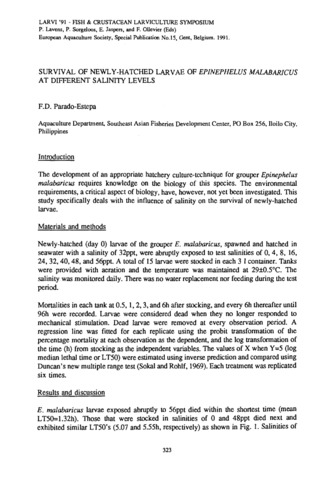
Survival of newly-hatched larvae of Epinephelus malabaricus at different salinity levels.
(European Aquaculture Society. EAS Special Publication No. 15, 1991)The development of an appropriate hatchery culture-technique for grouper Epinephelus malabaricus requires knowledge on the biology of this species. The environmental requirements, a critical aspect of biology, have, however, not yet been investigated. This study specifically deals with the influence of salinity on the survival of newly-hatched larvae. -
An artificial diet for larval rabbitfish Siganus guttatus Bloch.
(Asian Fisheries Society. AFS Spec. Publ. 5, 1991)A 21-day feeding trial was conducted to determine growth, survival and metamorphosis of larval rabbitfish (Siganus guttatus ) fed artificial diets containing approximately 40, 45, 50 and 55% crude protein. Artemia nauplii served as the control feed. Larvae performed equally well on all artificial diets with specific growth rate, % metamorphosis and % survival of 7.80-8.35, 95.2-97.9% and 59.9-70.3%, respectively. In contrast, Artemia -fed larvae exhibited poor growth (5.03) and low survival (51%) possibly due to inadequate feeding level or poor nutritional quality of Artemia . Hence, a diet with 40% protein and estimated energy content of 3,971 kcal kg super(-1) may be used with satisfactory results during hatchery production of rabbitfish. -
Microbound larval feed as supplement to live food for milkfish (Chanos chanos Forsskal) larvae
(European Aquaculture Society, 1991)Highly variable results using Brachionus as food for milkfish (Chanos chanos) larvae may be related to: (1) relatively low content of highly unsaturated fatty acids (HUFAs) in Brachionus and (2) inability of first feeding larvae (day 2) to ingest rotifers in sufficient numbers. Early supplemental feeding with a microbound diet high in HUFAs may improve growth and survival of milkfish larvae. -
Defatted soybean meal and Leucaena leaf meal as protein sources in diets for Penaeus monodon juveniles
(Asian Fisheries Society, 1990)Penaeus monodon juveniles, mean weight 0.38 g, were fed 12 practical diets with 30, 20 or 16% Peruvian fish meal, 15 or 35% defatted soybean meal (DSM), 10% Leucaena leucocephala , leaf meal (LM), and 15% shrimp meal with and without vitamins and/or minerals. The diets contained 42-48% crude protein and 11-13% crude fat. The animals were stocked at 10 per fiberglass tank, and reared in 40 aerated seawater in a flowthrough system for 8 weeks. Growth and survival were not affected by the level of DSM but significantly decreased in prawn fed diets with LM. Feed conversion ratios of prawn were better for complete diets than those where vitamins only were added. Poor feed conversion ratios and specific growth rates were obtained when no vitamins and minerals or only minerals were added to the diets. -
Growth and survival of Oreochromis niloticus, O. mossambicus and their F1 hybrids at various salinities
(Asian Fisheries Society, 1990)Growth and survival of Oreochromis niloticus, O. mossambicus, and their F1 hybrids were studied at various salinities (0-32 ppt) in net cages inside 12-tonne concrete tanks after acclimation. Growth, measured as weight gain, and survival were assessed after three months of culture. Results showed that although O. niloticus, O. mossambicus, and their F1 hybrids can be acclimated and grown at varying salinities, optimum salinity ranges for good growth varied greatly. The salinity ranges for good growth of O. mossambicus and F1 hybrids were wider than O. niloticus. O. mossambicus had the highest growth rates at 15 and 32 ppt. The optimum salinity range for growth of F1 hybrids was 15-32 ppt, while for O. niloticus it was 0-10 ppt. Salinity up to 20 ppt had no significant effect (P>0.05) on survival of all test strains. However, at 25-32 ppt survival of O. niloticus was significantly lower (P<0.05) than that of O. mossambicus and the F1 hybrids. -
Milkfish fry collection and handling
(Food and Agriculture Organization of the United Nations, South Pacific Aquaculture Development Project, 1990)Milkfish fry can be collected in almost all the coastal waters of the tropical Indo-Pacific region. The fry season occurs at different times of the year in various sections of the species' geographical range. The season is longer near the equator and become progressively shorter at higher latitudes. In regions affected by monsoon or trade winds, the peak fry season typically coincides with one or both of the biannual wind shifts. These seasonal peaks are more or less predictable, but fry abundance may vary from year to year. This paper summarizes the methods and practices of collection, storage, transport and acclimation of milkfish fry in various countries. -
Series: Actes de Colloque 9
Mineral requirements of Penaeids
(Institut Francais de Recherche pour l'Exploitation de la Mer, 1990)Marine shrimps absorb minerals from their aquatic environment aside from the minerals that come from the food they eat. Thus, the dietary requirement of shrimps for certain minerals will depend on the amounts and availability of these minerals in the aquatic environment. Dietary sources for growth may be necessary due to losses during moltings. Most of the dietary studies for mineral requirements have been done under laboratory conditions with purified or semi-purified diets and hardly any information is available under practical culture conditions. Most published data for mineral requirements are for juvenile Penaeus japonicus. There are few data for P. monodon, P. californiensis, P. merguiensis, P. aztecus. Calcium and phosphorus are the minerals that have been studied the most. These two have been found to be related to problems of soft-shelling in P. monodon. Apparently calcium and phosphorus requirements are within the range of 1 to 2%. The ratio of calcium to phosphorus in the diet is also an important factor in the efficient utilization of both minerals. It seems that a 1 :1 ratio provides for good growth. Phosphorus deficiency results in reduced growth while lack of magnesium brings about decreased growth, poor survival and reduced feed efficiency in P. japonicus. Iron toxicity has also been observed in P. japonicus. It might not be necessary to include some minerals in the diet of penaeids. -
Heterogeneity in Philippine milkfish populations
(Asian Fisheries Society, 1990)Twelve milkfish (Chanos chanos ) populations from 6 coastal areas in the Philippines, collected at the fry stage and reared until fingerling size, were analysed for electrophoretic variation at 28 presumptive loci. Seven loci were polymorphic at the 0.99 level (5 at the 0.95 level) while 21 were monomorphic. Significant departures from the expected Hardy-Weinberg genotype distributions were observed only at the Pgm locus in samples 843 and 862. G-tests for heterogeneity revealed significant differences in genotype distributions at the Est-1, Gpi-1, Gpi-2, Mp-2 and Pgm loci within each year of sampling, within one location at different sampling years, and within two geographical areas east and west of the Philippines. -
Hormone-induced spawning of cultured tropical finfishes
(IFREMER, 1990)Commercially important tropical freshwater and marine finfishes are commonly spawned with pituitary homogenate, human chorionic gonadotropin (HCG) and semi-purified fish gonadotropins. These preparations are often administered in two doses, a lower priming dose followed a few hours later by a higher resolving dose. Interval between the first and second injections may vary from 3 - 24 hours depending on the species. Variable doses are used even for the same species and may be due to variable potencies of the gonadotropin preparations. Synthetic analogues of luteinizing hormone-releasing hormone (LHRHa) are becoming widely used for inducing ovulation and spawning in a variety of teleosts. For marine species such as milkfish, mullet, sea bass, and rabbitfish, a single LHRHa injection or pellet implant appears to be effective. Multiple spawnings of sea bass have also been obtained following a single injection or pellet implant of a high dose of LHRHa. In a number of freshwater fishes such as the cyprinids, LHRHa alone however has limited efficacy. Standardized methods using LHRHa together with the dopamine antagonists pimozide, domperidone and reserpine have been developed for various species of carps. The technique may also be applicable for spawning marine teleosts that may not respond to LHRHa alone or where a high dose of the peptide is required. Although natural spawning is the preferred method for breeding cultivated fish, induced spawning may be necessary to control timing and synchrony of egg production for practical reasons. -
Bacterial exoskeletal lesions of the tiger prawn Penaeus monodon
(Asian Fisheries Society, 1990)Tank- and pond-reared Penaeus monodon with exoskeletal lesions were examined. The incidence rate was up to 36% for broodstock in concrete tanks and to 20% for pond-reared prawns. The increase in disease incidence was related to prawn age or duration of culture. Bacterial isolation yielded mostly Vibrio spp. Pathogenicity was tested on healthy P. monodon juveniles by a combination of injury and exposure to the test bacteria. Cumulative mortality was 60% within 72 hours in stabbed prawns and 20-40% after 96 hours for superficially-cut prawns. Growth of the bacteria in culture was active in 0.5-8% NaCl and at 12-40 degree C. In-vitro, test isolates were sensitive to chloramphenicol, furazolidone, nitrofurantoin, oxytetracycline and sulfamethoxazole trimethoprim; and resistant to erythromycin, furanace, kanamycin and streptomycin. -
Fisheries biology of milkfish (Chanos chanos Forskal)
Garcia, Luis Maria (Food and Agriculture Organization of the United Nations, South Pacific Aquaculture Development Project, 1990)
Milkfish (Chanos chanos Forskal) is one of the most important food fish species in the world. In Indonesia, Taiwan and the Philippines, more than a quarter of a million tonnes of milkfish are harvested annually in brackish ponds, contributing roughly 60% of the total fish production from aquaculture in Southeast Asia. This tremendous level of production from a single fish commodity is projected to further increase in the coming years to meet the dietary protein needs of an ever-growing population in Southeast Asia. To address vital research gaps afflicting the milkfish industry, research has correspondingly intensified over the past 15 years particularly in the Philippines, Taiwan and Hawaii. Results of such research projects have widespread application not only among Southeast Asian nations but also among many untapped areas in the Pacific, the Middle East, Africa and Central America where milkfish culture is feasible. A sound approach to initiate a milkfish aquaculture project is to have an adequate knowledge of the basic biology of this species. Several researchers have presented in great technical detail some of these biological aspects at numerous symposia (Juario et al., 1984, Lee, Gordon and Watanabe, 1986). This paper will therefore summarize in moderate detail some recent additional information on several aspects of milkfish biology: taxonomy, distribution, life history and habitat, food and feeding habits, growth, reproduction and tolerance to environmental conditions. Aside from increasing our understanding of milkfish, it is hoped that this short review will goad others to undertake further scientific research on many unknown aspects of the species, thus contributing to both the quality and the quantity of milkfish served on our dinner tables. -
Survival of larval milkfish, Chanos chanos, during changeover from endogenous to exogenous energy sources
(Asian Fisheries Society, 1990)Survival of laboratory-reared larvae of milkfish, Chanos chanos , during transition from the prelarval to postlarval stages was examined in relation to the changeover of energy sources. The prelarval and early postlarval stages of the fish can be divided into 5 phases; 1) rapid growth corresponding to rapid yolk less rapid yolk resorption; 3) stagnant growth with rapid yolk resorption, yolk being still the only nutrient for the larvae; 4) stagnant growth based on both yolk and exogenous food, from the onset of feeding to the complete exhaustion of yolk; and 5) rapid growth based solely on exogenous food. The survival rate decreased when the larvae depended solely on yolk, then leveled off when they had both endogenous and exogenous energy sources, and again declined when they came to depend totally on exogenous food. Feeding during the period from the onset of feeding to complete yolk resorption seems important for the successful survival of milk-fish larvae thereafter. -
Milkfish culture in the Philippines
(South Pacific Aquaculture Development Project, Food and Agriculture Organization of the United Nations, 1990)In the Philippines, the level of intensity of Chanos chanos culture is categorized into traditional and extensive management. Pond types for different culture systems, stocking practices, acclimation practices, water management, growout culture and harvesting are discussed. Fish pen culture and management are also briefly considered.