Journal Articles, Conference Papers and Book Chapters by SEAFDEC Staff: Recent submissions
Now showing items 1021-1040 of 1693
-
Lunar synchronization of spawning in sea bass, Lates calcarifer (Bloch): Effect of luteinizing hormone-releasing hormone analogue (LHRHa) treatment
Garcia, Luis Maria (Wiley-Blackwell, 1992)
Based on egg collection records, spontaneous spawning activity of sea bass, Lates calcarifer (Bloch), reared in floating net cages followed a semilunar cycle. The peak of multiple spawnings coincided with declining spring tides of quarter moon periods. Maximum diameter of intra-ovarian, ripe oocytes (0.51–0.55 mm) occurred in synchrony with the quarter moon periods. Smaller oocytes (0.44–0.47 mm) were sampled during the new and full moon periods. Two structural analogues of luteinizing hormone-releasing hormone (LHRHa) (des-Gly10, D-Ala6-LHRH ethylamide and D-Ala6, Pro9-Nethylamide-LHRH), in pelleted or dissolved form, induced mature female sea bass with a mean egg diameter of at least 0.40 mm to spawn at any day during the lunar cycle. The onset of spontaneous and LHRHa-induced spawnings occurred during low tides in the evening until dawn (from 19.00 to 05.00 hours). These results demonstrate that LHRHa can effectively induce mature sea bass to spawn independent of the highly predictable semilunar spawning rhythm. In addition, the occurrence of both spontaneous and hormone-induced spawnings at a precise period of the day suggest a tidal and diurnal cue entraining spawning of mature female sea bass.
(Wiley-Blackwell, 1992)
Based on egg collection records, spontaneous spawning activity of sea bass, Lates calcarifer (Bloch), reared in floating net cages followed a semilunar cycle. The peak of multiple spawnings coincided with declining spring tides of quarter moon periods. Maximum diameter of intra-ovarian, ripe oocytes (0.51–0.55 mm) occurred in synchrony with the quarter moon periods. Smaller oocytes (0.44–0.47 mm) were sampled during the new and full moon periods. Two structural analogues of luteinizing hormone-releasing hormone (LHRHa) (des-Gly10, D-Ala6-LHRH ethylamide and D-Ala6, Pro9-Nethylamide-LHRH), in pelleted or dissolved form, induced mature female sea bass with a mean egg diameter of at least 0.40 mm to spawn at any day during the lunar cycle. The onset of spontaneous and LHRHa-induced spawnings occurred during low tides in the evening until dawn (from 19.00 to 05.00 hours). These results demonstrate that LHRHa can effectively induce mature sea bass to spawn independent of the highly predictable semilunar spawning rhythm. In addition, the occurrence of both spontaneous and hormone-induced spawnings at a precise period of the day suggest a tidal and diurnal cue entraining spawning of mature female sea bass. -
Gonad development of Placuna placenta Linnaeus fed Isochrysis galbana Parke, Tetraselmis tetrahele (G.S. West) Butch, or their combination
(Elsevier, 1992)A study was conducted to determine a suitable algal diet for the window-pane oyster, Placuna placenta Linnaeus, during gonad development. Sexually immature P. placenta (70 mm shell height) were fed Isochrysis galbana Parke, Tetraselmis tetrahele (G.S. West) Butch, or their 1:1 combination, at 100 000 cells per ml divided into two rations per day. Temperature and salinity ranged from 27 to 29 °C and 28 to 32 ppt, respectively. Monthly gonad histological examination showed a rapid gonad development in P. placenta fed the combination of I. galbana and T. tetrahele, attaining sexual maturity in the third month of rearing, a month ahead of those fed single algal species. -
Use of gonad color in sexing broodstock of Placuna placenta (Linnaeus, 1758)
(California Malacozoological Society, Inc., 1992)The window pane oyster, Placuna placenta (Linnaeus, 1758), is a highly valuable bivalve species inhabiting the muddy bottom of coastal bays from the Arabian Sea on the west through the Indian Ocean and Malayan Seas to the coast of China on the east (Hornell, 1909). In the Philippines, P. placenta is extensively collected from the wild because of the high demand for its translucent shell, which is fashioned into various articles exported to the United States and Europe. As a result of overharvesting, P. placenta population in some natural beds are already depleted. Therefore, there is a need to conserve this resource through aquaculture. Hatchery techniques should be developed to produce seeds for reseeding and farming purposes. At the Aquaculture Department of the Southeast Asian Fisheries Development Center (SEAFDEC/AQD), Placuna placenta has been induced to spawn by water flow manipulation (Young, 1980). Other methods such as the addition of gametes, temperature shock, and salinity shock are presently being tried. With these induced spawning methods, there is a need to have a high degree of certainly as to the sex of the animal being used. Further, it is important that the method of sexing does not involve sacrificing the animal. However, it has been reported that sexes in P. placenta can be determined only by gonad histology. Rosell (1979) stated that male and the female P. placenta, which are dioecious, are distinguishable upon histological examination of the gonads, but they are without apparent sexual dimorphism. Macsuci et al. (1980) reported that the sex of P. placenta cannot be differentiated except by microscopic examination. Nevertheless, if gonad color, as seen through the translucent shell, could be proven to be a highly reliable basis for sexing, then this method would be useful in broodstock selection. Therefore, this study was conducted to investigate the use of gonad color for sexing P. placenta broodstock. -
The use of a Visual Implant tag to monitor the reproductive performance of individual milkfish Chanos chanos Forsskal
(Blackwell Publishing, 1992)Nine-year old milkfish (3.8 kg., average body weight) were individually marked with Visible Implant (VI) tags to monitor their reproductive performance following hormonal induction. All tags were retained after one year; only 5 out of 64 tags were not readable due to improper implantation. The advantages of using VI tags include: less tagging time (less than one minute), high retention rate, longer retention, infection-free, and easily readable. -
A simple semi flow-through culture technique for the controlled super-intensive production of Artemia juveniles and adults
(Elsevier, 1992)A simple semi flow-through Artemia culture unit is described for possible integration in marine fish and shellfish hatcheries as source of a cheap nursery diet. The system does not require the use of feeding pumps and involves minimal care. Food preparation and addition to the feeding tank is reduced to one or two manipulations per day during the meta-nauplius stages (day 1–3) and the juvenile stages (day 4–14), respectively. Biomass productions are superior to those reported for stagnant culture systems and are comparable to those demonstrated for flow-through culture units. This simple rearing technique offers the possibility of producing brine shrimp populations with a uniform size. Furthermore, by varying the feeding regime with the Artemia density at the start of the culture, specific Artemia prey sizes corresponding to the daily physical requirements in shrimp and fish hatcheries can be obtained. -
Requirement for tryptophan by milkfish (Chanos chanos Forsskal) juveniles
(Springer Verlag, 1992)Groups of milkfish juveniles (mean initial weight 7.7 g) were fed semipurified diets containing 0.9, 1.4, 2.1, 3.1, 4.1 and 6.1 g tryptophan/kg dry diet for 12 weeks. The mean crude protein content of the diets (containing white fishmeal, gelatin and free amino acid mixture to simulate the pattern of hydrolysed milkfish protein) was 49%. On the basis of the growth response, the tryptophan requirement of milkfish juveniles was estimated to be 3.1 g/kg diet. Fish fed low levels of tryptophan exhibited low weight gains and poor feed conversion ratios. Survival (92–100%) was consistently high in all treatments. Fish fed diets containing tryptophan levels greater than 3.1 g/kg had slightly lower survival rates. The activity of hepatic tryptophan pyrrolase showed no significant differences with increasing dietary tryptophan levels. No nutritional deficiency signs were observed other than the depression in growth rates in fish given the tryptophan deficient diets. -
Market survey of snappers (Genus Lutjanus) from Panay and Palawan waters
(Science and Technology Information Institute, 1992)Thirteen species of snappers (genus Lutjanus) were identified and sourced for location of capture from surveys conducted at the Iloilo Fishing Port and Central Market. They were Lutjanus argentimaculatus,Lutjanus boutton, Lutjanus carponotatus, Lutjanus decussatus, Lutjanus fulviflamma, Lutjanus malabaricus, Lutjanus monostigma, Lutjanus quinquelineatus, Lutjanus rivulatus and Lutjanus vitta. Incidence of lutjanids was year round with a peak in May. Most abundant and commonly observed were Lutjanus vitta, Lutjanus gibbue and Lutjanus argentimaculatus. -
Lipid and fatty acid composition of milkfish (Chanos chanos Forsskal) grown in freshwater and seawater
(Elsevier, 1992)The lipid and fatty acid compositions of the various organs of milkfish fed with an invariant diet and reared in seawater (SW) and freshwater (FW) were determined using column chromatography and gas chromatography. Phospholipid content of the gills, kidney, liver, intestines and depot fat was higher in SW than in FW while the organs from fish in FW had higher contents of neutral lipid. Fatty acid patterns of total lipids in the liver, intestines and depot fat of milkfish reared in FW and SW were similar. There were marked differences in fatty acid patterns of gills and kidney. The proportions of saturated to unsaturated fatty acids in gills and kidney were lower in SW than in FW. Likewise, the ratio of n-3 to n-6 fatty acids and total polyunsaturated fatty acids (PUFAs) of gills and kidney were higher in SW than in FW. The fatty acid patterns of the phospholipid fractions showed that SW-reared milkfish have higher total PUFAs, especially of the n-3 fatty acids, than the FW-reared milkfish not only in gills and kidney but in all organs examined. The differences in lipid and fatty acid composition reflect a physiological response to the salinity in which milkfish were reared. -
The essential fatty acid requirement of milkfish (Chanos chanos Forsskal)
(Springer Verlag, 1992)The essential fatty acid (EFA) requirement of milkfish was examined by a 12-week feeding trial using defined, purified diets at water temperature of 28–29°C and salinity of 32‰. The test diets contained varying levels of 18:0 (triglyceride form, TG), 18:3(n−3), 18:2(n−6) and (n−3) highly unsaturated fatty acids (n−3 HUFA). Milkfish juveniles were starved for 7 days and were than fed lipid-free diet for 30 days before the initiation of feeding trials. Low growth and feed efficiency together with high mortalities were observed in fish fed the lipid-free diet as well as in the EFA-deficient diet. Supplementation of 2% 18:2(n−6) to the tristearin based diet did not improve growth rate of milkfish as effectively as feeding with (n−3) fatty acids. The highest weight gain was obtained in milkfish fed a combination of 5% 18:0 + 1.0% 18:3(n−3) + 0.5% 20:5(n−3) + 0.5% 22:6(n−3) although the supplementation of 2% 18:3(n−3) alone or combination of 0.5% 20:5(n−3) + 0.5% 22:6(n−3) to the tristearin based diets were also effective for improvement of growth. Thus, (n−3) fatty acids, such as 18:3(n−3) and (n−3)HUFA were nutritionally more important than 18:2(n−6) for milkfish. The fatty acid composition of the polar lipids from whole body of milkfish juveniles fed the various test diets were influenced by the composition of the dietary fatty acids. -
Dietary requirement of milkfish (Chanos chanos Forsskal) juveniles for total aromatic amino acids
(Elsevier, 1992)The phenylalanine requirement of milkfish at two dietary tyrosine levels was determined using a 2× 6 factorial feeding experiment. The amino acid test diets (45% crude protein) contained vitamin-free casein and gelatin supplemented with crystalline L-amino acids to provide an amino acid profile similar to milkfish tissue protein except for the test amino acid. The experimental diets consisted of 12 isonitrogenous and isocaloric diets containing six graded levels of phenylalanine (1.18, 1.3, 1.6, 1.9, 2.2, and 2.5% of dry diet) at two levels of tyrosine (0.45 and 1.2% of dry diet). Each of the 12 diets was fed to triplicate groups of 15 milkfish juveniles (initial mean weight = 0.58 ± 003 g) for 12 weeks. Breakpoint linear regression analysis of the growth data estimated the phenylalanine requirement to be 1.90% of the dry diet (4.22% of dietary protein) at 0.45% dietary tyrosine. In the presence of 1.2% dietary tyrosine, the phenylalanine requirement was estimated to be 1.26% of the dry diet (2.80% of dietary protein), suggesting that tyrosine can supply a portion of the total aromatic amino acid requirement thereby sparing phenylalanine. The optimum total aromatic amino acid requirement of milkfish obtained in the study was 5.22% of dietary protein and the replacement value of tyrosine for phenylalanine was computed to be about 46%. Total aromatic amino acid levels higher than 6.88% caused a significant depression of growth in milkfish juveniles. -
Effects of antioxidants on feed quality and growth of Penaeus monodon juveniles
(Wiley-Blackwell, 1992)Four practical diets were formulated to contain 0.05%, of the following antioxidants: butylated hydroxytoluene (BHT), butylated hydroxy anisole (BHA), propyl gallate (PG) or ethoxyquin (ETHQ). A fifth diet, with no added antioxidant, served as a control. The diets were fed to Penaeus monodon juveniles to determine the effects of antioxidants on feed quality and growth of the animals. The results showed no significant difference (P> 0.05) between the control and the feeds containing antioxidants in 2-thiobarbituric acid values after 0, 30, 60, and 90 days storage, respectively. There was a significant difference by the 120th day of storage, but no signs of physical deterioration were observed in any of the diets. The highest weight gains (704% and 742%) were obtained with shrimps fed diets with BHT and BHA, respectively, as antioxidants. Hepatopancreatic lesion formation was evident with shrimps fed diets containing antioxidants but not with shrimps fed a diet without antioxidant. Shrimps fed with BHT-added feed showed fewest lesions in the hepatopancreas. Although all shrimp samples given feed containing PG and ETHQ showed lesions, these were patchy in nature and did not affect the growth rates of the animals. -
Spontaneous maturation and spawning of sea bass Lates calcarifer in floating net cages
(Blackwell Publishing, 1991)Male and female sea bass (Lates calcarifer Bloch) from 1982 wild-caught juveniles reared in floating net cages matured at about 2.0–2.5 years (mean body weight =1.1 kg; mean total length = 42.0 cm) and 3–4 years (2,7 kg; 54.5 cm), respectively. To monitor the occurrence of natural spawning, thirteen females were paired with twenty-eight males in a separate net cage in 1986. A “hapa” net with the same dimension as the net cage was installed to retain the spawned eggs. Spontaneous spawning occurred from June to October. The monthly total number of eggs collected varied from 393,000 to 60 million. Spawning appeared to be related to the lunar phase. Of the 26 recorded spawnings, seventeen took place within four days before or after the first quarter moon, while nine occurred within five days before or three days after the last quarter moon. All spawnings were observed between 1900–2300 hrs. The results demonstrate the feasibility of breeding sea bass in floating net cages, which is relatively cheaper and simpler than other existing methods. -
Cryopreservation of different strains of the euryhaline rotifer Brachionus plicatilis embryos
(Japanese Society of Fisheries Science, 1991)Cryopreserevation of different strains of Brachionus plicatilis symmetrical stage embryos was conducted. One S-type strain, namely Yashima-S (YS), and three L-type strains, namely Yashima-L (YL), Nagasaki (NG), and Hamana (HA), were used. Symmetrical stage embryos in 10% DMSO-28‰ sea water solution were frozen at -196°C using a two-step freezing procedure; the embryos were first cooled slowly from -5°C to -20°C at a rate of 0.3°C/min and then cooled rapidly by direct transfer to liquid nitrogen. Frozen samples were thawed in a gently stirred water bath at room temperature. A mean survival rate of 36% after 30 days storage in liquid nitrogen of HA strain was significantly lower than YS (55%), YL (58%), and NG (54%), and is due likely to its relatively larger embryo volume. There was no significant difference in the intrinsic rate of increase (r) between strains among clones taken from the cryopreservation or unfrozen control group. The results also indicate that various strains of B. plicatilis embryos can be cryopreserve without seriously altering their reproductive capability. The freezing method described could be of great potential in aquaculture and in future studies on rotifer genetics. -
Suitability of different formalin-containing fixatives for the eggs of freshwater Asian catfish Clarias macrocephalus (Gunther)
(Society of Israeli Aquaculture and Marine Biotechnology, 1991)The suitability of different formalin-containing fixatives was tested for the eggs of the catfish (Clarias macrocephalus) by comparing the osmotic pressure of several fixatives with catfish plasma and measuring the size of the eggs at several intervals after fixation. The test solutions consisted of Gilson fluid, 0.5% to 10% buffered formalin, 0.1% to 1% unbuffered formalin with 0.7% sodium chloride (NaCl) and 0.1% to 1% unbuffered formalin with 0.9% NaCl. The osmotic pressure of 1% phosphate-buffered formalin was not significantly different from the catfish plasma, hence it was considered to be the most suitable of all the fixatives tested. Measurement of catfish eggs can be done within 0.5 to 120 hours after fixation in this solution because the rate of swelling (4% to 11% of the size of fresh samples) has been determined. This information is important in induced breeding work of catfish, especially on studies involving the use of egg size. -
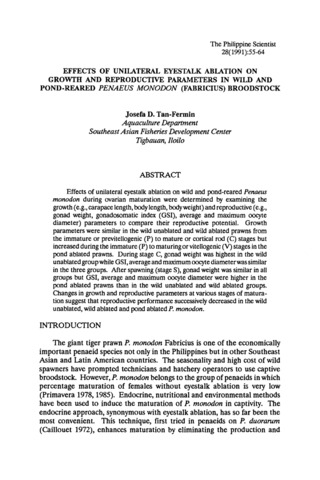
Effects of unilateral eyestalk ablation on growth and reproductive parameters in wild and pond-reared Penaeus monodon (Fabricius) broodstock
(San Carlos Publications, University of San Carlos, 1991)Effects of unilateral eyestalk ablation on wild and pond-reared Penaeus monodon during ovarian maturation were determined by examining the growth (e.g., carapace length, body length, body weight) and reproductive (e.g., gonad weight, gonadosomatic index (GSI), average and maximum oocyte diameter) parameters to compare their reproductive potential. Growth parameters were similar in the wild unablated and wild ablated prawns from the immature or previtellogenic (P) to mature or cortical rod (C) stages but increased during the immature (P) to maturing or vitellogenic (V) stages in the pond ablated prawns. During stage C, gonad weight was highest in the wild unablated group while GSI, average and maximum oocyte diameter was similar in the three groups. After spawning (stage S), gonad weight was similar in all groups but GSI, average and maximum oocyte diameter were higher in the pond ablated prawns than in the wild unablated and wild ablated groups. Changes in growth and reproductive parameters at various stages of maturation suggest that reproductive performance successively decreased in the wild unablated, wild ablated and pond ablated P. monodon. -
Effects of unilateral eyestalk ablation on ovarian histology and oocyte size frequency of wild and pond-reared Penaeus monodon (Fabricius) broodstock
(Elsevier, 1991)Effects of eyestalk ablation on ovarian maturation of wild and pond-reared Penaeus monodon were determined to compare their reproductive potential. This was done by counting the oocyte size frequency in four regions of the ovary and comparing the percentage of each cell type present at each stage of maturation per group. Sampling of ablated prawns was done during three maturation or spawning periods within the first molt cycle after ablation. It took 5 and 14 days for wild and pondreared prawns, respectively, to show signs of ovarian maturation after ablation. Percentage of proliferating cells, the smallest germinal cells in the prawn ovary, was higher in wild unablated (8.3%) than ablated (2.5–5.0%) groups. Significant differences were observed in all cell types at different stages of maturation. In both unablated and ablated prawns, there was a uniform development of the whole ovary and similar occurrence of atresia at all stages. The presence of bigger oocytes in the ovaries of ablated prawns sampled after spawning provided histological evidence for lower number of eggs per spawn and faster rematuration. -
Evaluation of different supplemental feeds for milkfish (Chanos chanos) reared in brackishwater ponds
(Elsevier, 1991)The effects of supplemental feeding on milkfish growth, production, survival, water quality, and economic benefits in brackishwater ponds were evaluated by comparing a rice bran diet, containing 11.3% protein, and two pelleted diets, containing 22.0% and 27.4% protein, with an unfed control. Four 800-m2 tide-fed ponds, subdivided into quarters, were used. Each treatment was replicated in four random pond compartments. Milkfish with initial average weight of 1 g were stocked at 8000/ha and feeding commenced when the average weight and standing crop were 57 g and 417 kg/ha, respectively. All supplemental feeds significantly (P<0.05) increased growth and production over the unfed control. Feeding diets containing 22.0% and 27.4% protein resulted in 35.3% and 46.7% higher net profits, respectively, whereas feeding rice bran resulted in a 34.4% lower net profit when compared to the unfed control. The growth of milkfish became significantly slower (P<0.01) than those fed the 27.4% protein diets when the standing crop of unfed and rice bran-fed fish reached 535 kg/ha and fish fed the 22.0% protein diet reached 972 kg/ha. Survival was not significantly different among the treatments. The concentration of metabolites in the culture water for all treatments was low but a significant increase (P<0.05) in level of total carbon dioxide and nitrite-nitrogen was observed as biomass increased. -
Effects of fiber in supplemental feeds on milkfish (Chanos chanos Forsskal) production in brackishwater ponds
(Asian Fisheries Society, 1991)The study explores the nutritive value of fiber in supplemental feeds for milkfish. The feeding rates were adjusted so that all treatments involved equal protein-N load (6 g·kg-1 fish/day), and varying energy and fiber loads. Rice hull provided the bulk of dietary fiber. Fresh chicken manure, containing 16% protein, served as control. Four 800-m2 earthen ponds divided into four compartments were used. Milkfish juveniles (29 g) were stocked at 7,000·ha-1. After three months of culture, milkfish growth and production and protein efficiency ratio were significantly higher (α = 0.05) in fed ponds than in manured ponds. Average yield and manure conversion ratio in manured ponds were 436 kg·ha-1 and 14.5, respectively. There was no significant difference in yields (600-624 kg·ha-1) between feed treatments. Fish exposed to low protein/33% fiber diet had a worse feed conversion ratio (5.8) than those exposed to high protein/15 or 24% fiber diets (3.6). The results indicate that energy was not limiting in the high fiber (24%) treatment compared to low fiber (15%), but additional fiber (33%) did not further improve growth; and fiber in low protein diets was utilized further as a direct or indirect source of energy. Thus, a low protein/high fiber diet can be an economical way of increasing milkfish production in brackishwater ponds. -
Utilization of feed and rice straw compost for milkfish, Chanos chanos, production in brackishwater ponds
(Blackwell Publishing, 1991)The study was undertaken to determine the effect of 0, 25, 50 and 75% replacement of organic matter in the feed with rice straw compost on milkfish (Chanos chanos) growth and production. Treatments have similar organic matter and nitrogen loads. Up to 50% substitution (Treatments 1 to 3) was possible without significantly affecting fish growth and yield (668–725 kg/ha). A significant reduction in growth and yield (456 kg/ha) with 75% substitution (Treatment 4) implies that organic matter from compost did not contribute much to fish growth. Low phosphorus content of compost and inadequate phosphorus load in spite of increasing mineral input from compost resulted in similar primary productivity in all treatments. It appeared that compost was not a satisfactory feed substitute and that the fish derived most of their nutrition from the feed. The results further suggest that yield could be economically increased by using a low protein diet (23.8%) given at a lower rate (1.75% of body weight). To further improve yield, feeding rate can be gradually increased as biomass increases, although the most cost-effective ration will depend on the fish capacity to grow under certain environmental conditions. -
Influence of stocking density and fertilization regime on growth, survival and gross production of Penaeus monodon Fabricius in brackishwater ponds
(Society of Israeli Aquaculture and Marine Biotechnology, 1991)Twelve 0.1 ha earthen ponds were stocked at 3,500 or 7,000/ha with 1-month old nursery reared Penaeus monodon Fabricius (1.73 g). Fertilizer treatments were 125 kg chicken manure plus 4.1 kg diammonium phosphate (18-46-0) and 6.56 kg urea (45-0-0) per application for treatments U3500 and U7000 and 125 kg chicken manure plus 8.15 kg diammonium phosphate and 0.89 kg urea per application for treatments P3500 and P7000. Fertilizers were broadcast 10 days after pest eradication and every two weeks thereafter. Water was exchanged (20%) one day before fertilization throughout the 86-day culture period. Shrimp yields at harvest were: P7000, 193.6 kg/ha; P3500, 119.4 kg/ha; U3500, 97.5 kg/ha; and U7000, 82.4 kg/ha. Mean survival for each treatment was 96.2%, 97%, 89.3% and 75%, respectively. There were significant differences in shrimp yields at harvest among treatments (p < 0.05).