Risk analysis in aquaculture


Share
นามธรรม
The information presented in this paper were taken from several key FAO documents. The objective is to continuously raise awareness about the concept of risk analysis and its application to the aquaculture sector.The paper provides information in response to several key risk questions, e.g.: (1) what is risk versus hazard, (2) what is risk analysis, (3) who uses risk analysis, (4) why do countries need to be able to use risk analysis? An overview of the risks in aquaculture is also provided in terms of the process and approaches; and the different risk sectors in aquaculture.The paper concludes with some key points and challenges. Risk analysis is a decisionmaking tool that contributes to protecting national health and welfare. It can also contribute to sustainable aquaculture and the success of individual aquaculture businesses and operations. Risk analysis does not stand alone - it supports and is supported by other components of a National Strategy on Aquatic Animal Health. A basic strength of the risk analysis process is its flexibility - it is adaptable to almost any sector/system where risk and uncertainty occur.Countries will often be confronted with a lack of scientific information, both quality and quantity, to support the risk analysis process. Nevertheless, governments must often act under these uncertainties as well as make decisions in the face of a great deal of complexity, significant variability, and multiple management goals.
การอ้างอิง
Bondad-Reantaso, M. G. (2019). Risk analysis in aquaculture. In E. A. Tendencia, L. D. de la Peña, & J. M. V. de la Cruz (Eds.), Aquatic Emergency Preparedness and Response Systems for Effective Management of Transboundary Disease Outbreaks in Southeast Asia: Proceedings of Asean Regional Technical Consultation, 20-22 August 2018, Centara Grand Central Ladprao, Bangkok, Thailand (pp. 85-91). Tigbauan, Iloilo, Philippines: Aquaculture Department, Southeast Asian Fisheries Development Center.
Type
Conference paperISBN
9789719931089Related items
Showing items related by title, author, creator and subject.
-
OIE international standards on aquatic animals
(Aquaculture Department, Southeast Asian Fisheries Development Center, 2019)The World Organisation for Animal Health (OIE) is the intergovernmental organisation responsible for improving animal health worldwide. It is recognised as a reference organisation by the World Trade Organization (WTO) to develop international standards for animal health and zoonoses; as of May 2018, it counts a total of 182 Members. As the global leader for animal health and welfare standards, the OIE plays an influential role in the prevention, control and information sharing of animal diseases including aquatic animal diseases. The objectives of OIE are to: (1) Ensure transparency in the global animal disease situation; (2) Collect, analyse and disseminate veterinary scientific information; (3) Encourage international solidarity in the control of animal diseases; (4) Safeguard World trade by publishing health standards for international, trade in animals and animal products; (5) Improve the legal framework and resources, national veterinary services and aquatic animal health services; and (6) to provide a better guarantee of food of animal origin and to promote animal welfare. As an international standard setting organisation, the OIE Aquatic Animal Health Code (the Aquatic Code) provides standards for the improvement of aquatic animal health worldwide. It also includes standards for the welfare of farmed fish and use of antimicrobial agents in aquatic animals. The sanitary measures in the Aquatic Code provide international standards on importing and exporting countries for early detection, reporting and control of pathogenic agents in aquatic animals (amphibians, crustaceans, fish and molluscs) and to prevent their spread via international trade in aquatic animals and their products, while avoiding unjustified sanitary barriers to trade. In addition, to provide a standardised approach to the diagnosis of the diseases listed in the Aquatic Code and to facilitate health certification for trade in aquatic animals and aquatic animal products, the OIE also developed the OIE Manual of Diagnostic Tests for Aquatic Animals. OIE Aquatic Animal Code chapter 2.1 Import Risk Analysis provide recommendations and principles for conducting transparent, objective and defensible risk for importing aquatic animals and aquatic animal products. The components of risk analysis are 1) hazard identification, 2) risk assessment, 3) risk management and 4) risk communication. Additionally, the OIE international standards (Code and Manual), World Animal Health Information System, and OIE Tool for the Evaluation of Performance of Aquatic Animal Health Services also provide scientific evidence to the MCs on import risk analysis. -
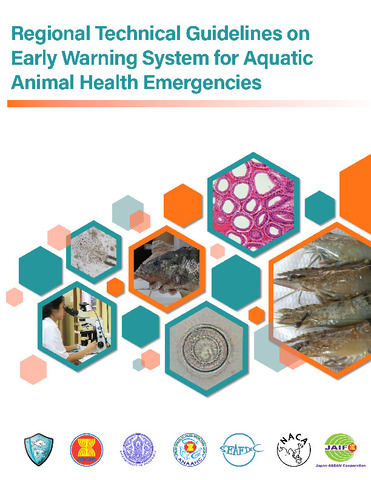
Regional technical guidelines on early warning system for aquatic animal health emergencies
(Aquaculture Department, Southeast Asian Fisheries Development Center, 2020)This Regional Technical Guidelines for Early Warning System on Aquatic Animal Health Emergencies was developed to enumerate the actions to be undertaken by the AMS in case of the occurrence of known, unknown, existing, emerging or re-emerging disease(s). The guidelines identified the key players in aquatic emergency preparedness and response system including their roles and responsibilities. Actions to be undertaken during any disease emergencies were also described. -
FAO TCP/INT/3501: Emergency preparedness and response systems capacity and performance self-assessment survey
(Aquaculture Department, Southeast Asian Fisheries Development Center, 2019)The purpose of this survey is to obtain information on national capacity and the agencies mandated to implement emergency preparedness and response systems with respect to aquatic animal diseases. The results of this survey will help guide regional and national strategic planning with respect to improving aquatic EPR systems, thereby improving aquatic animal health more broadly and assuring adequate and rational support services to achieve sustainable aquaculture development. This FAO questionnaire on aquatic EPR system capacity and performance is a country level self-assessment survey with four sections: (1) general administration, (2) operational components, (3) support systems and (4) additional information.