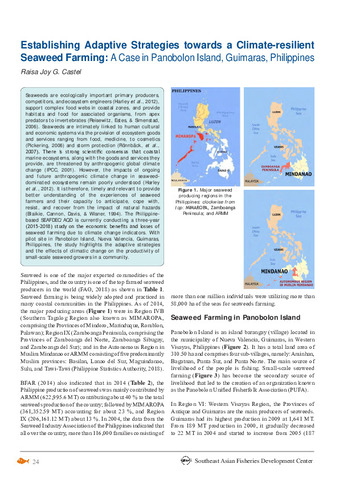
Establishing adaptive strategies towards a climate-resilient seaweed farming: A case in Panobolon Island, Guimaras, Philippines


Share
นามธรรม
Seaweeds are ecologically important primary producers, competitors, and ecosystem engineers (Harley et al., 2012), support complex food webs in coastal zones, and provide habitats and food for associated organisms, from apex predators to invertebrates (Reisewitz, Estes, & Simenstad, 2006). Seaweeds are intimately linked to human cultural and economic systems via the provision of ecosystem goods and services ranging from food, medicine, to cosmetics (Pickering, 2006) and storm protection (Rönnbäck, et al., 2007). There is strong scientific consensus that coastal marine ecosystems, along with the goods and services they provide, are threatened by anthropogenic global climate change (IPCC, 2001). However, the impacts of ongoing and future anthropogenic climate change in seaweeddominated ecosystems remain poorly understood (Harley et al., 2012). It is therefore, timely and relevant to provide better understanding of the experiences of seaweed farmers and their capacity to anticipate, cope with, resist, and recover from the impact of natural hazards (Blaikie, Cannon, Davis, & Wisner, 1994). The Philippine-based SEAFDEC/AQD is currently conducting a three-year (2015-2018) study on the economic benefits and losses of seaweed farming due to climate change indicators. With pilot site in Panobolon Island, Nueva Valencia, Guimaras, Philippines, the study highlights the adaptive strategies and the effects of climatic change on the productivity of small-scale seaweed growers in a community.
การอ้างอิง
Castel, R. J. G. (2018). Establishing adaptive strategies towards a climate-resilient seaweed farming: A case in Panobolon Island, Guimaras, Philippines. Fish for the People , 16(3), 24-27. http://hdl.handle.net/20.500.12066/4331
Type
magazineArticleISSN
1685-6546คอลเลกชัน
- Fish for the People [41]
Related items
Showing items related by title, author, creator and subject.
-
Navigating risks and uncertainties: Risk perceptions and risk management strategies in the Philippine seaweed industry
(Elsevier, 2021-04)The Philippine seaweed industry is affected by multiple but interrelated risks. Farmers mainly encountered environment-related risks (e.g. disease, pest infestations) which, if unmanaged, could result to production failure. Traders and processors considered volatility of seaweed supply and poor quality of raw materials as precursors of other risks such as increased competition among local traders and processing companies. Gender differences in awareness and knowledge of risks were more prominent among seaweed farmers but not among traders and processors as roles become more homogenous up the value chain. Poor governance resulted in the adoption of informal and market-driven strategies to prevent or minimise losses. However, this restricted farmers to participating in higher-income trading and processing activities and contributed to increased market inefficiency. The lack of government support has also curtailed the capacity of traders and processors to engage in product development and diversification. Gender and community experiences influence and shape people’s understanding of their situations and environment including their coping and adaptive strategies in sustaining livelihoods amidst recurring risk events. Embedding informal structures and the differential needs of the stakeholders in the national institutional framework is therefore essential for the promotion of resilient and sustainable seaweed industry. -
Status of seaweed farming in Region 9
(Aquaculture Department, Southeast Asian Fisheries Development Center, 2002) -
What you should know about seaweeds
(Aquaculture Department, Southeast Asian Fisheries Development Center, 1991)