Toxicity of four botanical insecticides to fingerlings of Nile tilapia and common carp


Share
นามธรรม
Static bioassay test was done to determine the toxicity of four botanical insecticides (BI) - Blumea balsamifera leaves, Vitex negundo leaces, Azadirachta indica seeds, Tinospora rumphii stems to fingerlings (0.8 - 1.5g) nile tilapia (Oreochromis niloticus) and common carp (Cyprinus carpio). Median lethal concentration (g/1) obtained at 96 - hour of exposure for O. niloticus and C. carpio, respectively, were 1.54 and 137 (B. balsamifera), 4.95 and 3.53 (V. negundo), 1.59 and 0.55 (A.indica), and, 0.77 and 2.13 (T. rumphii).
Analysis on the levels of toxicity of each BI showed that A. indica was the most toxic to O. niloticus to C. carpio, at 24 - h of exposure. At 96 - h, however, B. balsamifera and T. rumphii appeared to be the most toxic to O. niloticus while T. rumphii to C. carpio. V. negundo was the least toxic to both test species. Results of this study could be used as basis for field application rates of the test botanicals as piscicide in ponds and as insecticide in pest management rice-fish farming.
Type
Conference paperคอลเลกชัน
- Conference Proceedings [300]
Related items
Showing items related by title, author, creator and subject.
-
Polyculture of bighead carp, common carp and Nile tilapia in cages in Laguna lake
(Fisheries Research Society of the Philippines, 1986)Increasing fish production through polyculture was clearly demonstrated to the fishfarmers in Laguna lake. The rearing of different species of fish of proper number and species combinations had resulted to the efficient utilization of all the available food niches/zones in the lake. Fish production is site specific in Laguna lake. Wide variation in growth increment and fish yield were observed among the different bays and among farm sited within a bay. The final mean weights of the fish species were 355 mg to 2300 g for bighead carp, 32 g to 103.3 g for tilapia and 8.3 g to 1800 g for common carp. -
Demonstration of tilapia-carp polyculture in lowland and highland farms
(Bureau of Agricultural Research, Department of Agriculture, 2007)Technology demonstration was conducted in three selected lowland freshwater ponds in Lucban, Quezon and in three highland ponds in Ifugao. The ponds varied in location, size, water source, and operators. The polyculture system included 60% Nile tilapia, 30% common carp, and 10% bighead carp, seeded at a density of 5/m2. Two lowland ponds had total production of 4,737 and 4,416 kg/ha-yr (8.83 kg/m3 and 6.77 kg/m3). One highland pond yielded 2,786 kg/ha-yr (11.14 kg/m3). Survival rates were better in lowland areas, mostly because the farmer cooperators had better training and more experience. Costs-and-returns analysis showed high profitability of tilapia-carp polyculture. With proper management, polyculture can produce fish and increase farmers‘ incomes, even during the off-season for traditional crops. -
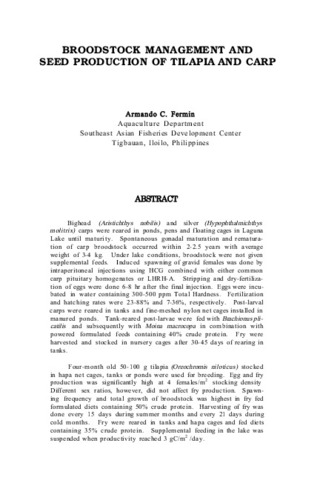
Broodstock management and seed production of tilapia and carp
(Aquaculture Department, Southeast Asian Fisheries Development Center, 1988)Bighead (Aristichthys nobilis) and silver (Hypophthalmichthys molitrix) carps were reared in ponds, pens and floating cages in Laguna Lake until maturity. Spontaneous gonadal maturation and rematuration of carp broodstock occurred within 2-2.5 years with average weight of 3-4 kg. Under lake conditions, broodstock were not given supplemental feeds. Induced spawning of gravid females was done by intraperitoneal injections using HCG combined with either common carp pituitary homogenates or LHRH-A. Stripping and dry-fertilization of eggs were done 6-8 hr after the final injection. Eggs were incubated in water containing 300-500 ppm Total Hardness. Fertilization and hatching rates were 23-88% and 7-36%, respectively. Post-larval carps were reared in tanks and fine-meshed nylon net cages installed in manured ponds. Tank-reared post-larvae were fed with Brachionus plicatilis and subsequently with Moina macrocopa in combination with powered formulated feeds containing 40% crude protein. Fry were harvested and stocked in nursery cages after 30-45 days of rearing in tanks. Four-month old 50-100 g tilapia (Oreochromis niloticus) stocked in hapa net cages, tanks or ponds were used for breeding. Egg and fry production was significantly high at 4 females/m2 stocking density Different sex ratios, however, did not affect fry production. Spawning frequency and total growth of broodstock was highest in fry fed formulated diets containing 50% crude protein. Harvesting of fry was done every 15 days during summer months and every 21 days during cold months. Fry were reared in tanks and hapa cages and fed diets containing 35% crude protein. Supplemental feeding in the lake was suspended when productivity reached 3 gC/m2 /day.