
Evaluation of fish protein concentrate and lactic yeast as protein sources for shrimp feeds
View/
Date
1994Page views
5,519ASFA keyword

AGROVOC keyword
Taxonomic term

Metadata
Show full item recordShare
Abstract
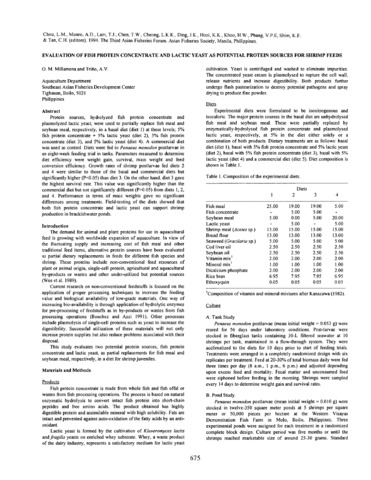
Protein sources, hydrolyzed fish protein concentrate and plasmolyzed lactic yeast, were used to partially replace fish meal and soybean meal, respectively, in a basal diet (diet 1) at these levels; 5% fish protein concentrate + 5% lactic yeast (diet 2), 5% fish protein concentrate (diet 3), and 5% lactic yeast (diet 4). A commercial diet was used as control. Diets were fed to Penaeus monodon postlarvae in an eight-week feeding trial in tanks. Parameters measured to determine diet efficiency were weight gain, survival, mass weight and feed conversion efficiency. Growth rates of shrimp postlarvae fed diets 2 and 4 were similar to those of the basal and commercial diets but significantly higher (P<0.05) than diet 3. On the other hand, diet 3 gave the highest survival rate. This value was significantly higher than the commercial diet but not significantly different (P>0.05) from diets 1, 2, and 4. Performance in terms of mass weights gave no significant differences among treatments. Field-testing of the diets showed that both fish protein concentrate and lactic yeast can support shrimp production in brackishwater ponds.
Type
Conference paperCollections
- Conference Proceedings [300]
Related items
Showing items related by title, author, creator and subject.
-
Earthworm, marine annelids and squid as feed ingredients in formulated diets for juvenile Penaeus monodon
(Aquaculture Department, Southeast Asian Fisheries Development Center, 1985)Earthworm and annelids were incorporated in diets for Penaeus monodon juveniles (mean weight 0.54 g) either in wet or dry form. These protein sources were added in amounts needed to replace 10% of the animal source of protein. Other sources of protein in the diet were shrimp head meal, fish meal, and defatted soybean meal. Diets were computed such that two-thirds of total protein came from animal sources and one-third from vegetable sources. Other components of the diet were rice bran, sago palm starch, cod liver oil and a vitamin-mineral mixture. Another diet, used as maintenance diet, served as control. Postlarvae were randomly stocked at 6 individuals/tank in a flowthrough system with 5 replicates/treatment. Each of the oval fiberglass tanks had three 10-cm diameter PVC pipes for shelter. The prawns were fed 10% of biomass twice daily. Although treatment means for percent weight gain were not significantly different, the diet that contained dried earthworm or annelid meal gave higher weight gain than diets containing the wet form. The earthworm diet gave higher weight gain than diets containing annelids. Survival rate also followed a similar pattern as that of weight gain. Shrimp fed earthworm (wet or dried) gave survival rates numerically higher than those fed marine annelids. Shrimp fed the control diet had survival rates lower than those fed earthworm-containing diets but higher than those fed the wet annelid diet. In another experiment, earthworm or squid was incorporated in the diet. Survival rates of shrimp with earthworm or squid in the diet were significantly higher than those fed the control. Weight gains were not significantly different from each other. Food conversion was generally low. The drawback in the use of earthworm, annelids and squid is that they are relatively expensive compared to fish meal and shrimp head meal. -
FAO policies and initiatives promoting responsible and efficient use of feed ingredients from marine animal origin
(Aquaculture Department, Southeast Asian Fisheries Development Center, 2015)After rapid development for three decades, aquaculture has become the most important source of food fish in Asia, which currently supplies about 55 per cent of food fish for the people. The rapid growth of aquaculture production has been largely the result of intensification of aquaculture, which heavily relies on artificial feeding. The development of shrimp and high value marine and inland finfish culture has greatly increased the demand for feed ingredients from animal sources, particularly fish meal and fish oil and low value fish as direct feed. Due to various factors, the production of fish meal from whole fish has, overall, declined gradually since 2005 despite some fluctuations. This decrease has been only partly offset by a growing share of fish meal production obtained from fishery by-products. In contrast, the overall demand for fish meal continued to grow, pushing prices to historic high at US$1,919 per mt in January 2013, with an increase of 206 percent between January 2005 and January 2013. The soaring price of fish meal and fish oil has significantly affected the economic return from farm production that relies on the feed with high content of fish meal and fish oil or direct use of low value fish as feed. Furthermore, the increasing use of fish meal and fish oil from whole fish that can be direct source of animal food for people has raised major public concerns. Due to the population and economic growth, it is projected that in 2030 the Asia-Pacific region will need to increase fish production by 30 million mt, mainly through aquaculture. With the on-going process of aquaculture intensification and potential increase of high value commodities that require high protein in feed, it is anticipated that demand of Asian aquaculture for feed ingredients, particularly the protein source, will continue to increase. With the stagnant capture fish production and potentially more production to be directed for direct consumption by people, there will be a gap between the demand for feed ingredients and the supply of traditional sources such as fish meal, fish oil and fresh/frozen low value fish. How effectively the gap can be filled might determine the future of the aquaculture industry and whether the increasing demand of people for fish can be met effectively. Therefore, responsible and effective use of feed ingredients from animal sources of marine origin is the key to achieve sustainable growth of aquaculture for food security and nutrition, livelihood development and economic growth in the region. This paper provides a global and regional picture of use of marine origin animal feed and feed ingredients in aquaculture. It also briefly discussed major issues on the use of marine origin animal feed and feed ingredients in aquaculture. It briefly introduced the FAO policy and its global and regional initiatives that promote responsible and efficient use of feed ingredients from marine animal origin. -
Use of plant protein sources in aquafeed for high value marine species in ASEAN member states
(Aquaculture Department, Southeast Asian Fisheries Development Center, 2015)Cultured marine aquatic species are predominantly carnivorous. Major species in the region are seabass, grouper, snapper, tiger shrimp, mangrove crab and abalone. These species, except for abalone, require a high level of dietary protein mostly supplied by marine sources such as fish meal. Global production of marine fish and marine shrimps showed a 3-4 fold increase from 1995 to 2010. For the same period, the usage of commercial feed for production of marine fish and shrimps increased while the fish meal portion in the formulation decreased. This is indicative of fish meal being substituted with alternative sources in commercial feed production, and to some extent the substitution of marine oil which particularly improved the FCR for the marine fish production from 2.0 to 1.9 and for marine shrimps from 2.0 to 1.6. Plant products that include cereal grains, legumes and oilseeds have the most potential among the alternative ingredients for use in aquafeed. The use of these resources for high value marine species is limited due to a variety of anti-nutritional substances they contain. Removal of these substances by processing techniques has improved utilization but with added cost. Hence, fish meal is still the primary source of protein for marine carnivores and its substitution with higher amounts of alternative plant proteins may be difficult compared with lower levels of replacements. The Asian region has accounted for the more than 50% of the total global aquaculture production in 2012 with indications of increased utilization of alternative protein sources in commercial feed production. For the major marine species in the region the increasing trend of plant protein usage with the targeted levels of substitution of fish meal with plant protein sources should be sustainable.


