Review of SEAFDEC/AQD fish nutrition and feed development research


Share
นามธรรม
Research on fish nutrition and feed development at SEAFDEC Aquaculture Department has focused on three major areas: nutrient requirements and their interrelationships, digestive enzymes and digestibility, and practical feed development for important species such as milkfish (Chanos chanos Forsskal), sea bass (Lates calcarifer), Nile tilapia (Oreochromis niloticus), bighead carp (Aristichthys nobilis), and tiger shrimp (Penaeus monodon). Early studies on the nutrient requirements were mainly on protein, lipid and carbohydrate. Studies on essential amino acids and fatty acids, and optimum proteln:energy ratio in the diets for cultured species were conducted later. Likewise, requirements for other essential nutrients in shrimps, like phospholipid and cholesterol, were studied. Dietary calcium and phosphorus required to prevent soft-shelled shrimps were determined. Requirements for water-soluble vitamins and bioavailability of stable forms of vitamin C were evaluated. Little is known of the vitamin and mineral requirements.The major digestive enzymes in milkfish have been studied. The apparent digestibility of common feedstuffs were determined in vivo and in vitro for milkfish and tiger shrimp, and presently, for sea bass. Development of cost-effective practical feed continues to be a major research undertaking at SEAFDEC/AQD. Diet refinement emphasizes on use of inexpensive and indigenous materials in diet formulations. The feasibility of using legumes, leaf meals, and agricultural by-products and wastes as feed components has been demonstrated. Feed and feedstuff quality control and proper processing techniques were found to improve the nutritional value of low-grade raw materials. Improved feeding techniques and practices have been pursued to minimize feeding costs. Studies on the effect of feeds on the environment are being initiated. Economically feasible grow-out diets for semi-intensive culture of milkfish, Nile tilapia, and tiger shrimp, and diets for broodstock and larvae of these species have been developed.
การอ้างอิง
Millamena, O.M. (1996). Review of SEAFDEC/AQD fish nutrition and feed development research. In: C.B. Santiago, R.M. Coloso, O.M. Millamena & I.G. Borlongan (Eds.). Feeds for Small-Scale Aaquaculture. Proceedings of the National Seminar-Workshop on Fish Nutrition and Feeds (pp. 52-63). Tigbauan, Iloilo, Philippines : SEAFDEC Aquaculture Department.
Type
Conference paperคอลเลกชัน
Related items
Showing items related by title, author, creator and subject.
-
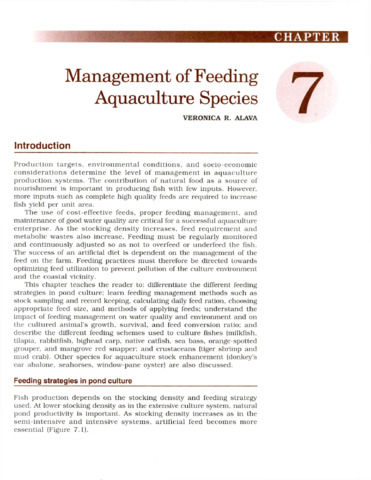
Management of feeding aquaculture species
(Aquaculture Department, Southeast Asian Fisheries Development Center, 2002)This chapter teaches the reader to: differentiate the different feeding strategies in pond culture; learn feeding management methods such as stock sampling and record keeping, calculating daily feed ration, choosing appropriate feed size, and methods of applying feeds; understand the impact of feeding management on water quality and environment and on the cultured animal’s growth, survival, and feed conversion ratio; and describe the different feeding schemes used to culture fishes (milkfish, tilapia, rabbitfish, bighead carp, native catfish, sea bass, orange-spotted grouper, and mangrove red snapper; and crustaceans (tiger shrimp and mud crab). Other species for aquaculture stock enhancement (donkey’s ear abalone, seahorses, window-pane oyster) are also discussed. -
Potential of feed pea (Pisum sativum) meal as a protein source in practical diets for milkfish (Chanos chanos Forsskal)
(Elsevier, 2003)A 12-week feeding trial was conducted to evaluate the use of feed pea meal as a dietary protein source for juvenile milkfish. Six isonitrogenous (30% crude protein) and isocaloric (16.5 kJ/g) practical diets were formulated. The control diet contained fish meal, soybean meal, meat and bone meal and copra meal as principal protein sources. Feed pea meal was progressively substituted at 0%, 5%, 10%, 15%, 20%, 25% and 30% of total protein. A leading commercial milkfish feed was also tested as an additional control. The experimental diets were fed to triplicate groups of milkfish fingerlings (mean initial weight of 0.42±0.01 g) at 10% body weight/day. Growth performance (expressed as percentage of weight gain and SGR), survival, feed conversion ratio (FCR) and protein efficiency ratio (PER) of milkfish fed diets with up to 10% substitution of the dietary protein with feed pea meal were not significantly different (P>0.05) compared to fish fed the control diet. Replacement with feed pea meal at 15% and higher levels led to milkfish fed these diets showing a significantly lower growth response compared to fish fed with the control without any feed pea meal. Nevertheless, it was observed that milkfish fed diets with up to 20% of total dietary protein substitution with feed pea meal showed better growth rates and feed conversion ratios than the commercial feed control. Whole body composition (crude protein, crude fat, crude fiber, nitrogen-free extracts and ash content) of milkfish fed the various test diets was not significantly different. Apparent digestibility coefficients of feed pea meal and experimental diets in milkfish were also determined. Results indicate that feed pea meal is an acceptable protein source and can replace up to 20% of the total dietary protein in milkfish diets. -
A preliminary study on the purified test diet for young milkfish, Chanos chanos
(Aquaculture Department, Southeast Asian Fisheries Development Center, 1976)In studying the nutritional requirements of young milkfish experiments were conducted to develop a purified test diet. Mixtures of the purified constituents tested were: vitamin-free casein, vitamin-free gelatin, supplemented with L-tryptophan and L-cystine as the protein sources; shark liver oil and soybean oil as the far sources; and dextrin as the carbohydrate source. Mineral mixture and vitamin mixture were also added. The results showed that a test diet containing vitamin-free casein supplemented with L-tryptophan as the protein source, was best for the growth of young milkfish. Soybean oil was found to be a better source of fat. Vitamin mixture (4%) and mineral mixture (10%) were observed to promote growth in young milkfish. A purified test diet consisting of vitamin-free casein 60%, L-tryptophan 0.5%, soybean oil 10%, vitamin mixture 4%, mineral mixture 10%, carbohydrate and others 16% was thus suggested for young milkfish.