The plight of older women in a fishing village: The women fish traders of Bugtong Bato, Aklan, central Philippines

Share
Abstract
The changing nature of the fisheries in Bugtong Bato, a small fishing community in Central Philippines has also changed the role of women, particularly of older women, in the community. Until the 1980s, fishing used mainly traditional gears and methods and was highly seasonal. The livelihood activities of men were highly diversified, and fishermen undertook seasonal outmigration to the sugarcane plantations in Negros. Younger women and women of child-bearing age attended to domestic chores, helped their husbands prepare for the day's fishing activities, sought employment as domestic helpers in the capital town or Manila, or engaged in seasonal jobs such as rice harvesting or sinamay fiber knotting. Older women mainly attended to domestic chores. With the introduction of new fishing gears and methods, seasonal outmigration has virtually stopped. The men who participated in group fishing financed by local financiers earn better incomes from these new fishing techniques. However, as fishing now requires longer periods at sea, older fishermen are unable to join their younger counterparts, and rely only on traditional fishing methods for their livelihood. Due to physical limitations and poor health, older fishermen are unable to earn enough to support their families, and their wives seek supplementary means of livelihood. The introduction of new fishing gears and methods has increased considerably the volume of fish landed and spurred the development of a new economic activity in this community - that of fish trading. Most fish traders are older women whose husbands are unable to fish or whose income from fishing cannot meet their daily needs. As such, older women in this community have assumed the role of primary providers for their families.
Suggested Citation
dela Pena, L., & Marte, C. L. (2001). The plight of older women in a fishing village: The women fish traders of Bugtong Bato, Aklan, central Philippines. In M. J. Williams, M. C. Nandeesha, V. P. Corral, E. Tech, & P. S. Choo (Eds.), International Symposium on Women in Asian Fisheries: Fifth Asian Fisheries Forum, 13 November 1998, Chiang Mai, Thailand (pp. 165-172). Penang, Malaysia: ICLARM.
Type
Conference paperKoleksi
- Conference Proceedings [300]
Related items
Showing items related by title, author, creator and subject.
-
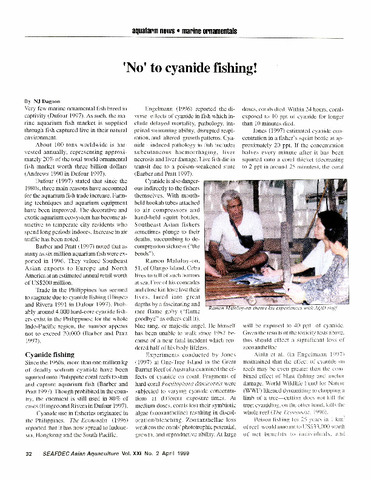
'No' to cyanide fishing!
(Aquaculture Department, Southeast Asian Fisheries Development Center, 1999) -
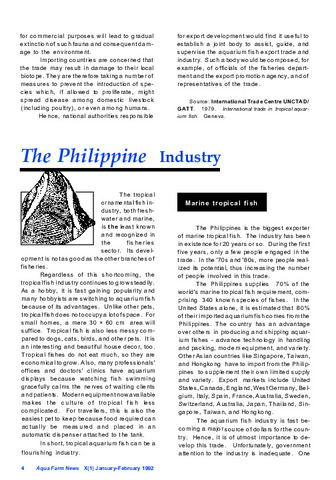
The Philippine industry: Marine tropical fish
(Aquaculture Department, Southeast Asian Fisheries Development Center, 1992) -
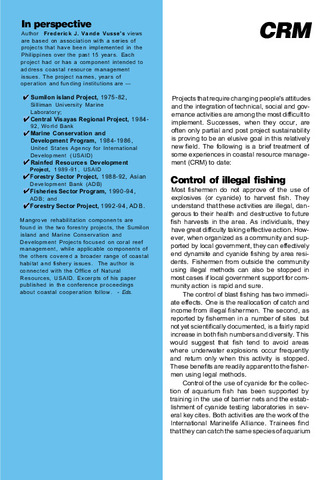
CRM in the Philippines: Lessons learned
(Aquaculture Department, Southeast Asian Fisheries Development Center, 1996)Philippine coastal communities can become capable fishery resource managers and that their management practices can become largely self-sustaining if the project approach focuses on assisting fishermen to learn how to help themselves. Community organization is an essential part of the process and should not be viewed as an end product in itself. There are also no quick fixes, and projects require a complex array of activities if large numbers of coastal residents are to be assisted. In some of these projects, the control of illegal fishing combined with limiting of commercial fishing to offshore areas and good coastal habitat management resulted in a doubling of daily fish catch and income for small-scale fishermen. However, even with the best of management, the total fishery harvest is limited and further increases in individual fishing income can only come from reducing total fishing effort. This will require a system of control on access to the resource to limit the number and kind of fishing gears and to divide the resource equitably. Assisting coastal communities to devise and implement realistic equitable access controls is the major challenge facing coastal resource co-management.