Community-based Fishery Resources Management Project in Malalison Island: Institutional arrangements for fisheries co-management


Share
Abstract
The paper discusses the monitoring mechanism of the SEAFDEC/AQD Community-based Fisheries Resources Management (CFRM) Project at Malalison Island in west central Philippines. The objective of the project was to learn from the collaboration of community organizations, biologists, and social scientists in adapting aquaculture and fishery management techniques and to assess the replicability of the experience to other fishing communities.
The monitoring mechanism used was Process Documentation Research (PDR), a way of recording the development process of a project focusing on the participatory model of the resource management strategy. A full-time, site-based process documentator gathered information. All activities, meetings, and consultations were tape-recorded. Informal talks or encounters with the people were also recorded.
The paper showed that PDR provided a better understanding and insight on the positive and negative perceptions of the project beneficiaries on the CFRM project. Unlike other research monitoring methods that match budget with accomplishments, PDR bares the feelings, hopes, and fears of the project beneficiaries regarding the impact of the project on their lives.
Suggested Citation
Agbayani, R. F., & Babol, A. S. (2001). Community-based Fishery Resources Management Project in Malalison Island: Institutional arrangements for fisheries co-management. In L. M. B. Garcia (Ed.), Responsible Aquaculture Development in Southeast Asia. Proceedings of the Seminar-Workshop on Aquaculture Development in Southeast Asia organized by the Aquaculture Department, Southeast Asian Fisheries Development Center, 12-14 October 1999, Iloilo City, Philippines (pp. 221-229). Tigbauan, Iloilo, Philippines: Aquaculture Department, Southeast Asian Fisheries Development Center.
Type
Conference paperISBN
9718511474Collections
- ADSEA '99 [21]
Related items
Showing items related by title, author, creator and subject.
-
Institutional capacity development for sustainable aquaculture and fisheries: Strategic partnership with local institutions
(Terrapub, 2008)Many people living in the rural areas in the Philippines, as in other developing countries in Southeast Asia, depend on aquatic resources for their food and livelihood. For the past two decades, the Aquaculture Department of the Southeast Asian Fisheries Development Center (SEAFDEC-AQD) has been working with fishing communities and people’s organizations, business sector, local government units, national government agencies, non-government organizations (NGOs) and academic and other research institutions to promote the efficient conservation, management and sustainable development of the country’s fisheries and aquatic resources so that these may continue to serve the needs of the people today and tomorrow. Using the lessons learned from those two decades of multi-sectoral and inter-disciplinary collaborations, SEAFDEC-AQD launched in late 2006 a project called Institutional Capacity Development for Sustainable Aquaculture (ICDSA) to hasten the transfer to and adoption by coastal villagers of appropriate technologies that would enhance the productivity of aquatic resources and at the same time safeguard the fragile balance of the aquatic ecology. The experience of SEAFDEC in coastal resource management shows that it is important to engage the collaboration of the local government units and other “on-the-ground” institutions, such as NGOs and people’s organizations, to be able to introduce effectively any social and technological interventions to target community-beneficiaries. However, before a fruitful collaboration among these institutions could be attained, there is a need to build their capacities, and those of the beneficiaries, for the vital roles that they play in the implementation of livelihood projects and environmental management programs. As of January 2008, SEAFDEC-AQD is implementing ICDSA projects in four provinces—Antique, Capiz, Guimaras and Northern Samar in central Philippines. In the pipeline are similar projects for a province in southern Philippines and two provinces in the north. -
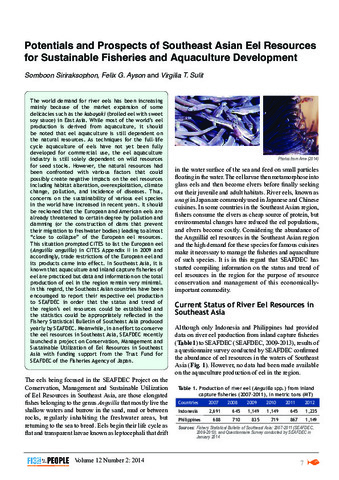
Potentials and prospects of Southeast Asian eel resources for sustainable fisheries and aquaculture development
(Secretariat, Southeast Asian Fisheries Development Center, 2014)The world demand for river eels has been increasing mainly because of the market expansion of some delicacies such as the kabayaki (broiled eel with sweet soy sauce) in East Asia. While most of the world’s eel production is derived from aquaculture, it should be noted that eel aquaculture is still dependent on the natural resources. As techniques for the full-life cycle aquaculture of eels have not yet been fully developed for commercial use, the eel aquaculture industry is still solely dependent on wild resources for seed stocks. However, the natural resources had been confronted with various factors that could possibly create negative impacts on the eel resources including habitat alteration, overexploitation, climate change, pollution, and incidence of diseases. Thus, concerns on the sustainability of various eel species in the world have increased in recent years. It should be reckoned that the European and American eels are already threatened to certain degree by pollution and damming (or the construction of dams that prevent their migration to freshwater bodies) leading to almost “close to collapse” of the European eel resources. This situation prompted CITES to list the European eel (Anguilla anguilla) in CITES Appendix II in 2009 and accordingly, trade restrictions of the European eel and its products came into effect. In Southeast Asia, it is known that aquaculture and inland capture fisheries of eel are practiced but data and information on the total production of eel in the region remain very minimal. In this regard, the Southeast Asian countries have been encouraged to report their respective eel production to SEAFDEC in order that the status and trend of the region’s eel resources could be established and the statistics could be appropriately reflected in the Fishery Statistical Bulletin of Southeast Asia produced yearly by SEAFDEC. Meanwhile, in an effort to conserve the eel resources in Southeast Asia, SEAFDEC recently launched a project on Conservation, Management and Sustainable Utilization of Eel Resources in Southeast Asia with funding support from the Trust Fund for SEAFDEC of the Fisheries Agency of Japan. -
Beginnings: SEAFDEC/AQD, CFRM, and Malalison Island
(Aquaculture Department, Southeast Asian Fisheries Development Center, 1996)The paper documents the community fishery resources management activities of Southeast Asian Fisheries Development Center, Aquaculture Department (SEAFDEC/AQD) in Malalison Island, Antique, Philippines.