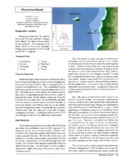
Mararison Island

Share
Suggested Citation
Garcia, L. M. B., Marte, C. L., & Agbayani, R. F. (2002). Mararison Island. In P. M. Aliño, E. F. B. Miclat, C. L. Nañola Jr., H. A. Roa-Quiaoit, & R. T. Campos (Eds.), Atlas of Philippine Coral Reefs (pp. 83-85). Quezon City, Philippines: Goodwill Trading Co., Inc. (Goodwill Bookstore).
Type
Book chapterCollections
- Books and Book Chapters [123]
Related items
Showing items related by title, author, creator and subject.
-
Coral culture and transplantation and restocking of giant clams in the Philippines
(Aquaculture Department, Southeast Asian Fisheries Development Center, 2006)Recently, the Pew Project (2001 to 2005) of the senior author entitled ‘Coral reef habitat and productivity enhancement through coral transplantation and giant clam restocking’ was implemented with the aim to improve the biodiversity and productivity of stressed coral reef habitats in 10 selected demonstration sites in the Philippines. These were meant to serve as models for other communities. Transplantation of corals and reseeding of giant clams were the approaches. Nubbins or small fragments from nearby large coral colonies and abundant solitary forms were transplanted to the target sites. Care was exercised to avoid or reduce any negative impacts on the natural source communities. Only cultured giant clams were used, specifically the threatened Tridacna gigas at sizes that would ensure their chances of survival in the wild (approximately 20-30 cm shell length). Following deployment, monitoring activities were undertaken, focusing on macro-invertebrates and fish, as well as the assessment of the survival and growth of experimental animals. Liaison work was done with local communities to raise their environmental awareness and to ensure their cooperation. This manuscript draws principally from results of the Pew Project. At present, two other restoration projects supported by the European Union and the Global Environment Facility Coral Reef Targeted Research Project are being implemented at the Bolinao Marine Laboratory of the University of the Philippines Marine Science Institute (UP-MSI) in Pangasinan. These projects are testing the efficiency of floating and standing coral nurseries in growing coral nubbins in addition to transplanting fragments or branches of corals to restore degraded coral reefs. -
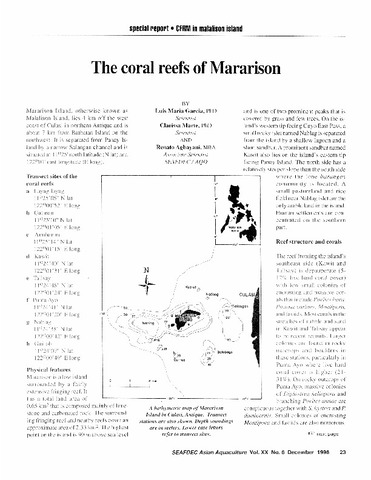
The coral reefs of Mararison
Garcia, Luis Maria ; ; (Aquaculture Department, Southeast Asian Fisheries Development Center, 1998)
-
The coral communities of Mararison Island, Culasi, Antique, Philippines
(University of the Philippines in the Visayas, 2006)An assessment of the extensive fringing reefs surrounding Mararison lsland, Culasi, Antique was undertaken in 1994 to 1996 and in 1998 to provide scientific basis for management and enhancement of the island s resources as part of the Community Fisheries Resource Management project launched in 1991. The fringing reefs on the northwest side of the island are characterized by high percent coral cover (53-65%) consisting of very diverse coral species. The dominant forms are branching non-Acropora,with numerous small colonies of other coral forms. In contrast, the southeast side of the island fronting the fishing village is depau perate (4.7 -17.6% coral cover) with few small colonies of encrusting and massive corals characteristic of stressed reefs. However, highest coral cover consisting of dense stands of branching Acropora interspersed with branching non-Acropora was observed along the reef slope of Nablag station located at the western end of the island. Coral cover in the offshore reef (Guiob) was relatively fair (24%-46%). A total of 166 scleractinian corals were seen although only few species occurred frequently or provided high percent coral cover. Following the bleaching event of 1998, dramatic decreases (30%-61%) in live coral cover, particularly along the reef slopes, were observed in all stations.