Browsing Feeds for Small-scale Aquaculture by Subject "feed preparation"
Now showing items 1-4 of 4
-
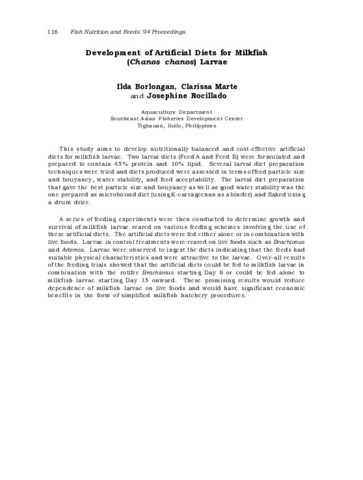
Development of artificial diets for milkfish (Chanos chanos) larvae
(Aquaculture Department, Southeast Asian Fisheries Development Center, 1996)This study aims to develop nutritionally balanced and cost-effective artificial diets for milkfish larvae. Two larval diets (Feed A and Feed B) were formulated and prepared to contain 45% protein and 10% lipid. Several larval diet preparation techniques were tried and diets produced were assessed in terms of feed particle size and bouyancy, water stability, and feed acceptability. The larval diet preparation that gave the best particle size and bouyancy as well as good water stability was the one prepared as microbound diet (using K-carrageenan as a binder) and flaked using a drum drier.A series of feeding experiments were then conducted to determine growth and survival of milkfish larvae reared on various feeding schemes involving the use of these artificial diets. The artificial diets were fed either alone or in combination with live foods. Larvae in control treatments were reared on live foods such as Brachionus and Artemia. Larvae were observed to ingest the diets indicating that the feeds had suitable physical characteristics and were attractive to the larvae. Over-all results of the feeding trials showed that the artificial diets could be fed to milkfish larvae in combination with the rotifer Brachionus starting Day 8 or could be fed alone to milkfish larvae starting Day 15 onward. These promising results would reduce dependence of milkfish larvae on live foods and would have significant economic benefits in the form of simplified milkfish hatchery procedures. -
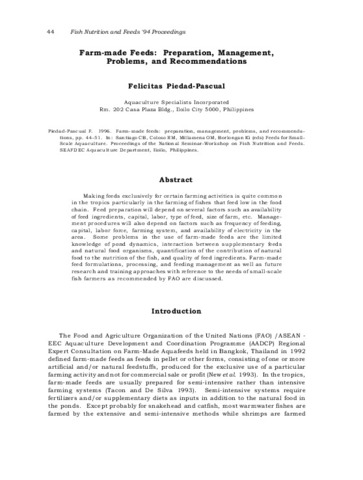
Farm-made feeds: preparation, management, problems, and recommendations
(Aquaculture Department, Southeast Asian Fisheries Development Center, 1996)Making feeds exclusively for certain farming activities is quite common in the tropics particularly in the farming of fishes that feed low in the food chain. Feed preparation will depend on several factors such as availability of feed ingredients, capital, labor, type of feed, size of farm, etc. Management procedures will also depend on factors such as frequency of feeding, capital, labor force, farming system, and availability of electricity in the area. Some problems in the use of farm-made feeds are the limited knowledge of pond dynamics, interaction between supplementary feeds and natural food organisms, quantification of the contribution of natural food to the nutrition of the fish, and quality of feed ingredients. Farm-made feed formulations, processing, and feeding management as well as future research and training approaches with reference to the needs of small-scale fish farmers as recommended by FAO are discussed. -
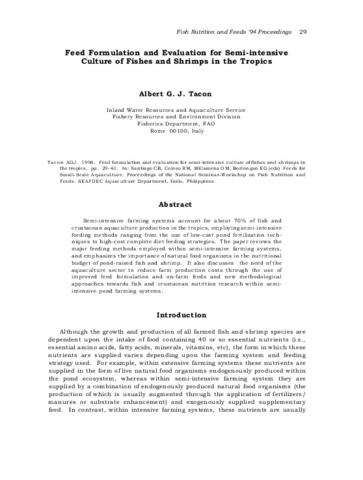
Feed formulation and evaluation for semi-intensive culture of fishes and shrimps in the tropics
(Aquaculture Department, Southeast Asian Fisheries Development Center, 1996)Semi-intensive farming systems account for about 70% of fish and crustacean aquaculture production in the tropics, employing semi-intensive feeding methods ranging from the use of low-cost pond fertilization techniques to high-cost complete diet feeding strategies. The paper reviews the major feeding methods employed within semi-intensive farming systems, and emphasizes the importance of natural food organisms in the nutritional budget of pond-raised fish and shrimp. It also discusses the need of the aquaculture sector to reduce farm production costs through the use of improved feed formulation and on-farm feeds and new methodological approaches towards fish and crustacean nutrition research within semiintensive pond farming systems. -
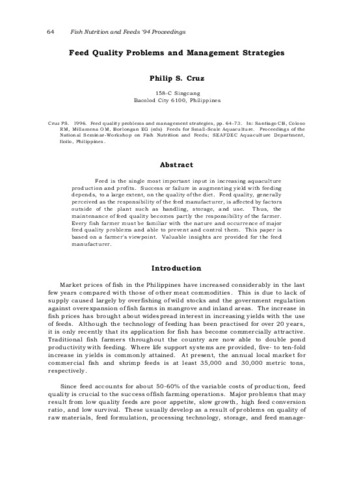
Feed quality problems and management strategies
(Aquaculture Department, Southeast Asian Fisheries Development Center, 1996)Feed is the single most important input in increasing aquaculture production and profits. Success or failure in augmenting yield with feeding depends, to a large extent, on the quality of the diet. Feed quality, generally perceived as the responsibility of the feed manufacturer, is affected by factors outside of the plant such as handling, storage, and use. Thus, the maintenance of feed quality becomes partly the responsibility of the farmer. Every fish farmer must be familiar with the nature and occurrence of major feed quality problems and able to prevent and control them. This paper is based on a farmer's viewpoint. Valuable insights are provided for the feed manufacturer.