Philippine Council for Agriculture, Aquatic and Natural Resources Research and Development (PCAARRD): Recent submissions
Now showing items 1-20 of 69
-
Extension and training programs in support of tilapia farming in the Philippines
(Philippine Council for Agriculture, Forestry and Natural Resources Research and Development, 1987)The Bureau of Fisheries and Aquatic Resources (BFAR), now a staff bureau of the Department of Agriculture (DA), is an agency mandated to look after the national development and management of the fishing industry. It constantly demonstrated its sensitivity towards the attainment of improving the lot of poor fish farmers and fishermen in the countryside. Fisheries, as a major sector of agriculture is expected to push the country s Economic Recovery Program and must be developed to realize its potential contribution. This sector contributed 4.7% at current prices to the Gross National Product (GNP) and 5.0% on constant prices in 1985. The fishing industry directly employs an estimated one million fishfarmers and fishermen. Indirectly, the industry provides employment to household members who are engaged in allied fisheries industries like fish processing, net making, boat building, ice plant and cold storage operation, fish handling, marketing and fish distribution. -
Handling and processing of tilapia
(Philippine Council for Agriculture, Forestry and Natural Resources Research and Development, 1987)Tilapia is a very promising aquaculture species with the development of the aquaculture industry. The commercial value of tilapia varies greatly with size in certain countries like Israel and Africa. In Southeast Asia, size is not an important factor; the market price varies regionally. Although tilapia could compare favorably with other aquaculture products, its flesh being very high in quality, some consumers have a strong objection to its dark skin. Nonetheless, tilapia is currently one of the most important fish crops in most countries of the world. With the improvement of aquaculture technology, tilapia is now grown in fish cages, fishponds and other inland waters. There is no doubt that this has helped increase the production of the aquaculture sector to the total fish production by over 20% in 1983. The 1984 production of tilapia in fish cages was 7,070 kg; for inland fisheries, the production was 22,295 kg; and in fishponds, 10,508 kg. This gave a total value of P485,653 (BFAR Statistics 1981). With appropriate processing technology, tilapia can be manufactured into various products both for human consumption and as feed ingredients which will help increase its commercial value. Tilapia which are too small for human consumption should not be wasted. These can be converted into feed ingredients for livestock feeds or used as baits in commercial fishing. In developing countries like the Philippines where there is an immediate need for protein source, tilapia could be readily available due to subsistence and commercial-scale culture of this fish. -
Marketability of tilapia in Metro Manila
(Philippine Council for Agriculture, Forestry and Natural Resources Research and Development, 1987)The Nile tilapia (Tilapia nilotica) is now accepted in Metro Manila market. The past ten years have shown an increasing trend in the marketability of tilapia. From a price of P5.00 per kilo in 1976, tilapia is now selling at P15.00 per kilo, more or less. The volume of production of this particular fish has increased during the last ten years. The increase in price and volume is very indicative of the acceptability of tilapia in the market. There is no doubt that this fish, when properly cultured, is now considered a quality fish, like milkfish. -
Tilapia marketing in Metro Manila
(Philippine Council for Agriculture, Forestry and Natural Resources Research and Development, 1987)The culture of tilapia in the Philippines has spread across the country. Tilapia production is increasing as reflected in the volume of tilapia unloaded in major fish landings in the country. In Metro Manila, where a large percentage of the country s population is concentrated, tilapia consumption has gained wide acceptance among consumers. The introduction of a new and better tilapia species which is meaty and bigger in size than the first species introduced in the country has ushered in the acceptance of tilapia even among sophisticated consumers in urban areas. While literature on the culture of tilapia abounds, only a few papers on the marketing of this fish have been written, thus leaving much questions on this matter still unanswered. This paper hopes to add to whatever information is available on the marketing of tilapia. Primary focus is given on the marketing of tilapia in Metro Manila. Special emphasis of this paper will be on the distribution, production, price trends and problems in marketing of tilapia in Metro Manila. The data are based on a study conducted among fish traders, wholesalers and retailers and other available information related to the subject. Experiences and observations of the author in marketing tilapia in Metro Manila for the past five years have also been included to add practical relevance to this paper. -
Culture studies on Tilapia sp. under saline conditions at the Brackishwater Aquaculture Center
(Philippine Council for Agriculture, Forestry and Natural Resources Research and Development, 1987)This paper reviews the various researches on tilapia at the BAC with the purpose of disseminating the information so far generated and identifying the gaps in tilapia research under saline conditions. Primary studies on tilapia at BAC were concentrated on increasing production of tilapia in brackishwater ponds and how this targetted production could be obtained more effectively and efficiently. Monoculture and polyculture procedures for tilapias including fertilization and feeding were studied. Forage fish: carnivore fish ratios were established for certain species which could be effective in thinning down the population of young tilapia while allowing the original stocks to grow bigger and at the same time producing fingerlings for restocking. This paper presents the results of various studies on tilapia. -
Commercial production of tilapia in freshwater ponds and cages in the Philippines
(Philippine Council for Agriculture, Forestry and Natural Resources Research and Development, 1987)This paper reviews the state-of-the-art of Nile tilapia production on a commercial scale in Philippine freshwater ponds and cages. Culture practices and problems are also discussed. Commercial production of tilapia as applied here refers to growing of table fish to generate income. -
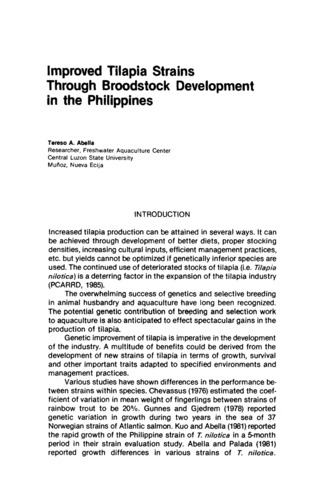
Improved tilapia strains through broodstock development in the Philippines
(Philippine Council for Agriculture, Forestry and Natural Resources Research and Development, 1987)Increased tilapia production can be attained in several ways. It can be achieved through development of better diets, proper stocking densities, increasing cultural inputs, efficient management practices, etc. but yields cannot be optimized if genetically inferior species are used. The continued use of deteriorated stocks of tilapia (i.e. Tilapia nilotica) is a deterring factor in the expansion of the tilapia industry (PCARRD, 1985). -
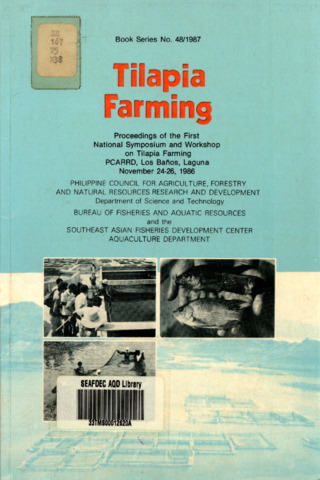
Tilapia Farming: Proceedings of the First National Symposium and Workshop on Tilapia Farming, PCARRD, Los Baños, Laguna, November 24-26, 1986
(Philippine Council for Agriculture, Forestry and Natural Resources Research and Development, 1987) -
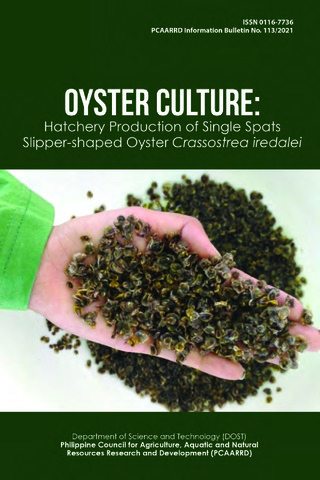
Series: PCAARRD Information Bulletin; No. 113/2021
Oyster culture: Hatchery production of single spats slipper-shaped oyster Crassostrea iredalei
(DOST-PCAARRD, 2021)This manual intends to provide information on the techniques, processes, and recommend practices on hatchery production of single spats slipper-shaped oyster Crassostrea iredalei. This will serve as a guide for hatchery ... -
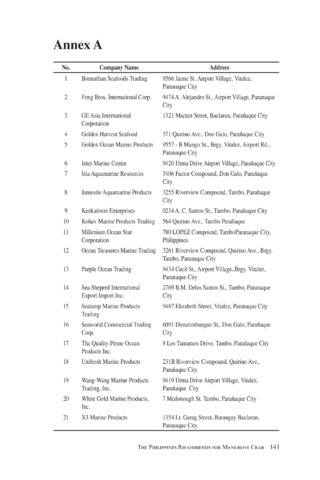
Series: Philippines Recommends Series;No. 100/2021
The Philippines recommends for mangrove crab
(DOST-PCAARRD, 2021) -
[The Philippines recommends for mangrove crab:] Genetics
(DOST-PCAARRD, 2021) -
[The Philippines recommends for mangrove crab:] Postharvest and transport
(DOST-PCAARRD, 2021) -
[The Philippines recommends for mangrove crab:] Soft-shell crab production
(DOST-PCAARRD, 2021) -
[The Philippines recommends for mangrove crab:] Grow-out phase
(DOST-PCAARRD, 2021) -
[The Philippines recommends for mangrove crab:] Culture of crablets
(DOST-PCAARRD, 2021) -
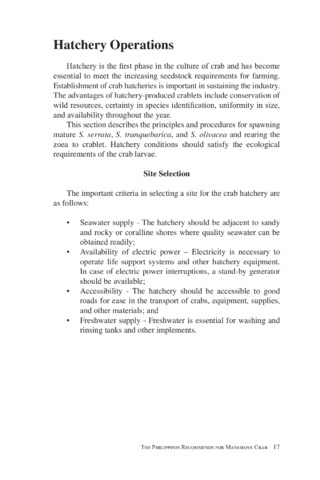
[The Philippines recommends for mangrove crab:] Hatchery operations
(DOST-PCAARRD, 2021) -
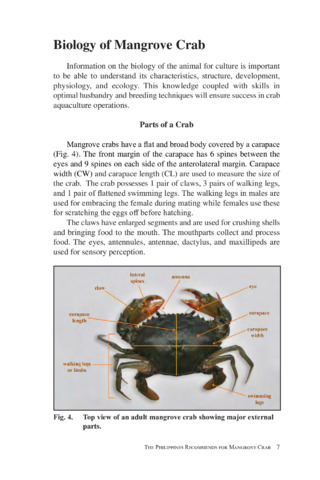
[The Philippines recommends for mangrove crab:] Biology of mangrove crab
(DOST-PCAARRD, 2021) -
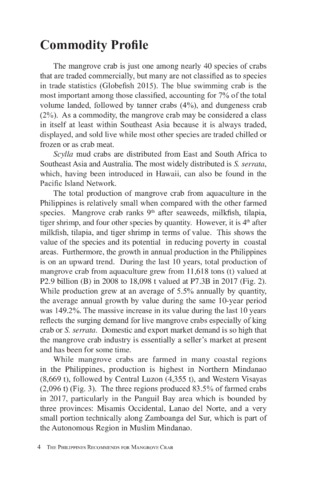
[The Philippines recommends for mangrove crab:] Commodity profile
(DOST-PCAARRD, 2021)