Browsing SEAFDEC/AQD-Rajiv Gandhi Centre for Aquaculture (MPEDA) by Subject "Mud crab"
Now showing items 1-6 of 6
-
Mud crab nursery rearing practices
; Quinitio, Emilia T. ; (Rajiv Gandhi Centre for Aquaculture (MPEDA), 2015)
The need for seeds for expansion of the mud crab industry led to the development of the hatchery technology. The nursery technology was developed as this served as a link between the hatchery, which produces megalopae or early crab instars, and the grow-out phase which requires bigger crab juveniles for a higher yield. The nursery has two phases, the first ending with production of crablets with 1- 1.5 cm carapace width (CW) and the second phase with crablets of 2.5-3.0 cm ICW. The more commonly recommended system employs stocking of megalopae or crab instars in net cages installed in ponds. Locally available unprocessed food and commercially available shrimp formulated diet are used for feeding. However, recent studies have successfully used formulated nursery diet for mud crab. One of the main problems in the nursery is cannibalism, and several strategies have been investigated and tried to address the problem.
; (Rajiv Gandhi Centre for Aquaculture (MPEDA), 2015)
The need for seeds for expansion of the mud crab industry led to the development of the hatchery technology. The nursery technology was developed as this served as a link between the hatchery, which produces megalopae or early crab instars, and the grow-out phase which requires bigger crab juveniles for a higher yield. The nursery has two phases, the first ending with production of crablets with 1- 1.5 cm carapace width (CW) and the second phase with crablets of 2.5-3.0 cm ICW. The more commonly recommended system employs stocking of megalopae or crab instars in net cages installed in ponds. Locally available unprocessed food and commercially available shrimp formulated diet are used for feeding. However, recent studies have successfully used formulated nursery diet for mud crab. One of the main problems in the nursery is cannibalism, and several strategies have been investigated and tried to address the problem. -
Soft-shell crab production using hatchery-produced mangrove crab Scylla serrata juveniles
(Rajiv Gandhi Centre for Aquaculture (MPEDA), 2015)Soft-shell crab production is being practiced in many Asian countries but the major source of seedstock is from the wild, which could no longer sustain the increasing demand. Commercial scale soft-shell crab production can become sustainable only if there is a continuous supply of seedstock not dependent on wild stock. Rajiv Gandhi Centre for Aquaculture (RGCA) under the Marine Products Export Development Authority (MPEDA) has established a pilot-scale mud crab hatchery at Thoduvai, Nagapattinam District, Tamilnadu in 2004 with the technical assistance from SEAFDEC/AQD. At present, RGCA has the biggest mud crab hatchery in India and a demonstration farm at Karaikal, U.T. of Puducherry, where nursery rearing, grow-out and soft-shell crab production are conducted using hatchery- produced mangrove crabs or mud crabs, Scylla serrata. This paper presents the results of the soft-shell crab production using hatcheryproduced S. serrata juveniles maintained in perforated low density polyethylene (LDPE) boxes. The duration of the molt interval, time of molt (day or night) and the increase in body weight and carapace width of each size group (40-60, 61-80, 81-100, 101-120, 121-140, 141-160, 161-180 g) after molting were determined. Results showed that the percentage increase in body weight and carapace width increased as the crabs grew bigger. Likewise, the molt interval was longer in bigger-sized groups of crabs. Sixty to seventy percent of the population molted during night time and the next molt occurred within 25 days in 80-160 g size groups. Soft-shell crabs in boxes within the water surface and juvenile crabs (2.5 cm CW initial size) for culture until market size in the pond can be a viable technology technology for mud crab growers. -
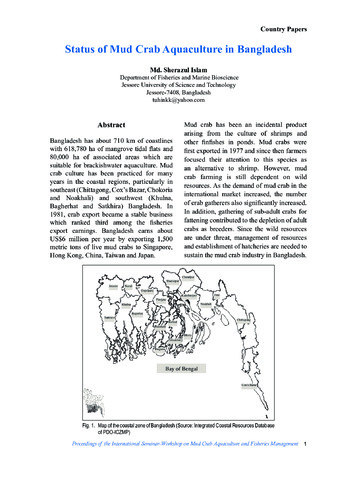
Status of mud crab aquaculture in Bangladesh
(Rajiv Gandhi Centre for Aquaculture (MPEDA), 2015)Bangladesh has about 710 km of coastlines with 618,780 ha of mangrove tidal flats and 80,000 ha of associated areas which are suitable for brackishwater aquaculture. Mud crab culture has been practiced for many years in the coastal regions, particularly in southeast (Chittagong, Cox’s Bazar, Chokoria and Noakhali) and southwest (Khulna, Bagherhat and Satkhira) Bangladesh. In 1981, crab export became a stable business which ranked third among the fisheries export earnings. Bangladesh earns about US$6 million per year by exporting 1,500 metric tons of live mud crabs to Singapore, Hong Kong, China, Taiwan and Japan. Mud crab has been an incidental product arising from the culture of shrimps and other finfishes in ponds. Mud crabs were first exported in 1977 and since then farmers focused their attention to this species as an alternative to shrimp. However, mud crab farming is still dependent on wild resources. As the demand of mud crab in the international market increased, the number of crab gatherers also significantly increased. In addition, gathering of sub-adult crabs for fattening contributed to the depletion of adult crabs as breeders. Since the wild resources are under threat, management of resources and establishment of hatcheries are needed to sustain the mud crab industry in Bangladesh. -
Status of mud crab industry in India
(Rajiv Gandhi Centre for Aquaculture (MPEDA), 2015)Mud crab is an economically important portunid crab species found in estuaries, coastal lagoons and nearshore waters of India. The genetics team of RGCA recently made an attempt to decipher the taxonomic ambiguity of mud crab species commonly available in Indian coastal waters using multiple molecular genetic markers and concluded that only two species of mud crabs, Scylla serrata and S. olivacea are commonly available in India. India has about 8,103 km of coastline with shallow coastal waters, brackishwater lakes, estuaries and intertidal swampy areas along the east and west coasts. It has been estimated that the potential resources of crabs particularly from the 7,770 km2 of estuaries and backwaters is 13,209 tonnes out of the total potential resources of 43,816 tonnes from Indian coastal waters. The southern part of the coast is potentially richer than the northern part. Estimated brackish water area in India is about 1,190,900 ha, out of which 167,193 ha developed for shrimp farming may become suitable for crab farming as evidently seen in Tuticorin, Tamil Nadu. Estimated mud crab culture area in Andhra Pradesh is more than 2,833 ha covering nearly 50 villages. Live mud crab export from India was higher in 2011-2012 (3,054 mt) compared to 2010-2011 (2,963 mt). Frozen and other forms of crab export declined in 2011-2012 (2,848 mt) compared to 2010- 2011 (3,251 mt). Apart from shrimp culture, mud crab farming, fattening and soft-shell crab production are now emerging as feasible business ventures in India. About 11 types of crab products are being exported from India with an average unit value realization of US$ 3.73 kg−1, highlighting its importance in the foreign exchange earnings. There has been a noticeable decline in the mud crab populations in the natural habitat throughout Indian coastal waters due to over exploitation and indiscriminate fishing of juvenile crabs by artisanal fishermen. Wild seeds are collected throughout the year in backwater zones of Sundarbans, Kakdwip and Namkhana of West Bengal; Chilika Lake of Odisha; coastal waters of Kakinada, Visakhapatnam and Rajahmundry of Andhra Pradesh; Pulicat Lake, Killai backwaters, Muthupet saline swamps, Punnakayal estuarine complex and Colachel coastal waters of Tamil Nadu; Neendakara, Cochin and Kozhikode backwaters of Kerala to meet the demand of culture operations. There is an urgent need to produce good quality hatchery seed to meet the demand of farmers. To address this, the Rajiv Gandhi Centre for Aquaculture (RGCA) established a state-ofthe- art mud crab hatchery for commercial scale production of seedstock to promote the adoption of the technology by the private entrepreneurs in the country. -
Status of mud crab industry in Thailand
(Rajiv Gandhi Centre for Aquaculture (MPEDA), 2015)Mud crab is an economically important crustacean commodity in Thailand due to its high nutritional and market value. All the four species of mud crab, Scylla paramamosain, S. olivacea, S. serrata and S. tranquebarica are found in Thailand. The production areas are along the coasts of Gulf of Thailand where S. paramamosain or white mud crab is abundant, and Andaman Sea where S. olivacea or black mud crab is dominant. Data from the Thai Department of Fisheries estimated that the total mud crab production in 2010 was 2,130 mt valued at Baht 322.7 million (US$10.84 million). In the last decade, the production from coastal aquaculture was 6,921 mt valued at Bath 491.4 million (US$16.51 million). The probable cause of the decrease in production is the over exploitation of the wild population. Mud crab culture systems commonly practiced are grow-out (culture from juveniles to market size crabs in ponds), fattening of lean crabs and production of soft-shell crabs. In the past, seedstocks for grow-out culture were collected from the wild. Recently, both wild and hatchery-reared seedstocks are being utilized for farming. Mud crabs for fattening and production of soft-shell rely mainly on wild resources. All culture practices are considered extensive or semiintensive except for soft-shell crab farming which is intensive. The current research and development activities include broodstock and seed production techniques, and formulated feed production. Further technical and financial support are required to improve the survival and production of mud crab. Likewise, support for the transfer of technology to farmers is needed. The lack of seed supply is a major issue facing the mud crab industry in Thailand. A few mud crab hatcheries, which belong to the government, have been established. It is becoming difficult to collect ovigerous females from the wild. Hence, most females are obtained from ponds. Collection of ovigerous females in the wild is prohibited from October to December. Restocking of mud crabs in the natural habitat has become a routine activity to increase the resources. -
Status of mud crab industry in the Philippines
Quinitio, Emilia T. (Rajiv Gandhi Centre for Aquaculture (MPEDA), 2015)
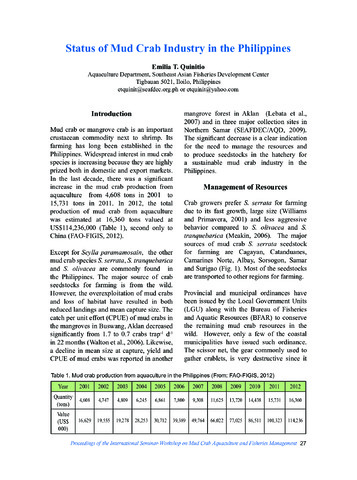
Mud crab farming has long been established in the Philippines. Scylla serrata, S. tranquebarica and S. olivacea are the common species found in the Philippines. S. serrata is the preferred species for farming by crab growers. The total production of mud crab from aquaculture was estimated at 13,720 valued at US$77,025,000 and 14,437 tons valued at US$86,511,000 in 2009 and 2010, respectively. The sources of crab seeds for farming are from the wild and in recent years, from the hatchery although in small percentage. The overexploitation of mud crabs and habitat losses have resulted in both reduced landings and mean capture size. To stem the wild harvest, the provincial and municipal government along with the Bureau of Fisheries and Aquatic Resources have introduced ordinances that prohibit the gathering and selling of crablets (≤ 3 cm) outside the municipality of origin. This resulted to increased acceptability of hatchery-reared crabs by crab growers. Basic technologies in all phases of culture (hatchery, nursery and grow-out) have been developed. However, there are still several issues that need to be addressed. In the hatchery phase, one of the major causes of low survival are the Molt Death Syndrome in which zoea 5 has difficulty molting to megalopa and diseases due to bacterial and fungal infection in eggs and larvae. The use of antibiotics as treatment for Vibrio spp. has proven to improve larval survival. However, the use of antibiotics can lead to the development of resistant strains of bacteria and abnormalities that become apparent at the juvenile stage. In the nursery phase, economic losses have been attributed to cannibalism. Providing sufficient food and shelters, reducing stocking density, size grading and removal or trimming of claws are the common strategies used to mitigate the high level of cannibalism. Recent findings showed that incorporating tryptophan in the diet can reduce the aggressive behavior of crabs. In the grow-out phase, culture of juvenile crabs to market size with one or two more commodities in earthen brackishwater ponds is the most prevalent practice. Due to the cannibalistic nature of mud crab, polyculture (usually with milkfish and shrimp) pond is carried out. Stocking density of each commodity varies with the size and the number of seed stock available and the abundance of natural food growth in the pond. Culture period ranges from 4-5 months. Monoculture of crabs is usually done for short term culture as in fattening in various systems. Mud crab culture is also integrated with the existing mangroves. Formulated diets have been verified in commercial grow-out ponds and showed promising results. Mud crabs are commonly fed with low value fish, molluscs and other unprocessed natural foods. Mortality in mud crabs in grow-out phase is oftentimes due to the white spot syndrome virus. The domestication of S. serrata has been done at SEAFDEC/AQD. The duration from spawning of the base population to F1 broodstock size was 10-14 months and from F1 to F2 was 11-12 months. Selective breeding of S. serrata is currently being done. The results serve as guide to understand and eliminate the obstacles to broodstock management and seed production. Recently, The Department of Science and Technology has funded the National Mud Crab Science and Technology Program being implemented by SEAFDEC/AQD and University of the Philippines Visayas to refine the existing technologies in all phases of culture and to aggressively promote the establishment of several mud crab hatcheries and nurseries in the Philippines. The Bureau of Fisheries and Aquatic Resources is also implementing the Philippine National Aquasilviculture Program, which includes the rehabilitation of mangrove forests and culture of commercially important aquatic animals including mud crab in established mangrove areas. On-site training on all phases of culture of mud crab has also been done by SEAFDEC/AQD not only in the Philippines but also in other countries like Brunei, Myanmar, India and Timor Leste. With the establishment of several hatcheries and nurseries, there will be sufficient seed stock supply for farming, thereby decreasing the dependence on wild stock.