Aquaculture breeding enhancement: Maturation and spawning in sea cucumbers using a recombinant relaxin-like gonad-stimulating peptide

Download URL
www.frontiersin.orgDate
2019-02-19Page views
2,502ASFA keyword

AGROVOC keyword
Taxonomic term

Metadata
Perlihat publikasi penuhShare
Abstract
Wild sea cucumber resources have been rapidly exhausted and therefore there is an urgent need to develop approaches that will help restocking. Currently, there is a lack of information regarding the genes involved in sea cucumber reproductive processes. The neurohormone relaxin-like gonad-stimulating peptide (RGP) has been identified as the active gonad-stimulating peptide in sea stars (Asteroidea), which could also be present in other echinoderm groups. In this study, a sea cucumber RGP was identified and confirmed by phylogenetic analysis. A recombinant Holothuria scabra RGP was produced in the yeast Pichia pastoris and confirmed by mass spectrometry. To assess bioactivity, four levels of purification were tested in an in vitro germinal vesicle breakdown (GVBD) bioassay. The most pure form induced 98.56 ± 1.19% GVBD in H. scabra and 89.57 ± 1.19% GVBD in Holothuria leucospilota. Cruder levels of purification still resulted in some GVBD. Upon single injection into female H. scabra, the recombinant RGP induced head waving behavior followed by spawning within 90–170 min. Spawned oocytes were fertilized successfully, larvae settled and developed into juveniles. Our results provide a key finding for the development of a break-through new artificial breeding approach in sea cucumber aquaculture.
Description
The Supplementary Material for this article can be found online at: https://www.frontiersin.org/articles/10.3389/fgene.2019.00077/full#supplementary-material
Suggested Citation
Chieu, H. D., Turner, L., Smith, M. K., Wang, T., Nocillado, J., Palma, P., Suwansa-ard, S., Elizur, A., & Cummins, S. F. (2019). Aquaculture breeding enhancement: Maturation and spawning in sea cucumbers using a recombinant relaxin-like gonad-stimulating peptide. Frontiers in Genetics , 10, 77. https://doi.org/10.3389/fgene.2019.00077
Type
ArticleISSN
1664-8021Koleksi
- Journal Articles [1267]

Except where otherwise noted, this item's license is described as http://creativecommons.org/licenses/by/4.0/
Related items
Showing items related by title, author, creator and subject.
-
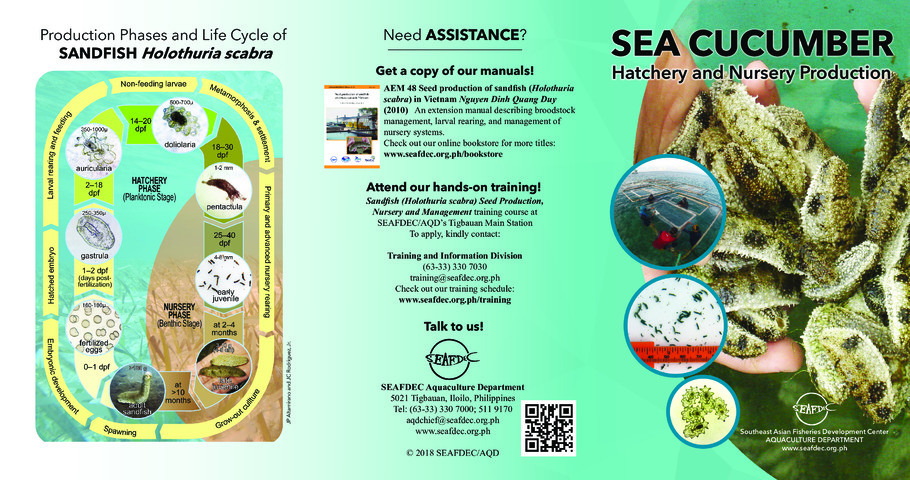
Sea cucumber hatchery and nursery production
(Aquaculture Department, Southeast Asian Fisheries Development Center, 2018)Contains information on the hatchery and nursery culture of the sea cucumber, Holothuria scabra. -
Series: Aquaculture extension manual; No. 69
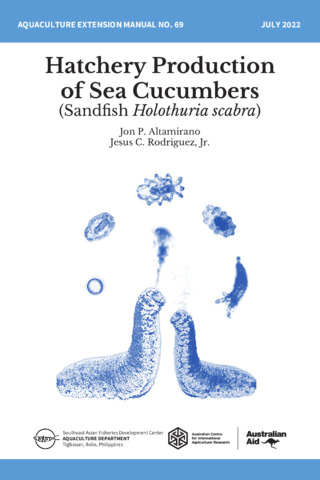
Hatchery production of sea cucumbers (sandfish Holothuria scabra)
Altamirano, JonThis manual, entitled Hatchery Production of Sea Cucumbers (Sandfish Holothuria scabra) includes the consolidated methods, practical protocols and good practices in sea cucumber breeding that were established within the ... ; (Aquaculture Department, Southeast Asian Fisheries Development Center; Australian Centre for International Agricultural Research, 2022-07)
-
Series: ACIAR Proceedings; No. 136
Overview of sea cucumber aquaculture and sea-ranching research in the South-East Asian region
(Australian Centre for International Agricultural Research, 2012)South-East Asia has traditionally been the global centre of production of tropical sea cucumbers for Chinese markets. Early research into culture methods took place outside this region, notably in India, the Pacific region and China. However, recent investment in Holothuria scabra (sandfish) culture has led to some significant advances within this region. The Philippines and Vietnam have been at the forefront of recent efforts, with involvement from substantial national programs and local institutions as well as international donors and scientific organisations. Smaller programs are ongoing in Thailand, Malaysia and Indonesia. Recent advances and simplifications in hatchery techniques are a major step forward, having promoted the development of experimental-scale sea-ranching ventures, and given rise to a small, commercial pond-based culture industry in Vietnam. Technology developments in nursery systems are likely to provide opportunities for culture enterprises in a broader range of environments than is now possible. A major research thrust in the Philippines towards developing cooperative sea-ranching enterprises has demonstrated good potential, and institutional/legislative arrangements to ensure adequate property rights have been tested. Rotational culture with shrimp is proving successful in Vietnam, while the possibility of proximate co-culture of sandfish and shrimp has largely been ruled out. Small-scale experiments in the Philippines raise the possibility of co-culture in ponds with a number of finfish species. Current research directions are looking at diversifying technology to increase success in a range of coastal conditions, better understanding the social and biophysical conditions required for success, and finding ways of effectively scaling-out developed systems and technology.