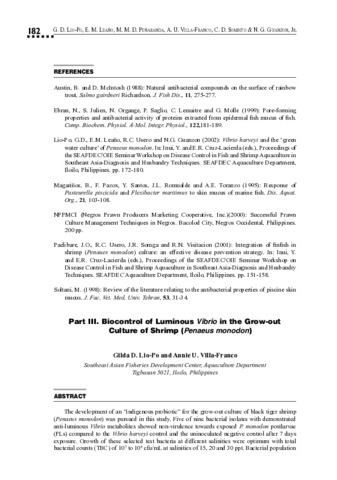
Antibacterial metabolites in the microbial and phytoplankton flora of the "green water" culture of shrimp (Penaeus monodon): Part III. Biocontrol of luminous Vibrio in the grow-out culture of shrimp (Penaeus monodon)
 AQD Access
วันที่
2005-03Page views
3,203ASFA keyword

AGROVOC keyword
Taxonomic term

เมตาดาต้า
แสดงระเบียนรายการเต็มShare
นามธรรม
The development of an “indigenous probiotic” for the grow-out culture of black tiger shrimp (Penaeus monodon) was pursued in this study. Five of nine bacterial isolates with demonstrated anti-luminous Vibrio metabolites showed non-virulence towards exposed P. monodon postlarvae (PLs) compared to the Vibrio harveyi control and the uninoculated negative control after 7 days exposure. Growth of these selected test bacteria at different salinities were optimum with total bacterial counts (TBC) of 107 to 109 cfu/mL at salinities of 15, 20 and 30 ppt. Bacterial population reduction was observed in most bacterial isolates including V. harveyi at 5 ppt. Co-cultivation of the bacterial isolates in pairs with luminous Vibrio demonstrated that most combinations resulted in the loss of their anti-luminous Vibrio properties. Only the co-cultivation of isolates 1213 and 1725 demonstrated consistent maximum inhibition of luminous Vibrio for 24 to 48 hr. Subsequent multiple combinations of four bacterial isolates 508 + 1213 + 1725 + 1896 or 508 + 1213 + 1637 + 1725 were shown to exert maximum anti-luminous Vibrio inhibition in 24 to 48 hr. The application of the “indigenous probiotic” and or Chaetoceros calcitrans in pond waters to shrimp pond soil showed that either or both treatments effectively reduced the luminous Vibrio population in 1-5 days post-exposure causing one to two logs reduction of luminous Vibrio in 5-7 days post-exposure. Penaeus monodon PLs treated with the “indigenous probiotic” before stocking in tanks yielded higher mean survival rates of 62-92% in comparison with the 50% survival rate of untreated control shrimps. The biomass was also higher in treatments where PLs were exposed to the “indigenous probiotic” upon packing at the hatchery source (treatments B, C and D) with weight ranges of 87.04-101.18 g while shrimps in the control tank without treatment (treatment A) or of PLs exposed to the “indigenous probiotic” after transport or upon stocking in tanks (treatment E) had average weights of 79.82 g and 79.43 g, respectively. Overall, both survival rates and biomass were highest in cultured P. monodon exposed to the “indigenous probiotic during transport and with bi-monthly addition (treatment D), yielding a mean weight of 101.18 g and survival rate of 92%. Viability assays of the selected bacteria after inoculation in sterile seawater medium indicated that these remained viable and stable for >45 days. The “indigenous probiotic” when cultivated in varying concentrations of nutrient broth, fish meal and rice bran suspensions, showed a more stable growth in 0.1% nutrient broth and 0.5% fish meal media yielding bacterial populations of 107-108 cfu/mL. Growth depression was observed with rice bran solutions attaining bacterial population levels of only 101-105 cfu/mL. By and large, the development of an “indigenous probiotic” in this study is a significant step towards the biocontrol of luminous vibriosis in the grow-out culture of black tiger shrimp.
การอ้างอิง
Lio-Po, G. D., & Villa-Franco, A. U. (2005). Antibacterial metabolites in the microbial and phytoplankton flora of the "green water" culture of shrimp (Penaeus monodon): Part III. Biocontrol of luminous Vibrio in the grow-out culture of shrimp (Penaeus monodon). In K. Nagasawa (Ed.), Recent Advances in Diagnosis and Prevention of Fish and Shrimp Diseases in Southeast Asia (pp. 182–195). Tigbauan, Iloilo, Philippines: Aquaculture Department, Southeast Asian Fisheries Development Center.
Type
Book chapterISBN
9718511732Related items
Showing items related by title, author, creator and subject.
-
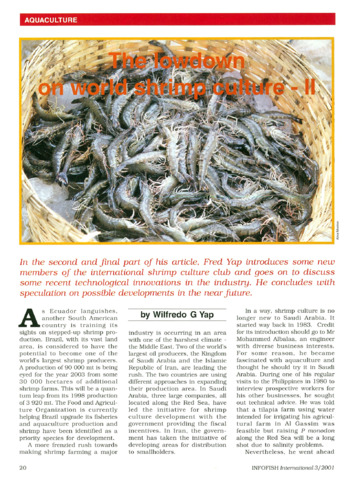
The lowdown on world shrimp culture - II
(INFOFISH, 2001)This paper introduces some new members of the international shrimp culture club and goes on to discuss some recent technological innovations in the industry, particularly the polyculture of tilapia (mainly Oreochromis mossambicus) and shrimp. -
Series: Aquaculture extension manual; No. 19
Prawn hatchery operations
; Quinitio, Emilia T. ; (Aquaculture Department, Southeast Asian Fisheries Development Center, 1996-05)
The manual, an updated version of the 1984 SEAFDEC/AQD manual, presents the underlying principles and step-by-step instructions of prawn larval and post-larval rearing. The techniques described are not only applicable to Penaeus monodon, but may also be modified and applied to other penaeid and metapenaeid species. The following aspects are covered: Site selection; Life cycle; Hatchery design and planning; Hatchery operations; Diseases; and Economics.
; (Aquaculture Department, Southeast Asian Fisheries Development Center, 1996-05)
The manual, an updated version of the 1984 SEAFDEC/AQD manual, presents the underlying principles and step-by-step instructions of prawn larval and post-larval rearing. The techniques described are not only applicable to Penaeus monodon, but may also be modified and applied to other penaeid and metapenaeid species. The following aspects are covered: Site selection; Life cycle; Hatchery design and planning; Hatchery operations; Diseases; and Economics. -
Series: Aquaculture extension manual; No. 19
Prawn hatchery operations
; Quinitio, Emilia T.; (Aquaculture Department, Southeast Asian Fisheries Development Center, 1991-02)
The manual, an updated version of the 1984 SEAFDEC/AQD manual, presents the underlying principles and step-by-step instructions of prawn larval and post-larval rearing. The techniques described are not only applicable to Penaeus monodon, but may also be modified and applied to other penaeid and metapenaeid species. The following aspects are covered: Site selection; Life cycle; Hatchery design and planning; Hatchery operations; Diseases; and Economics.