Macrobrachium culture industry in Thailand
View/

Date
2007Page views
NaNASFA keyword

AGROVOC keyword
Taxonomic term

Metadata
Show full item recordShare
Abstract
There are numerous freshwater prawns classified under the genus Macrobrachium which is generally categorized under the Family Palaemonidae Rafinesque, 1815, sub-family Palaemoninae Rafinesque, 1815. In Thailand, 19 Macrobrachium species that thrive in either freshwater or brackishwater, have been found and identified.
Of the nineteen species, below are the five species identified as the most economically important species for Thailand: Macrobrachium dienbienphuense, Macrobrachium niphanae, Macrobrachium lanchesteri, Macrobrachium sintangense, and Macrobrachium rosenbergii dacqueti.
Suggested Citation
Uraiwan, S., & Sodsuk, P. (2007). Macrobrachium culture industry in Thailand. In M. R. R. Eguia & M. L. C. Aralar (Comps.), Recent developments in the genetic improvement of the giant freshwater prawn (Macrobrachium sp.) (pp. 26–35). Tigbauan, Iloilo, Philippines: Aquaculture Department, Southeast Asian Fisheries Development Center.
Type
Book chapterISBN
9789718511848Related items
Showing items related by title, author, creator and subject.
-
Morphological and genetic diversity assessment of freshwater prawns (Macrobrachium spp.) in the Cairawan river, Antique province, Panay island, Philippines
; Wowor, Daisy ; ; Padilla, Philip Ian ; Romana-Eguia, Maria Rowena R. (National Fisheries Research and Development Institute, 2024)
Freshwater prawns of the genus Macrobrachium are among the most valuable cultured aquatic species in the world. The systematic study of Macrobrachium species in the Philippines has often been based on morphological trait assessment. Here, we combined morphology and molecular approaches to study the presence and actual distribution of Macrobrachium species along the Cairawan River in Laua-an, Antique Province, Panay Island. Using morphological characteristics, we identified 11 Macrobrachium species, the highest number of species reported from a single river. Molecular results based on the cytochrome oxidase subunit I (COI) mitochondrial DNA (mtDNA) sequences confirmed the morphological identification. The analysis revealed eight major clades with 19 distinct haplotypes within the species. Our results provide information on the identification of Macrobrachium species inhabiting the Cairawan River. The baseline information can be helpful for future genetic studies involving freshwater prawns with potential use in aquaculture. It can provide scientific data to facilitate the formulation of selective breeding plans and direct governance policies in freshwater prawn resource conservation and management in the Philippines.
; ; Padilla, Philip Ian ; Romana-Eguia, Maria Rowena R. (National Fisheries Research and Development Institute, 2024)
Freshwater prawns of the genus Macrobrachium are among the most valuable cultured aquatic species in the world. The systematic study of Macrobrachium species in the Philippines has often been based on morphological trait assessment. Here, we combined morphology and molecular approaches to study the presence and actual distribution of Macrobrachium species along the Cairawan River in Laua-an, Antique Province, Panay Island. Using morphological characteristics, we identified 11 Macrobrachium species, the highest number of species reported from a single river. Molecular results based on the cytochrome oxidase subunit I (COI) mitochondrial DNA (mtDNA) sequences confirmed the morphological identification. The analysis revealed eight major clades with 19 distinct haplotypes within the species. Our results provide information on the identification of Macrobrachium species inhabiting the Cairawan River. The baseline information can be helpful for future genetic studies involving freshwater prawns with potential use in aquaculture. It can provide scientific data to facilitate the formulation of selective breeding plans and direct governance policies in freshwater prawn resource conservation and management in the Philippines. -
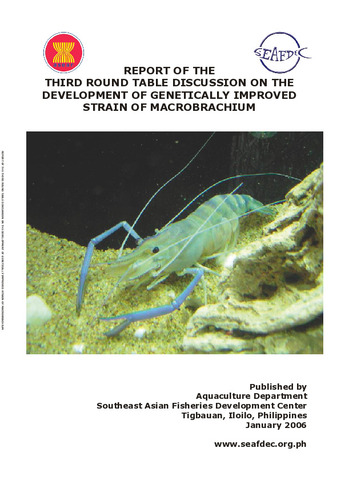
Report of the third round table discussion on the development of genetically improved strain of Macrobrachium, Bangkok, Thailand 3-4 December 2005
(Aquaculture Department, Southeast Asian Fisheries Development Center, 2006-01)In order to continue assessing the progress and status of the activities in the participating countries, the Third Roundtable Discussion was held in Bangkok, Thailand from 3 to 4 December 2005 in order to: 1) assess the ... -
Genetic characterization, domestication and improvement of Macrobrachium rosenbergii in the Philippines
Romana-Eguia, Maria Rowena R.; ; ; ; (Aquaculture Department, Southeast Asian Fisheries Development Center, 2007)
Extensive studies in the Philippines and in adjacent countries revealed that 528 caridean prawn species are found in this region alone (Chan, 1998). Of all the known species, the giant freshwater prawn is considered the most commercially important. Except for the Philippines, culture of the giant freshwater prawn, Macrobrachium rosenbergii, has already made substantial contributions to the local aquaculture production in Southeast Asia, i.e. in Thailand, Malaysia and Indonesia. However, efforts are now being made to improve the aquaculture production of Macrobrachium rosenbergii in the Philippines, thus, optimal methods for the culture and propagation of this high value freshwater aquaculture species are being developed by the Philippine Government fishery agencies as well as other research and academic institutions. The Integrated Rural Aquaculture Program under the ASEAN-SEAFDEC Special Five-Year Program or what is presently known as the Program on the Promotion of Sustainable Aquaculture in the ASEAN Region enabled the Bureau of Fisheries and Aquatic Resources, the Mindanao State University and the Aquaculture Department of SEAFDEC to jointly conduct studies on the genetic characterization, domestication and improvement of Macrobrachium rosenbergii stocks in the Philippines in order to improve the aquaculture production of the giant freshwater prawn. Under the collaborative project which started in late 2004, specific research activities under were conducted, and an update on their results are summarized.