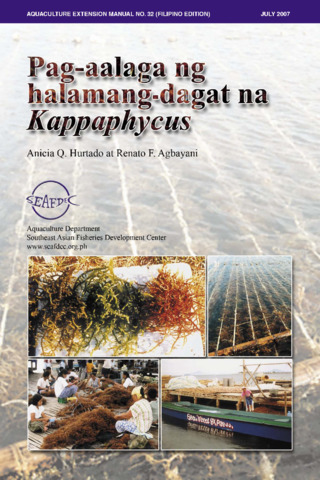
Pag-aalaga ng halamang-dagat na Kappaphycus


Share
Abstract
A 24-page manual that introduces the carrageenan-producing seaweed Kappaphycus whose culture has spread from Jolo in Mindanao to at least 14 sites in the Visayas and Luzon. Four culture methods are presented: fixed off-bottom, raft long-line (single or multiple), hanging long line, and polyculture of seaweeds with carnivorous fishes.
Other versions
EnglishSuggested Citation
Hurtado, A. Q., & Agbayani, R. F. (2007). Pag-aalaga ng halamang-dagat na Kappaphycus (M. R. R. Eguia, Trans.). Tigbauan, Iloilo, Philippines: Aquaculture Department, Southeast Asian Fisheries Development Center.
Type
BookISBN
9718511423Series
Aquaculture extension manual; No. 32Format
27 p. : col. ill.
Collections
Related items
Showing items related by title, author, creator and subject.
-
Navigating risks and uncertainties: Risk perceptions and risk management strategies in the Philippine seaweed industry
(Elsevier, 2021-04)The Philippine seaweed industry is affected by multiple but interrelated risks. Farmers mainly encountered environment-related risks (e.g. disease, pest infestations) which, if unmanaged, could result to production failure. Traders and processors considered volatility of seaweed supply and poor quality of raw materials as precursors of other risks such as increased competition among local traders and processing companies. Gender differences in awareness and knowledge of risks were more prominent among seaweed farmers but not among traders and processors as roles become more homogenous up the value chain. Poor governance resulted in the adoption of informal and market-driven strategies to prevent or minimise losses. However, this restricted farmers to participating in higher-income trading and processing activities and contributed to increased market inefficiency. The lack of government support has also curtailed the capacity of traders and processors to engage in product development and diversification. Gender and community experiences influence and shape people’s understanding of their situations and environment including their coping and adaptive strategies in sustaining livelihoods amidst recurring risk events. Embedding informal structures and the differential needs of the stakeholders in the national institutional framework is therefore essential for the promotion of resilient and sustainable seaweed industry. -
Understanding biosecurity: Knowledge, attitudes and practices of seaweed farmers in the Philippines
(Springer, 2021-01-26)Farmers are one of the most important components of any plant-based cultivation industry. The Philippines is one of the world’s major producers of red carrageenophyte algae and has tens of thousands of farmers involved in this industry. The production of algae such as Kappaphycus and Eucheuma increased significantly from the early 1970s, when the industry was established, before declining from the mid-2000s, due to a number of reasons, including disease and epiphyte outbreaks. The introduction of biosecurity measures has been one approach used to tackle this decline. Biosecurity-related knowledge, attitude and practices (KAP) of the seaweed farmers were assessed in the four highest seaweed producing regions in the Philippines: (1) Tawi-Tawi, (2) Palawan, (3) Zamboanga and (4) Bohol. Analyses showed that seaweed farmers from Tawi-Tawi had relatively higher KAP mean scores than the other three sites. Palawan and Bohol farmers, however, scored lower on their knowledge, higher on their attitude and highest on their practices compared with the other areas. Farmers from Zamboanga scored the lowest in both their attitude and practice mean scores, although their knowledge score was one of the highest. This is the first KAP assessment applied to the seaweed farming industry globally and the results, in which the farmers’ biosecurity-related knowledge and practices, which scored “Fair” (50–75%) across all the regions, and their attitudes, which scored predominantly “Good” (> 75%) suggest that there is potential to raise the score for biosecurity practices. This assessment highlights how biosecurity challenges are currently addressed by seaweed farmers in the Philippines and suggests how the KAP survey could be used as a tool by policymakers and scientists to address gaps in biosecurity management practices. -
Farming seaweeds at SEAFDEC/AQD
(Aquaculture Department, Southeast Asian Fisheries Development Center, 1995)The article presents the practices that have been developed or documented by SEAFDEC Aquaculture Department for farming seaweeds. These practices are: the cage culture of Kappaphycus, and the ‘rice planting’ method for cultivating Gracilaria. The seaweed gathering practices in coastal communities in western Visayas is also presented.