Revisiting the Ligawasan marshland in Mindanao: An indigenous resource management system study towards sustainability

Share
Abstract
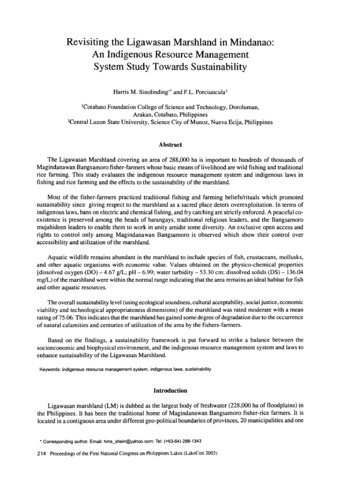
The Ligawasan Marshland covering an area of 288,000 ha is important to hundreds of thousands of Magindanawan Bangsamoro fisher-farmers whose basic means of livelihood are wild fishing and traditional rice farming. This study evaluates the indigenous resource management system and indigenous laws in fishing and rice farming and the effects to the sustainability of the marshland.
Most of the fisher-farmers practiced traditional fishing and farming beliefs/rituals which promoted sustainability since giving respect to the marshland as a sacred place deters overexploitation. In terms of indigenous laws, bans on electric and chemical fishing, and fry catching are strictly enforced. A peaceful coexistence is preserved among the heads of barangays, traditional religious leaders, and the Bangsamoro mujahideen leaders to enable them to work in unity amidst some diversity. An exclusive open access and rights to control only among Magindanawan Bangsamoro is observed which show their control over accessibility and utilization of the marshland.
Aquatic wildlife remains abundant in the marshland to include species of fish, crustaceans, mollusks, and other aquatic organisms with economic value. Values obtained on the physico-chemical properties [dissolved oxygen (DO) - 4.67 g/L; pH - 6.99; water turbidity - 53.30 cm; dissolved solids (DS) - 136.04 mg/L) of the marshland were within the normal range indicating that the area remains an ideal habitat for fish and other aquatic resources.
The overall sustainability level (using ecological soundness, cultural acceptability, social justice, economic viability and technological appropriateness dimensions) of the marshland was rated moderate with a mean rating of 75.06. This indicates that the marshland has gained some degree of degradation due to the occurrence of natural calamities and centuries of utilization of the area by the fishers-farmers.
Based on the findings, a sustainability framework is put forward to strike a balance between the socioeconomic and biophysical environment, and the indigenous resource management system and laws to enhance sustainability of the Ligawasan Marshland.
Suggested Citation
Sinolinding, H. M., & Porciuncula, F. L. (2005). Revisiting the Ligawasan marshland in Mindanao: An indigenous resource management system study towards sustainability. In M. L. Cuvin-Aralar, R. S. Punongbayan, A. Santos-Borja, L. V. Castillo, E. V. Manalili, & M. M. Mendoza (Eds.), Proceedings of the First National Congress on Philippine Lakes (pp. 214-229). Southeast Asian Regional Center for Graduate Study and Research in Agriculture (SEARCA).
Type
Conference paperISSN
1656-8099Collections
- LakeCon2003 [49]
Related items
Showing items related by title, author, creator and subject.
-
Optimization of feeding and growth conditions for hatchery-bred larvae of indigenous Philippine silver perch, Leiopotherapon plumbeus (Perciformes: Terapontidae)
; Aya, Frolan ; ; Romana-Eguia, Maria Rowena R. (Aquaculture Department, Southeast Asian Fisheries Development Center, 2015)
The Philippine silver perch, locally known as ayungin, is an endemic fish species and is considered as a potential candidate for aquaculture and for stock enhancement. However, high mortality associated with early larval stages presents a significant bottleneck to its latent commercialization. Culture experiments considered interactions among prey proportions, growth conditions and their consequences on fish growth performance and survival. Two phases of the experiment were conducted: (1) a short duration feeding trial utilizing different prey proportions of Brachionus calyciflorus and Moina macrocopa and (2) an indoor larval rearing technique that ensured optimum growth and survival of juveniles. Findings of this research will be used to propose an efficient rearing strategy addressing the aquaculture of this indigenous species.
; ; Romana-Eguia, Maria Rowena R. (Aquaculture Department, Southeast Asian Fisheries Development Center, 2015)
The Philippine silver perch, locally known as ayungin, is an endemic fish species and is considered as a potential candidate for aquaculture and for stock enhancement. However, high mortality associated with early larval stages presents a significant bottleneck to its latent commercialization. Culture experiments considered interactions among prey proportions, growth conditions and their consequences on fish growth performance and survival. Two phases of the experiment were conducted: (1) a short duration feeding trial utilizing different prey proportions of Brachionus calyciflorus and Moina macrocopa and (2) an indoor larval rearing technique that ensured optimum growth and survival of juveniles. Findings of this research will be used to propose an efficient rearing strategy addressing the aquaculture of this indigenous species. -
Bridging traditional knowledge with mainstream technology to sustain cultural and biological diversity in the product development of wild honey: Focus on the indigenous peoples of the Palawan Biosphere Reserve, Philippines
; Primavera, Jurgenne (UNESCO Office, 2008)
Declared a Man and Biosphere Reserve in 1991, the Palawan Biosphere Reserve in the Philippines is a biologically diverse province and home to a number of Indigenous Peoples particularly the Pala’wan, Tagbanua and Batak tribes. These IPs are dependent on their traditional wildlife hunting and gathering practices for food. The province-wide federation of the Indigenous Peoples, the Nagkakaisang Mga Tribung Palawan (NATRIPAL) or the United Tribes of Palawan, is undertaking projects in the area of education, health, organizing, advocacy and livelihood programs towards building a better future for the tribal peoples. A key initiative is the development for the mainstream market of specialty products such as the wild honey traditionally gathered for household consumption and at a limited scale for the local market. The opportunities, challenges and strategies in the development of this specialty product based on customary knowledge and practices of gathering enhanced by mainstream technology and enterprise management scheme(s) is discussed in the context of sustaining cultural and biological diversity of the indigenous peoples of Palawan Biosphere Reserve. -
Screening of inexpensive and indigeneous ingredients for use in practical feed for juvile sea bass (Lates calcarifer Bloch)
(Aquaculture Department, Southeast Asian Fisheries Development Center, 1996)An eight-week feeding experiment with juvenile sea bass (about 15 g) was conducted in 500-1 fiberglass tanks to screen the most cost-effective practical diet for use in ponds and floating cages. Eleven formulations and one control feed were tested. Protein sources used were locally available ingredients such as fish meal, shrimp head meal, scrap squid meal, cow's blood meal, poultry feather meal, leaf meals, soybean meal, and mung bean meal. The diets contained a combination of animal and vegetable protein sources such that the essential amino acid composition was close to the requirement or tissue levels. Crude protein and fat levels were about 42% and 8.3%, respectively. Fish were fed ad libitum twice a day at 0800 and 1600 h. Best weight gain (189%) and feed conversion ratio (FCR, 1.7) were observed in fish given a combination of fish meal, shrimp head meal, scrap squid meal, soybean bean meal, and kangkong leaf meal as protein sources. This was followed by those given a combination of fish meal, shrimp head meal, scrap squid meal, soybean meal, and ipil-ipil leaf meal (139% weight gain, FCR of 2.2). Worst growth (22%) and FCR were observed in fish given a combination of fish meal, cow's blood meal, scrap squid meal, soybean meal, and mulberry leaf meal. Control fish given a combination of fish meal, shrimp meal, and soybean meal showed weight gain of 195% and FCR of 1.8. Survival was high (83-100%) in all treatments. The two diets which gave the best growth rates, survival, and FCR in the screening phase can be tried in ponds and floating net cages.