Establishment and management of lake protected areas in the Philippines


Share
Abstract
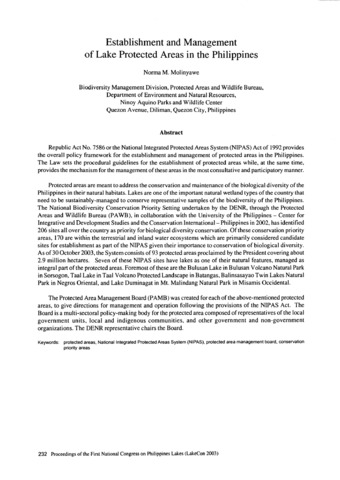
Republic Act No. 7586 or the National Integrated Protected Areas System (NIPAS) Act of 1992 provides the overall policy framework for the establishment and management of protected areas in the Philippines. The Law sets the procedural guidelines for the establishment of protected areas while, at the same time, provides the mechanism for the management of these areas in the most consultative and participatory manner.
Protected areas are meant to address the conservation and maintenance of the biological diversity of the Philippines in their natural habitats. Lakes are one of the important natural wetland types of the country that need to be sustainably-managed to conserve representative samples of the biodiversity of the Philippines. The National Biodiversity Conservation Priority Setting undertaken by the DENR, through the Protected Areas and Wildlife Bureau (PAWB), in collaboration with the University of the Philippines - Center for Integrative and Development Studies and the Conservation International - Philippines in 2002, has identified 206 sites all over the country as priority for biological diversity conservation. Of these conservation priority areas, 170 are within the terrestrial and inland water ecosystems which are primarily considered candidate sites for establishment as part of the NIPAS given their importance to conservation of biological diversity. As of 30 October 2003, the System consists of 93 protected areas proclaimed by the President covering about 2.9 million hectares. Seven of these NIPAS sites have lakes as one of their natural features, managed as integral part of the protected areas. Foremost of these are the Bulusan Lake in Bulusan Volcano Natural Park in Sorsogon, Taal Lake in Taal Volcano Protected Landscape in Batangas, Balinsasayao Twin Lakes Natural Park in Negros Oriental, and Lake Duminagat in Mt. Malindang Natural Park in Misamis Occidental.
The Protected Area Management Board (PAMB) was created for each of the above-mentioned protected areas, to give directions for management and operation following the provisions of the NIPAS Act. The Board is a multi-sectoral policy-making body for the protected area composed of representatives of the local government units, local and indigenous communities, and other government and non-government organizations. The DENR representative chairs the Board.
Description
Abstract only.
Suggested Citation
Molinyawe, N. M. (2005). Establishment and management of lake protected areas in the Philippines. In M. L. Cuvin-Aralar, R. S. Punongbayan, A. Santos-Borja, L. V. Castillo, E. V. Manalili, & M. M. Mendoza (Eds.), Proceedings of the First National Congress on Philippine Lakes (p. 232). Southeast Asian Regional Center for Graduate Study and Research in Agriculture (SEARCA).
Type
Conference paperISSN
1656-8099Collections
- LakeCon2003 [49]
Related items
Showing items related by title, author, creator and subject.
-
Using local user perceptions to evaluate outcomes of protected area management in the Sagay Marine Reserve, Philippines
(Cambridge University Press, 2004)Local user perceptions of resource trajectory and indicators of protected area outcomes can be useful in the assessment of integrated conservation projects, both marine and terrestrial. In-depth stakeholder surveys using 12 performance indicators were used to evaluate the perceived outcomes of the Sagay Marine Reserve (SMR), the Philippines. These indicators were a measure of whether the SMR had achieved its management objectives in the recent past and what local stakeholders expected in the future. The respondents contextual situation could be correlated with their perceptions of SMR indicators. There was a generally high level of perceived equity and efficiency of SMR management outcomes, but the sustainability of the SMR, particularly the condition of the fisheries, had been poor over the previous 10 years. Few anticipated an improvement in sustainability indicators over the next 10 years. Respondents from an island village within the SMR had more negative (or less positive) perceptions of SMR outcomes because of their high dependence on the degraded resource, combined with physical and economic isolation. Specific remedies to enhance island villagers satisfaction, such as greater participation, empowerment, alternative economic opportunities and fisheries protection, and replenishment, are necessary. This research serves as an example of how indicators perceived by local resource-accessing stakeholders can and should be main components of both marine and terrestrial protected area assessment. -
Japan: Mangrove areas and their utilization
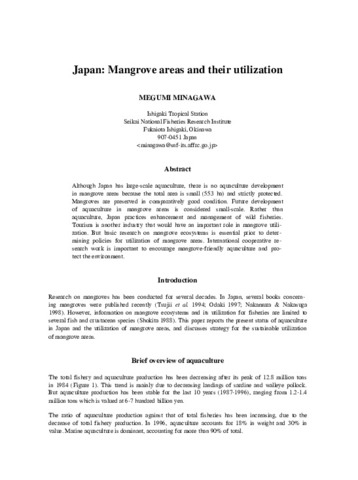
(Aquaculture Department, Southeast Asian Fisheries Development Center, 2000)Although Japan has large-scale aquaculture, there is no aquaculture development in mangrove areas because the total area is small (553 ha) and strictly protected. Mangroves are preserved in comparatively good condition. Future development of aquaculture in mangrove areas is considered small-scale. Rather than aquaculture, Japan practices enhancement and management of wild fisheries. Tourism is another industry that would have an important role in mangrove utilization. But basic research on mangrove ecosystems is essential prior to determining policies for utilization of mangrove areas. International cooperative research work is important to encourage mangrove-friendly aquaculture and protect the environment. -
Marine protected areas in the Philippines: The case of Malalison island in community-based management of reef fisheries
Garcia, Luis Maria ; Primavera, Jurgenne (UNESCO Office, 2004)
The extensive Philippine coastline of more than 22,540 k m provides the natural habitat of a variety of flora and fauna that make the Philippine archipelago one of the centers of marine biodiversity in the world. Resource-use conflicts, overexploitation, and the pressure to feed the teeming population in many fishing communities have however degraded these habitats, seriously threatening marine biodiversity that supports the biological productivity of the country's coastal fishery. Encouraged by recent enabling national legislation (e.g., the Local Government Code of 1991, the National Integrated Protected Areas System Act of 1992, the Philippine Fisheries Code of 1998), grassroots advocacy in many municipalities has grown to address this threat, resulting in the establishment of marine protected areas (MPAs), particularly in coral reef management. The over 550 MPA s catalogued in the Philippines to date were established primarily to enhance local fishery yields for artisanal fishers and secondarily to protect coastal habitats for biodiversity conservation and multiple economic uses. Enforcement in a majority of these MPAs is a serious problem however. Many government and donor-assisted projects, such as the UNESCO Biosphere Reserves in Puerto Galera and Palawan, have promoted integrated management of both upland and coastal habitats, but these too suffer from persistent conflicts in multiple resource-use and the lack of sustained enforcement by stakeholders. Our recent experience in Malalison Island, central Philippines describes the efforts of empowering the island fishers themselves to be effective and responsible managers of their marine resources. Grassroots empowerment required organizing the island fisherfolks in 1991 into a working association to promote collective action on a number of local reef fishery management initiatives, particularly the establishment of exclusive-use rights over the island's reef fishing grounds, which entailed influencing the municipal government and neighboring villages. Specific interventions that followed were highlighted by the establishment of a no-take marine reserve and the deployment of concrete artificial habitats in one of their fishing grounds in Gui-ob reef in 1995-1996. Indicators of equity, efficiency, and sustainability suggest that island fisherfolks have gained greater control over their reef fishery resources, allocated their fair share of access rights, and influenced the formulation of fishery co-management policies through direct participation. In the process of empowerment, the island community leaders and many members have become bold and confident in publicly articulating their vision of sustaining harvest from their reef fisheries, a trait that they have not openly displayed prior to 1991. The experience in Malalison Island has demonstrated that fishery co-management, as exemplified by sustained protection of a no-take marine reserve, can be an achievable goal in the Philippines. It may serve as a valuable model to be followed by other coastal fishing communities in Southeast Asia and elsewhere.
; Primavera, Jurgenne (UNESCO Office, 2004)
The extensive Philippine coastline of more than 22,540 k m provides the natural habitat of a variety of flora and fauna that make the Philippine archipelago one of the centers of marine biodiversity in the world. Resource-use conflicts, overexploitation, and the pressure to feed the teeming population in many fishing communities have however degraded these habitats, seriously threatening marine biodiversity that supports the biological productivity of the country's coastal fishery. Encouraged by recent enabling national legislation (e.g., the Local Government Code of 1991, the National Integrated Protected Areas System Act of 1992, the Philippine Fisheries Code of 1998), grassroots advocacy in many municipalities has grown to address this threat, resulting in the establishment of marine protected areas (MPAs), particularly in coral reef management. The over 550 MPA s catalogued in the Philippines to date were established primarily to enhance local fishery yields for artisanal fishers and secondarily to protect coastal habitats for biodiversity conservation and multiple economic uses. Enforcement in a majority of these MPAs is a serious problem however. Many government and donor-assisted projects, such as the UNESCO Biosphere Reserves in Puerto Galera and Palawan, have promoted integrated management of both upland and coastal habitats, but these too suffer from persistent conflicts in multiple resource-use and the lack of sustained enforcement by stakeholders. Our recent experience in Malalison Island, central Philippines describes the efforts of empowering the island fishers themselves to be effective and responsible managers of their marine resources. Grassroots empowerment required organizing the island fisherfolks in 1991 into a working association to promote collective action on a number of local reef fishery management initiatives, particularly the establishment of exclusive-use rights over the island's reef fishing grounds, which entailed influencing the municipal government and neighboring villages. Specific interventions that followed were highlighted by the establishment of a no-take marine reserve and the deployment of concrete artificial habitats in one of their fishing grounds in Gui-ob reef in 1995-1996. Indicators of equity, efficiency, and sustainability suggest that island fisherfolks have gained greater control over their reef fishery resources, allocated their fair share of access rights, and influenced the formulation of fishery co-management policies through direct participation. In the process of empowerment, the island community leaders and many members have become bold and confident in publicly articulating their vision of sustaining harvest from their reef fisheries, a trait that they have not openly displayed prior to 1991. The experience in Malalison Island has demonstrated that fishery co-management, as exemplified by sustained protection of a no-take marine reserve, can be an achievable goal in the Philippines. It may serve as a valuable model to be followed by other coastal fishing communities in Southeast Asia and elsewhere.