Production of microalgal paste in the Philippines

Download URL
scienggj.orgDate
2020Page views
1,462ASFA keyword

AGROVOC keyword
Metadata
Show full item recordShare
Abstract
Technical advances have made possible the production of microalgal concentrate in paste form. Chaetoceros calcitrans was concentrated and made into an algal paste through centrifugation, chemical flocculation, and electrolytic flocculation. The paste can be stored up to three months when refrigerated, and is diluted with seawater for feeding to the tiger prawn, Penaeus monodon. This can also be done with other cultured diatoms, and they can be fed to other penaeid shrimp and other organisms such as the Sydney rock oyster and the Pacific oyster. The use of algal paste can simplify hatchery operations and reduce costs among hatcheries with no microalgal culture facilities.
Suggested Citation
de la Peña, M. R., & Franco, A. V. (2020). Production of microalgal paste in the Philippines. In M. R. Martinez-Goss, W. L. Rivera, & N. K. Torreta (Eds.), Methods in Microalgal Studies (pp. 67–74). Los Baños, Laguna, Philippines: Philippine Science Letters; University of the Philippines Los Baños.
Type
Book chapterISBN
9789715473318Collections
- Books and Book Chapters [123]
Related items
Showing items related by title, author, creator and subject.
-
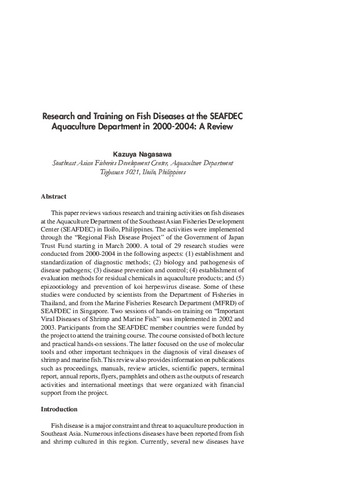
Research and training on fish diseases at the SEAFDEC Aquaculture Department in 2000-2004: A review
(Aquaculture Department, Southeast Asian Fisheries Development Center, 2004)This paper reviews various research and training activities on fish diseases at the Aquaculture Department of the Southeast Asian Fisheries Development Center (SEAFDEC) in Iloilo, Philippines. The activities were implemented through the "Regional Fish Disease Project" of the Government of Japan Trust Fund starting in March 2000. A total of 29 research studies were conducted from 2000-2004 in the following aspects: (1) establishment and standardization of diagnostic methods; (2) biology and pathogenesis of disease pathogens; (3) disease prevention and control; (4) establishment of evaluation methods for residual chemicals in aquaculture products; and (5) epizootiology and prevention of koi herpesvirus disease. Some of these studies were conducted by scientists from the Department of Fisheries in Thailand, and from the Marine Fisheries Research Department (MFRD) of SEAFDEC in Singapore. Two sessions of hands-on training on "Important Viral Diseases of Shrimp and Marine Fish" was implemented in 2002 and 2003. Participants from the SEAFDEC member countries were funded by the project to attend the training course. The course consisted of both lecture and practical hands-on sessions. The latter focused on the use of molecular tools and other important techniques in the diagnosis of viral diseases of shrimp and marine fish. This review also provides information on publications such as proceedings, manuals, review articles, scientific papers, terminal report, annual reports, flyers, pamphlets and others as the outputs of research activities and international meetings that were organized with financial support from the project. -
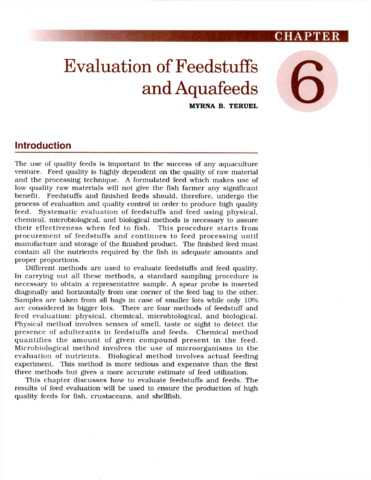
Evaluation of feedstuffs and aquafeeds
(Aquaculture Department, Southeast Asian Fisheries Development Center, 2002)This chapter discusses how to evaluate feedstuffs and feeds. The results of feed evaluation will be used to ensure the production of high quality feeds for fish, crustaceans, and shellfish. -
Swollen hindgut syndrome (SHG) in hatchery-reared Penaeus monodon postlarvae
(Fish Health Section, Asian Fisheries Society, 2002)In the course of routine microscopic analysis of hatchery-reared Penaeus monodon postlarvae, several batches were found with hindgut abnormalities not previously described in shrimp postlarvae. The abnormality was named swollen hindgut syndrome (SHG) because it affected mainly the hindgut. Postlarvae with SHG showed enlargement and distention of the hindgut folds and its junction with the midgut, although in some cases swelling also occurred in the midgut of the sixth abdominal segment. Over a five-year period, the yearly prevalence of SHG ranged from 6 to 13% of all batches examined. No seasonal pattern was observed as SHG occurred year-round. Despite the numerous samples obtained, SHG has not been associated with specific predisposing factors in the hatchery. The abnormality caused cessation of the rhythmic movements of the hindgut-midgut junction resulting to failure of affected postlarvae to excrete fecal pellets. Swollen hindgut syndrome, although reversible to some extent, caused mortality and significant size variation within batches of postlarvae resulting in their unsuitability for stocking in grow-out farms.