Research update on emergent shrimp pathogens in Thailand


Share
นามธรรม
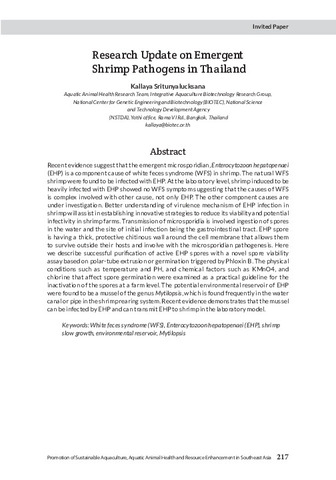
Recent evidence suggest that the emergent microsporidian, Enterocytozoon hepatopenaei (EHP) is a component cause of white feces syndrome (WFS) in shrimp. The natural WFS shrimp were found to be infected with EHP. At the laboratory level, shrimp induced to be heavily infected with EHP showed no WFS symptom suggesting that the causes of WFS is complex involved with other cause, not only EHP. The other component causes are under investigation. Better understanding of virulence mechanism of EHP infection in shrimp will assist in establishing innovative strategies to reduce its viability and potential infectivity in shrimp farms. Transmission of microsporidia is involved ingestion of spores in the water and the site of initial infection being the gastrointestinal tract. EHP spore is having a thick, protective chitinous wall around the cell membrane that allows them to survive outside their hosts and involve with the microsporidian pathogenesis. Here we describe successful purification of active EHP spores with a novel spore viability assay based on polar-tube extrusion or germination triggered by Phloxin B. The physical conditions such as temperature and PH, and chemical factors such as KMnO4, and chlorine that affect spore germination were examined as a practical guideline for the inactivation of the spores at a farm level. The potential environmental reservoir of EHP were found to be a mussel of the genus Mytilopsis, which is found frequently in the water canal or pipe in the shrimp rearing system. Recent evidence demonstrates that the mussel can be infected by EHP and can transmit EHP to shrimp in the laboratory model.
Description
Abstract only.
การอ้างอิง
Sritunyalucksana, K. (2021). Research update on emergent shrimp pathogens in Thailand. In F. A. Aya, L. D. de la Peña, N. D. Salayo, & E. A. Tendencia (Eds.), Proceedings of the International Workshop on the Promotion of Sustainable Aquaculture, Aquatic Animal Health, and Resource Enhancement in Southeast Asia (p. 217). Tigbauan, Iloilo, Philippines: Aquaculture Department, Southeast Asian Fisheries Development Center.
Type
Conference paperISBN
9789719931102 (Print); 9789719931119 (PDF)
Except where otherwise noted, this item's license is described as Attribution-NonCommercial-ShareAlike 3.0 IGO
Related items
Showing items related by title, author, creator and subject.
-
Asian shrimp situation
(Aquaculture Department, Southeast Asian Fisheries Development Center, 1990) -
Nutrient flow and physicochemical profile studies of an integrated poultry-salt-Artemia-milkfish-sea bass-shrimp pond production system
(Wetteren, Belgium: Universal Press, 1987)The physicochemical and biological parameters of an integrated flow-through poultry-salt-Artemia-milkfish-sea bass-shrimp pond production system were monitored for 6 months to determine the pattern of nutrient changes and associated plankton communities as water passed through the system. A 20 ha salt farm in Negros Oriental, Philippines, was used as a model of the integrated system. The construction of a poultry farm at the inlet reservoir provides continuous fertilization and allows considerable control of nutrient inputs to the pond system. Nutrients increase markedly in the chicken pond and in subsequent ponds undergo cycles of biological assimilation and bacterial mineralization. Principal component analysis ordinates temporal and spatial changes in 33 variables that were monitored. Using scatter diagrams of the principal components enabled separation of ponds adjacent to the crystallization bed and ponds high in fish biomass from the rest of the system. Variables that served to numerically delineate the ponds in this manner were salinity, phosphate, ammonia, alkalinity, turbidity, acidity, microplants, pico- and nannoplankton. The implications of this ordination in relation to pond management techniques is discussed. -
A further note to “fishing gear for prawn and shrimp used in the Philippines today”
(Carcinological Society of Japan, 1983)Motoh (1980) reported 9 and 13 kinds of shrimping gear for the fry and the adult respectively, of which most of them are indigenously used today in the Philippines. Howerver, druing the continued ecological survey of penaeids in the country conducted by him and his staff, six kinds of shrimping gear or devices were additionally found by them, which have been used traditionally in the country. The reasons that the present author intends to introduce the gear or devices are as follwos: 1) To record theses unque devices from the nature conservation point of view, which were invented by local people through their long experiences, though devices been forgotten due to their poor catching effectiveness, and 2) To recommend the continuous use of these devices by local people, which impose much less construction technique and energy on the users compared to modern mechanized catching tools.