Effects of exogenous hormones and broodstock age on the spawning response of captive silver therapon Leiopotherapon plumbeus


Share
Abstract
Evaluation of appropriate hormone and ideal broodstock age for optimal breeding efficiency may ensure the production of good quality eggs and larvae in the hatchery. In this study, the spawning response of captive silver therapon Leiopotherapon plumbeus to various hormonal treatments and broodstock age was examined. In Experiment 1, spawning success, latency period, absolute and relative fecundity, fertilization and hatching rates, and larval production of female silver therapon broodstock were determined after ovulation and spawning in response to human chorionic gonadotropin (hCG; 5000 and 10,000 IU/kg), Ovaprim (0.5 ml/kg), hCG + Ovaprim (5000 IU + 0.5 ml/kg; 10,000 IU + 0.5 ml/kg) or hCG + domperidone (5000 IU + 0.5 ml/kg; 10,000 IU + 0.5 ml/kg). In Experiment 2, reproductive performance of four domesticated broodstock age groups (1+, 2+, 3+ and 4+-year old) was examined for five consecutive months, coinciding with the spawning season. Higher dose of hCG + Ovaprim resulted in higher spawning (100%), fertilization (99.7 ± 0.1%), and hatching (85.8 ± 5.5%) rates than the other treatments. The effect of age on reproductive indices was not significant. However, better spawning performance was observed in 1+ to 3+-year old broodstock, with higher fertilization (96.8–98.5%) and hatching (63.7%–77.2%) rates than among the oldest age group (82.9% and 57.2%). Together, results suggest that the combination of hCG + Ovaprim is highly effective in inducing ovulation and spawning in silver therapon, and that domesticated broodstock up to 4+ years of age could still be used for breeding activities and seed production.
Suggested Citation
Aya, F., Sayco, M. J. P., & Garcia, L. M. (2022). Effects of exogenous hormones and broodstock age on the spawning response of captive silver therapon Leiopotherapon plumbeus. Journal of Applied Ichthyology , 38(2), 232-240. https://doi.org/10.1111/jai.14297
Type
ArticleISSN
0175-8659; 1439-0426Collections
- Journal Articles [1267]
Related items
Showing items related by title, author, creator and subject.
-
Effects of human chorionic gonadotropin (hCG) and handling stress on spermiation of silver perch Leiopotherapon plumbeus (Kner, 1864)
Denusta, Pastor Jones ; ; ; Garcia, Luis Maria (Wiley, 2014)
This study determined the effect of human chorionic gonadotropin (hCG) and handling stress on the spermiation and milt response of silver perch Leiopotherapon plumbeus based on the measurement of spermatocrit, sperm density, and milt production. Compared to saline-injected fish, the mean spermatocrit (or packed sperm) of hCG-treated fish was significantly lower at 18 h (47.9%) and 30 h (40.2%) post-injection while mean sperm density was significantly lower at 30 h post-injection (3.6 × 10⁶ cells μl−1) but not at 18 h. At 18 h (1.8 μl g-BW−1) and 30 h (2.5 μl g-BW−1) post-injection, mean milt production of hCG-treated fish was significantly higher than in the saline group. Milt consistency was also thinner in the hCG-treated group. Mean sperm density of handled fish (18.0 × 10⁶ cells μl−1) was significantly lower than control fish (23.4 × 10⁶ cells μl−1). However, mean sperm density of handled plus saline-injected (16.2 × 10⁶ cells μl−1) and handled plus hCG-treated fish (8.4 × 10⁶ cells μl−1) was significantly lower than in the control goup. Having thicker milt consistency, mean spermatocrit and milt production of handled (77.5%; 1.1 μl g-BW−1, respectively) and handled plus saline-injected fish (75.4%; 1.1 μl g-BW−1, respectively) were not significantly different from the control fish (76.2%; 1.3 μl g-BW−1, respectively). Handled plus hCG-treated fish had the lowest mean sperm density (8.4 × 10⁶ cells μl−1) and spermatocrit (54.7%), but had the highest mean milt production (5.5 μl g-BW−1) among the treatment groups. These results demonstrate that the hCG injection effectively induces spermiation and milt expression and that handling-related stress negatively affects such responses. The spermatocrit method may be used to assess the spermiation and milt response of silver perch.
; ; ; Garcia, Luis Maria (Wiley, 2014)
This study determined the effect of human chorionic gonadotropin (hCG) and handling stress on the spermiation and milt response of silver perch Leiopotherapon plumbeus based on the measurement of spermatocrit, sperm density, and milt production. Compared to saline-injected fish, the mean spermatocrit (or packed sperm) of hCG-treated fish was significantly lower at 18 h (47.9%) and 30 h (40.2%) post-injection while mean sperm density was significantly lower at 30 h post-injection (3.6 × 10⁶ cells μl−1) but not at 18 h. At 18 h (1.8 μl g-BW−1) and 30 h (2.5 μl g-BW−1) post-injection, mean milt production of hCG-treated fish was significantly higher than in the saline group. Milt consistency was also thinner in the hCG-treated group. Mean sperm density of handled fish (18.0 × 10⁶ cells μl−1) was significantly lower than control fish (23.4 × 10⁶ cells μl−1). However, mean sperm density of handled plus saline-injected (16.2 × 10⁶ cells μl−1) and handled plus hCG-treated fish (8.4 × 10⁶ cells μl−1) was significantly lower than in the control goup. Having thicker milt consistency, mean spermatocrit and milt production of handled (77.5%; 1.1 μl g-BW−1, respectively) and handled plus saline-injected fish (75.4%; 1.1 μl g-BW−1, respectively) were not significantly different from the control fish (76.2%; 1.3 μl g-BW−1, respectively). Handled plus hCG-treated fish had the lowest mean sperm density (8.4 × 10⁶ cells μl−1) and spermatocrit (54.7%), but had the highest mean milt production (5.5 μl g-BW−1) among the treatment groups. These results demonstrate that the hCG injection effectively induces spermiation and milt expression and that handling-related stress negatively affects such responses. The spermatocrit method may be used to assess the spermiation and milt response of silver perch. -
Series: Aquaculture extension manual; No. 67
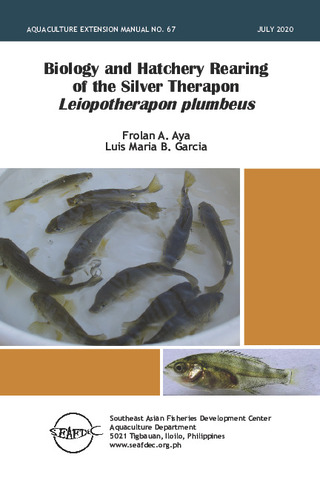
Biology and hatchery rearing of the silver therapon Leiopotherapon plumbeus
Aya, FrolanKnown for its tasty flesh, silver therapon, locally known as ayungin, has been regarded to be one of the most valuable edible native freshwater species in the Philippines. Demands for this fish species remain high which ...; Garcia, Luis Maria (Aquaculture Department, Southeast Asian Fisheries Development Center, 2020-07)
-
Diet composition, feed preferences and mouth morphology of early stage silver therapon (Leiopotherapon plumbeus, Kner 1864) larvae reared in outdoor tanks
Aya, Frolan; ; Garcia, Luis Maria (Wiley, 2015)
This study examined the diet composition, feeding preferences, and mouth morphology of the silver therapon (Leiopotherapon plumbeus, Kner 1864) larvae under captive conditions. Larvae were reared in outdoor tanks (4 m3) with natural food grown 2 weeks prior to start of larval rearing. Food preference was measured by the Chesson's electivity index (αi). Gut content analysis of larvae sampled between 5 and 25 days after hatching (DAH) showed the dominance in the diet by zooplankton, mainly copepod nauplii, cladocerans and insect larvae. Small fish larvae (5–9 DAH; 3.32–6.29 mm standard length) preferred cladocerans, ciliates and copepod nauplii; whereas older larvae (12–25 DAH; 5.45–19.26 mm standard length) preferred insect larvae over cladocerans and adult insects. The mouth gape size at 5 DAH was 359 μm and increased to 3.75 mm at 40 DAH when body size grew at an average rate of 0.59 mm d−1. The standard length (SL) of L. plumbeus larvae was strongly associated with mouth size (r2 = 0.98, P < 0.05), indicating a progressive increase of ingested prey size of the fish larvae. These results clarified the early life feeding ecology of this species, which is essential in developing effective hatchery techniques.