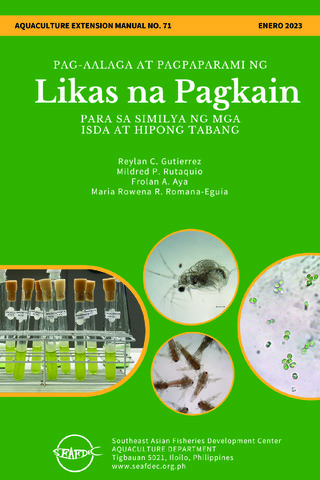
Pag-aalaga at pagpaparami ng likas na pagkain para sa similya ng mga isda at hipong tabang

Date
2023-01Page views
2,991ASFA keyword

AGROVOC keyword
Taxonomic term

Geographic names

Metadata
Show full item recordShare
Abstract
Inilalarawan sa manwal na ito ang iba’t-ibang paraan ng pag-aalaga at pagpaparami ng microalgae at iba pang natural na organismong pagkain para sa mga similya ng isda at hipong tabang na inaalagaan at pinaparami sa mga hatcheries. Sa pamamagitan ng manwal na ito, maisusulong ang paggamit ng mga natural at naproseso na mga nasabing organismo bilang isang paraan para mapabuti ang produksyon ng mga isda at hipong tabang.
Ang manwal na ito ay sadyang isinulat para makatulong sa mga lokal na may-ari ng mga hatcheries ng ulang at isdang tabang kabilang na ang kanilang mga technicians. Ito ay naglalayong magkaroon sila ng mas mahusay na pag-unawa sa kahalagahan ng pagpaparami at pag-aalaga ng ng mga likas na pagkain bilang isang kritikal na aspeto sa pag-aalaga at masaganang produksyon ng mga similya sa hatchery.
Keywords
giant freshwater prawn bighead carp Clariid catfish silver therapon ayungin hito ulang bangus
Other versions
EnglishSuggested Citation
Gutierrez, R. C., Rutaquio, M. P., Aya, F., & Romana-Eguia, M. R. R. (2023). Pag-aalaga at pagpaparami ng likas na pagkain para sa similya ng mga isda at hipong tabang. Aquaculture Department, Southeast Asian Fisheries Development Center.
Type
BookISSN
0115-5369Series
Aquaculture extension manual; No. 71Format
40 pages : color illustrations.
Collections
The following license files are associated with this item:

Except where otherwise noted, this item's license is described as Attribution-NonCommercial-ShareAlike 3.0 IGO
Related items
Showing items related by title, author, creator and subject.
-
Broodstock management and seed production of tilapia and carp
(Aquaculture Department, Southeast Asian Fisheries Development Center, 1988)Bighead (Aristichthys nobilis) and silver (Hypophthalmichthys molitrix) carps were reared in ponds, pens and floating cages in Laguna Lake until maturity. Spontaneous gonadal maturation and rematuration of carp broodstock occurred within 2-2.5 years with average weight of 3-4 kg. Under lake conditions, broodstock were not given supplemental feeds. Induced spawning of gravid females was done by intraperitoneal injections using HCG combined with either common carp pituitary homogenates or LHRH-A. Stripping and dry-fertilization of eggs were done 6-8 hr after the final injection. Eggs were incubated in water containing 300-500 ppm Total Hardness. Fertilization and hatching rates were 23-88% and 7-36%, respectively. Post-larval carps were reared in tanks and fine-meshed nylon net cages installed in manured ponds. Tank-reared post-larvae were fed with Brachionus plicatilis and subsequently with Moina macrocopa in combination with powered formulated feeds containing 40% crude protein. Fry were harvested and stocked in nursery cages after 30-45 days of rearing in tanks. Four-month old 50-100 g tilapia (Oreochromis niloticus) stocked in hapa net cages, tanks or ponds were used for breeding. Egg and fry production was significantly high at 4 females/m2 stocking density Different sex ratios, however, did not affect fry production. Spawning frequency and total growth of broodstock was highest in fry fed formulated diets containing 50% crude protein. Harvesting of fry was done every 15 days during summer months and every 21 days during cold months. Fry were reared in tanks and hapa cages and fed diets containing 35% crude protein. Supplemental feeding in the lake was suspended when productivity reached 3 gC/m2 /day. -
Nursery and grow-out operation for tilapia and carp
(Aquaculture Department, Southeast Asian Fisheries Development Center, 1988)Most researches conducted at the Binangonan Freshwater Station of the SEAFDEC Aquaculture Department were directed toward enhancing growth and survival of the young tilapia and carp in the nursery as well as increasing yields in grow-out cages, pens, and ponds. Studies included the culture and evaluation of phytoplankton and zooplankton as feeds of the tilapia and carp fry to fingerlings; determination of protein and amino acid requirements of young Nile tilapia; development of practical dry diets; evaluation of feeding regimes, feeding rates, and feeding frequencies ; and the use of fertilizers in nursery ponds. For the grow-out aspect, one of the earliest studies demonstrated the profitability of the monoculture of tilapia in cages which triggered the initial proliferation of tilapia cage culture by the private sector in areas near the Station. Subsequently, supplemental feeds were developed and evaluated; non-conventional feedstuffs were tested as feeds or feed components; and the growth rates of Nile tilapia fingerlings in cages at varying stocking densities were evaluated at three distinct rearing periods covering one year. Prior to the successful mass production of bighead carp fingerlings at the Station, studies on polyculture of tilapia, milk fish, and different species of carp were conducted in cages and pens with remarkable results. This led to the technology-verification projects on polyculture at various areas in Laguna Lake. With the availability of freshwater fishponds for research purposes, studies on polyculture in ponds were also conducted. -
Optimum stocking density and feeding level for laboratory‐reared early‐stage silver therapon (Leiopotherapon plumbeus) larvae
Aya, Frolan ; ; Garcia, Luis Maria (Wiley, 2021)
Growth, survival and feeding of early‐stage silver therapon Leiopotherapon plumbeus larvae reared at different stocking densities and feeding levels were examined. Larvae (8 days post hatch (dph); 0.38–0.50 mg body weight (BW); 5.33–6.90 mm in total length (TL)) were stocked at densities of 5, 15, 25 and 35 larvae/L and co‐fed with live food (Brachionus rotundiformis and Artemia nauplii) and formulated microdiet or fed Artemia alone for 28 days. Another batch of 8 dph silver therapon larvae (0.65 mg BW; 9.47 mm TL) were stocked at 15 larvae/L and were fed 1, 2 or 5 Artemia nauplii/mL for 28 days. Survival at lower densities (5 and 15 larvae/L) was significantly improved than in high‐density reared larvae. Furthermore, larvae fed Artemia alone showed higher survival (20.4%–81.4%) than those offered live food and formulated microdiet combined (3.5%–32.9%) in each stocking density, indicating the suitability of Artemia for early‐stage silver therapon larvae. Growth parameters were significantly affected by stocking density in larvae fed Artemia alone but not in the live food and formulated microdiet co‐fed group. No significant differences in growth and survival were observed in silver therapon larvae reared on three feeding levels. However, higher feed intake at 5 nauplii/mL resulted in significantly higher body lipid contents than those fed 1 or 2 nauplii/mL. The results suggest that larvae held at stocking densities of 5 and 15 larvae/L and fed 5 Artemia nauplii/mL promote maximum growth, survival and higher feed intake of early‐stage silver therapon larvae under laboratory conditions.
; ; Garcia, Luis Maria (Wiley, 2021)
Growth, survival and feeding of early‐stage silver therapon Leiopotherapon plumbeus larvae reared at different stocking densities and feeding levels were examined. Larvae (8 days post hatch (dph); 0.38–0.50 mg body weight (BW); 5.33–6.90 mm in total length (TL)) were stocked at densities of 5, 15, 25 and 35 larvae/L and co‐fed with live food (Brachionus rotundiformis and Artemia nauplii) and formulated microdiet or fed Artemia alone for 28 days. Another batch of 8 dph silver therapon larvae (0.65 mg BW; 9.47 mm TL) were stocked at 15 larvae/L and were fed 1, 2 or 5 Artemia nauplii/mL for 28 days. Survival at lower densities (5 and 15 larvae/L) was significantly improved than in high‐density reared larvae. Furthermore, larvae fed Artemia alone showed higher survival (20.4%–81.4%) than those offered live food and formulated microdiet combined (3.5%–32.9%) in each stocking density, indicating the suitability of Artemia for early‐stage silver therapon larvae. Growth parameters were significantly affected by stocking density in larvae fed Artemia alone but not in the live food and formulated microdiet co‐fed group. No significant differences in growth and survival were observed in silver therapon larvae reared on three feeding levels. However, higher feed intake at 5 nauplii/mL resulted in significantly higher body lipid contents than those fed 1 or 2 nauplii/mL. The results suggest that larvae held at stocking densities of 5 and 15 larvae/L and fed 5 Artemia nauplii/mL promote maximum growth, survival and higher feed intake of early‐stage silver therapon larvae under laboratory conditions.