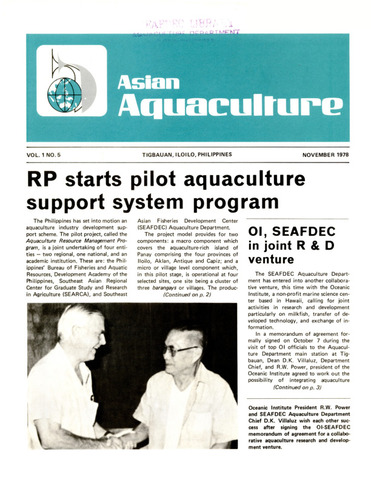
RP starts pilot aquaculture support system program


Share
Abstract
The Philippines has set into motion an aquaculture industry development support scheme, jointly undertaken by 4 institutions. The project model provides for two components: a macro component which covers the island of Panay, and a micro or village level component concerned with milkfish, crustacean (including sugpo, or tiger prawn), and mollusc production. Details of the proposed infrastructure, technology, field implementation and management are given.
Keywords
experimental cultureSubjects
Philippines. Bureau of Fisheries and Aquatic Resources Southeast Asian Regional Centre for Graduate Study and Research in Agriculture Southeast Asian Fisheries Development Center. Aquaculture Department Development Academy of the Philippines Aquaculture--Technology transfer
Suggested Citation
SEAFDEC/AQD (1978). RP starts pilot aquaculture support system program. Asian Aquaculture , 1(5), 1-3. http://hdl.handle.net/10862/6428
Type
magazineArticleISSN
0115-4974Koleksi
Related items
Showing items related by title, author, creator and subject.
-
Institutional capacity development for sustainable aquaculture and fisheries: Strategic partnership with local institutions
(Terrapub, 2008)Many people living in the rural areas in the Philippines, as in other developing countries in Southeast Asia, depend on aquatic resources for their food and livelihood. For the past two decades, the Aquaculture Department of the Southeast Asian Fisheries Development Center (SEAFDEC-AQD) has been working with fishing communities and people’s organizations, business sector, local government units, national government agencies, non-government organizations (NGOs) and academic and other research institutions to promote the efficient conservation, management and sustainable development of the country’s fisheries and aquatic resources so that these may continue to serve the needs of the people today and tomorrow. Using the lessons learned from those two decades of multi-sectoral and inter-disciplinary collaborations, SEAFDEC-AQD launched in late 2006 a project called Institutional Capacity Development for Sustainable Aquaculture (ICDSA) to hasten the transfer to and adoption by coastal villagers of appropriate technologies that would enhance the productivity of aquatic resources and at the same time safeguard the fragile balance of the aquatic ecology. The experience of SEAFDEC in coastal resource management shows that it is important to engage the collaboration of the local government units and other “on-the-ground” institutions, such as NGOs and people’s organizations, to be able to introduce effectively any social and technological interventions to target community-beneficiaries. However, before a fruitful collaboration among these institutions could be attained, there is a need to build their capacities, and those of the beneficiaries, for the vital roles that they play in the implementation of livelihood projects and environmental management programs. As of January 2008, SEAFDEC-AQD is implementing ICDSA projects in four provinces—Antique, Capiz, Guimaras and Northern Samar in central Philippines. In the pipeline are similar projects for a province in southern Philippines and two provinces in the north. -
Community fishery resources management on Malalison Island, Philippines: R & D framework, interventions, and policy implications
(Taylor & Francis, 2000)In 1991, the Aquaculture Department of the Southeast Asian Fisheries Development Center launched a community-based fishery resources management project on Malalison Island, in central Philippines, to help conserve the country's marine resources and to help the fisherfolk rise above their poverty. The eight-year project integrated various disciplines in biology, economics, sociology, public administration, and engineering in its study of fishery resources and fishing communities and in evolving intervention strategies for resource conservation and management, and for community development. The project's most important accomplishment was the inculcation among the fisherfolk of the importance of resource conservation and management. The most important lesson learned was that an enlightened and empowered fisherfolk could be effective managers and responsible users of fishery resources. -
Basis for a blue revolution?
(International Development Research Centre, 1979)In 1977, scientists at the Southeast Asian Fisheries Development Centre (SEAFDEC) in the Philippines became the first anywhere to succeed in breeding milkfish (Chanos chanos) in captivity. The advance was made possible by an IDRC grant, approved in 1974, for a three-year project of research in the breeding and rearing of this important source of protein. The initial grant, for $826,000, was renewed for another three years in December 1978 in the amount of $421,100.