Behavior changes and \(\mathsf{LC_{50}}\) of dried garlic (Allium sativum) acute toxicity in Nile tilapia (Oreochromis niloticus) juvenile

View/
Date
2023-06Page views
1,123ASFA keyword

AGROVOC keyword
Taxonomic term

Metadata
Show full item recordShare
Abstract
Plant-based compounds are emerging substitutes for chemical treatments in aquaculture since they are known to cause less harm to both the environment and its organisms. Garlic (Allium sativum) is a popular herb that has a broad range of uses, especially in the control and treatment of bacterial and parasitic diseases. However, its toxicity to tilapia is not well-studied. Hence, this study was conducted to test the toxicity levels of garlic powder in juvenile Nile tilapia (Oreochromis niloticus) by determining the cumulative mortality and median lethal concentration (LC50). Test fish were exposed through immersion in 6 concentrations (150, 200, 250, 300, 350, and 400 mg L-1) of garlic powder with 25% allicin and a control in 96 h static bioassay. Within 24 h, test fish exposed to 250 mg L-1 garlic and above, exhibited abnormal behaviors such as lethargy, gasping for air, and weak responses to environmental stimuli. Cumulative mortality was highest at 100% in 400 mg L-1 garlic at 48 h. Mortalities were dependent on the concentration and duration of exposure. The 96 h LC50 of garlic powder to O. niloticus is 225.86 mg L-1 with lower and upper confidence limits of 210.37 and 242.50 mg L-1, respectively at 27°C.
Keywords
behavioral response cumulative mortality garlic tilapia median lethal concentration (LC50) 96 h static bioassaySuggested Citation
Erazo-Pagador, G., Dumaran-Paciente, H. R., & Caloyloy, B. J. (2023). Behavior changes and \(\mathsf{LC_{50}}\) of dried garlic (Allium sativum) acute toxicity in Nile tilapia (Oreochromis niloticus) juvenile. Philippine Agricultural Scientist , 106(2), 215-220. http://hdl.handle.net/10862/6448
Type
ArticleISSN
0031-7454Collections
- Journal Articles [1266]
Related items
Showing items related by title, author, creator and subject.
-
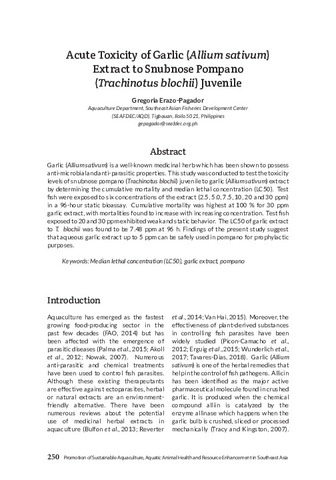
Acute toxicity of garlic (Allium sativum) extract to snubnose pompano (Trachinotus blochii) juvenile
(Aquaculture Department, Southeast Asian Fisheries Development Center, 2021-12)Garlic (Allium sativum) is a well-known medicinal herb which has been shown to possess anti-microbial and anti-parasitic properties. This study was conducted to test the toxicity levels of snubnose pompano (Trachinotus blochii) juvenile to garlic (Allium sativum) extract by determining the cumulative mortality and median lethal concentration (LC50). Test fish were exposed to six concentrations of the extract (2.5, 5.0, 7.5, 10, 20 and 30 ppm) in a 96-hour static bioassay. Cumulative mortality was highest at 100 % for 30 ppm garlic extract, with mortalities found to increase with increasing concentration. Test fish exposed to 20 and 30 ppm exhibited weak and static behavior. The LC50 of garlic extract to T. blochii was found to be 7.48 ppm at 96 h. Findings of the present study suggest that aqueous garlic extract up to 5 ppm can be safely used in pompano for prophylactic purposes. -
Acute lethal toxicity of dried garlic (Allium sativum) powder on orange-spotted grouper (Epinephelus coioides) juveniles under static exposure
(European Association of Fish Pathologists, 2022-10-05)The present study was carried out to assess the toxic effect and determine the lethal concentration of dried garlic (Allium sativum) powder on the orange-spotted grouper (Epinephelus coioides) juveniles. Laboratory static bioassays were conducted to determine the 96-h LC50 of different concentrations of garlic (0, 30, 60, 90, 120, 150 and 180 mg L-1) on grouper juveniles (mean weight, 35.4±6.18 g and mean length, 13.2±0.51 cm). The 96-h LC50 was 74.78 mg L-1 with lower and upper confidence limits of 62.8 and 89.06 mg L-1, respectively. All fish exposed to 30 to 180 mg L-1 exhibited rapid movement, faster opercular activity and erratic swimming whereas at higher concentrations (90 mg L-1 to 180 mg L-1) fish showed additional behavioral changes such as loss of balance, lethargy, gulping for air and respiratory distress. Water quality parameters were within the recommended acceptable limits. This LC50 value can be used as a baseline reference to generate an effective concentration of garlic for future prophylaxis and treatment for parasitic, viral and bacterial infection in grouper. -
Series: Aquaculture extension manual; No. 36
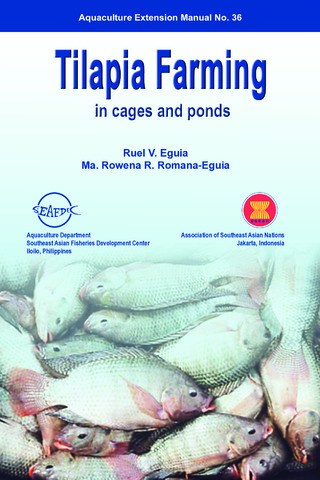
Tilapia farming in cages and ponds
; Romana-Eguia, Ma. Rowena R.This 40-page manual describes the farming practices for tilapia in cages, pens, ponds, and tanks. Also details selection of quality seedstock, maintenance of stock (feeding, water management), and harvesting. A list of ... (Aquaculture Department, Southeast Asian Fisheries Development Center, 2004)