Susceptibility of Macrobachium rosenbergii to local white spot syndrome virus isolate using immersion assay
Download URL
www.dlsu.edu.phDate
2017Page views
772ASFA keyword

AGROVOC keyword
Taxonomic term

Metadata
Show full item recordShare
Abstract
White spot syndrome virus (WSSV) continue to be one of the leading causes of serious epizootic in cultured shrimp. Macrobrachium rosenbergii or giant freshwater prawns are found to be resistant in White spot syndrome virus (WSSV). However, conflicting studies have shown that pathogenicity of WSSV to M.rosenbergii may vary according to the life cycle of prawn, strain of WSSV and the source of the virus during passaging. On this preliminary study, the susceptibility of M. rosenbergii stocks to local strain of WSSV as exposed via immersion assay will be determined. Likewise, the pathogenicity of WSSV will be identified using the median lethal dose (LD50). The confirmation for the presence of WSSV on giant freshwater prawns will be done using nested PCR. The preliminary study will provide valuable data for the succeeding experiments.
Type
Conference paperCollections
- Conference Proceedings [300]
Related items
Showing items related by title, author, creator and subject.
-
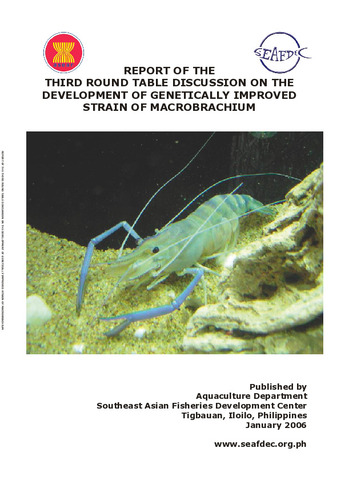
Report of the third round table discussion on the development of genetically improved strain of Macrobrachium, Bangkok, Thailand 3-4 December 2005
(Aquaculture Department, Southeast Asian Fisheries Development Center, 2006-01)In order to continue assessing the progress and status of the activities in the participating countries, the Third Roundtable Discussion was held in Bangkok, Thailand from 3 to 4 December 2005 in order to: 1) assess the ... -
Genetic characterization, domestication and improvement of Macrobrachium rosenbergii in the Philippines
Romana-Eguia, Maria Rowena R. ; ; ; ; (Aquaculture Department, Southeast Asian Fisheries Development Center, 2007)
Extensive studies in the Philippines and in adjacent countries revealed that 528 caridean prawn species are found in this region alone (Chan, 1998). Of all the known species, the giant freshwater prawn is considered the most commercially important. Except for the Philippines, culture of the giant freshwater prawn, Macrobrachium rosenbergii, has already made substantial contributions to the local aquaculture production in Southeast Asia, i.e. in Thailand, Malaysia and Indonesia. However, efforts are now being made to improve the aquaculture production of Macrobrachium rosenbergii in the Philippines, thus, optimal methods for the culture and propagation of this high value freshwater aquaculture species are being developed by the Philippine Government fishery agencies as well as other research and academic institutions. The Integrated Rural Aquaculture Program under the ASEAN-SEAFDEC Special Five-Year Program or what is presently known as the Program on the Promotion of Sustainable Aquaculture in the ASEAN Region enabled the Bureau of Fisheries and Aquatic Resources, the Mindanao State University and the Aquaculture Department of SEAFDEC to jointly conduct studies on the genetic characterization, domestication and improvement of Macrobrachium rosenbergii stocks in the Philippines in order to improve the aquaculture production of the giant freshwater prawn. Under the collaborative project which started in late 2004, specific research activities under were conducted, and an update on their results are summarized.
; ; ; ; (Aquaculture Department, Southeast Asian Fisheries Development Center, 2007)
Extensive studies in the Philippines and in adjacent countries revealed that 528 caridean prawn species are found in this region alone (Chan, 1998). Of all the known species, the giant freshwater prawn is considered the most commercially important. Except for the Philippines, culture of the giant freshwater prawn, Macrobrachium rosenbergii, has already made substantial contributions to the local aquaculture production in Southeast Asia, i.e. in Thailand, Malaysia and Indonesia. However, efforts are now being made to improve the aquaculture production of Macrobrachium rosenbergii in the Philippines, thus, optimal methods for the culture and propagation of this high value freshwater aquaculture species are being developed by the Philippine Government fishery agencies as well as other research and academic institutions. The Integrated Rural Aquaculture Program under the ASEAN-SEAFDEC Special Five-Year Program or what is presently known as the Program on the Promotion of Sustainable Aquaculture in the ASEAN Region enabled the Bureau of Fisheries and Aquatic Resources, the Mindanao State University and the Aquaculture Department of SEAFDEC to jointly conduct studies on the genetic characterization, domestication and improvement of Macrobrachium rosenbergii stocks in the Philippines in order to improve the aquaculture production of the giant freshwater prawn. Under the collaborative project which started in late 2004, specific research activities under were conducted, and an update on their results are summarized. -
Brackishwater integrated farming systems in Southeast Asia
(Aquaculture Department, Southeast Asian Fisheries Development Center, 1995)Integrated aquaculture-agriculture systems are more common in fresh water than in brackish water. Nevertheless, southeast Asian countries already have considerable research and experience in brackishwater integrated farming systems. In the Philippines, the effects of animal wastes on water quality and production of fish have been studied: chicken wastes on the mixed culture of milkfish Chanos chanos, tilapia Oreochromis niloticus, and shrimp Penaeus indicus; chicken and cattle manures on P. monodon and Artemia; and swine wastes on tilapia O. mossambicus. In Indonesia, about 60 hectares of fish farms have crops (pumpkin, spinach, cassava, maize, and chili) or livestock (cattle, goat, sheep, chicken, and duck) grown on the dikes of milkfish ponds. In Vietnam, culture of the giant prawn Macrobrachium rosenbergii, Scylla serrata and marine shrimps has been integrated with coastal rice farming. Aquaculture-silviculture is a flourishing venture in Vietnam and Indonesia and gaining ground with experimental sites in Thailand and the Philippines. The seaweed Gracilaria has been cultured with fishes and shrimps in Taiwan, Vietnam, Thailand, and the Philippines. The production of Artemia cysts and biomass has been integrated with salt-making and fish or shrimp farming in the Philippines and Thailand. Production inputs and outputs from these integrated farming systems vary widely and socioeconomic information is nil. It is imperative to conduct follow-up research and evaluation of each system in terms of production and socioeconomics.