A survey of stock of the donkey’s ear abalone, Haliotis asinina L. in the Sagay Marine Reserve, Philippines: Evaluating the effectiveness of marine protected area enforcement

ดู/
วันที่
2004
Page views
453ASFA keyword

AGROVOC keyword
Taxonomic term

Geographic names

เมตาดาต้า
แสดงระเบียนรายการเต็มShare
นามธรรม
Marine protected areas (MPA) are tools for integrated coastal management (ICM); they have gained worldwide acceptance as a strategy for resource restoration and conservation. Research must gauge the effectiveness of MPA implementation in promoting fisheries recovery. This study investigated the effectiveness of enforcement in the Sagay Marine Reserve (SMR), western Philippines, in promoting the recovery of abalone stock. Enforcement of protection in the SMR is accomplished through the bantay-dagat (sea patrol), which utilizes reef watchtowers to deter illegal activities. The abalone populations in two protected reefs (well-enforced protection) and two open access reefs (poorly enforced protection) in the SMR were surveyed using 50m x 2m belt transects. Abalone density was significantly greater, and abalone were larger, on protected than on unprotected reefs. However, we found that recruitment appeared limited at all sites, and that abalone tended to be sexually mature at small sizes. This may indicate that the population has been near a critical threshold, that recent climatic events may have suppressed recovery rates, and/or that enforcement and rule compliance was low and with continued poaching. Nevertheless, the results of this study agree with findings of other research that a properly enforced no-take MPA can promote recovery of local stocks. Moreover, the investment of funds by the local government in monitoring activities (in this case, watchtowers) is necessary to achieve MPA objectives.
Keywords
Abalone Integrated coastal management Haliotis asinina Marine protected area Mollusks Monitoring Reef conservationการอ้างอิง
Maliao, R., Webb, E., & Jensen, K. R. (2004). A survey of stock of the donkey’s ear abalone, Haliotis asinina L. in the Sagay Marine Reserve, Philippines: Evaluating the effectiveness of marine protected area enforcement. Fisheries Research , 66(2-3), 343-353. https://doi.org/10.1016/S0165-7836(03)00181-4
Type
ArticleISSN
0165-7836; 1872-6763คอลเลกชัน
- Journal Articles [1266]
Related items
Showing items related by title, author, creator and subject.
-
Community-based stock enhancement of abalone, Haliotis asinina in Sagay marine reserve: Achievements, limitations and directions
(Training Department, Southeast Asian Fisheries Development Center, 2016)The Sagay Marine Reserve (SMR) under the National Integrated Protected Area System (NIPAS) is one of the many reef areas in the Visayan Sea in the central part of the Philippine archipelago. The SMR covers 32,000 ha or 59% of coastal waters north of the mainland Sagay City. Donkey’s ear abalone is one of the most sought mollusks traded by small-scale fishers in Molocaboc Island located within the SMR. High buying prices in local and international markets compared with other fish catch motivated fishers to target abalone and caused its overfishing. SEAFDEC/AQD, with support from the Government of Japan Trust Fund (JTF), conducted a community-based stock enhancement through a tri-party collaboration between the fisherfolks of Molocaboc Island, the Sagay local government at the village and city levels, and SEAFDEC/AQD. The study showed that the decision and implementation of stock enhancement and the definition of its objectives and relevance involves the strong engagement with stakeholders. For over a period of eight years (2007-2014), we learned that stock enhancement necessarily involve high financial investments and enormous transaction cost over a long period of time which are often not affordable to local governments of coastal communities in Southeast Asia. Thus, community-based collaborations may help achieve enhancement and restocking goals. -
Abalone aquaculture for stock enhancement and community livelihood project in northern Palawan, Philippines
(Aquaculture Department, Southeast Asian Fisheries Development Center, 2015)One of the interventions to feed the poorest of the poor fisheries sector in the country is the provision of livelihood in the form of mariculture of high value marine species. In the Philippines, livelihood in rural areas is largely linked to resource depletion, hence it is wise not only to provide livelihood to the community but also to encourage them to conserve and enhance the resources. As part of the revised R&D program, the Western Philippines University partnered with NGO and existing projects to embark on a community-based environment-concerned livelihood project, using hatchery bred abalone, although top shell was also considered for stock enhancement. This is in an on-going project thus, preliminary phases such as abalone production and cage-based grow-out as well as subsequent project plans will be discussed. The objectives of this study were to: (a) share the implementing experiences in this project, (b) identify success and failure drivers of the project, (c) explain the conceptual framework for the MPA-based stock enhancement to be used in this project, and (d) give recommendations to improve the implementation and ensure the success of the project. The following activities have thus far been conducted: (a) development of criteria for cage micro-site selection; (b) writing of proposal and provision of financial assistance for hatchery juvenile production through a partnership MOA; (c) presentation of site survey results to beneficiaries and stake holders; (d) conduct of trainings on abalone grow out culture to POs; (e) development and improvement of training module; (f) signing of conservation agreement; (g) giving of cage materials and juveniles to people s organizations; (h) on site coaching; and (i) partial monitoring. The next activities include improvement in juvenile production, conduct of researches on abalone nutrition, and development of market and value chain flow analysis. The conceptual framework for community-managed stock enhancement will follow that of the Department of Environment and Natural Resources-ICRMP, of which the stock enhancement project is anchored on the management of marine protected areas or MPAs. The steps in all the activities were documented and while the project was in progress, performance of the participants in training were measured, the training module was improved, the training approaches were revised according to needs, and the growth and survival of juvenile abalone were monitored. The problems identified were low production of juveniles, insufficient food for grow-out, political squabbles, social preparation, and delay in implementation schedule. Recommendations to improve or resolve the problems encountered were also presented in this paper. -
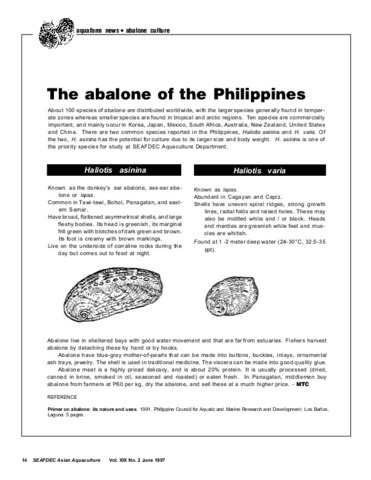
The abalone of the Philippines
(Aquaculture Department, Southeast Asian Fisheries Development Center, 1997)